Let the races begin!

Last Sunday I went with Doug and his dad to run the Journey Quest 5k in Fort Collins, a fundraiser for the Shared Journeys Brain Injury Foundation (SJBIF). The organization provides programs that help people with acquired brain injuries regain independent, satisfying and productive lives. This was my first 5k race since my ostomy surgery 16 months ago. The overall time I achieved in this run would determine my wave for the 10k Bolder Boulder, which I plan to run on Memorial Day.

Getting ready for the run.

I started running again last summer, but have mainly been working on endurance by going on longer runs. Since I have not been focusing on speed, I wasn’t sure what to expect my finishing time to be for this race. I have never been a very fast runner. My speed has been in the nine-minute mile range in just about every 5k or 10k I have done. Therefore, when I set my goal for this run, I simply hoped to at least match my time from the last 5K I did prior to surgery, which I completed in 29:43.

I felt fairly strong and crossed the one-mile mark in nine minutes and then the two-mile mark at 18 minutes. Despite the decent start, I really struggled in the final mile. There were a few times I had to tell myself that I needed to ease up because my lungs and heart felt like they could barely keep up with what I was trying to make my legs do– I simply could not breathe. I relaxed the pace a bit, crossed the finish line and realized that I actually shaved a handful of seconds off my last 5k with a time of 29:19. I was happy with the result, but could not believe how hard the race felt. I have never been so utterly exhausted during or after a 5k. Doug and his dad met me at the finish line after running great races too (Doug came in second in his age group, 40 to 49), and I couldn’t even talk from lack of breath. Doug’s mom caught us each on camera as we ran the race.
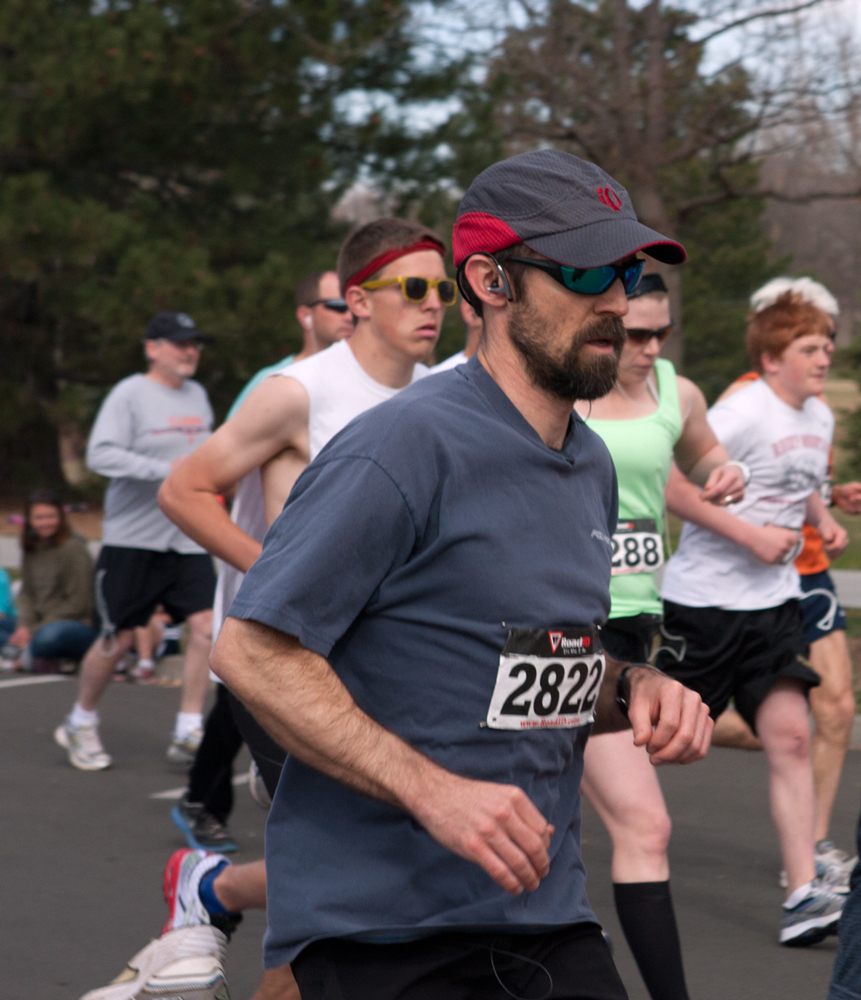
Doug heads out from the starting line.
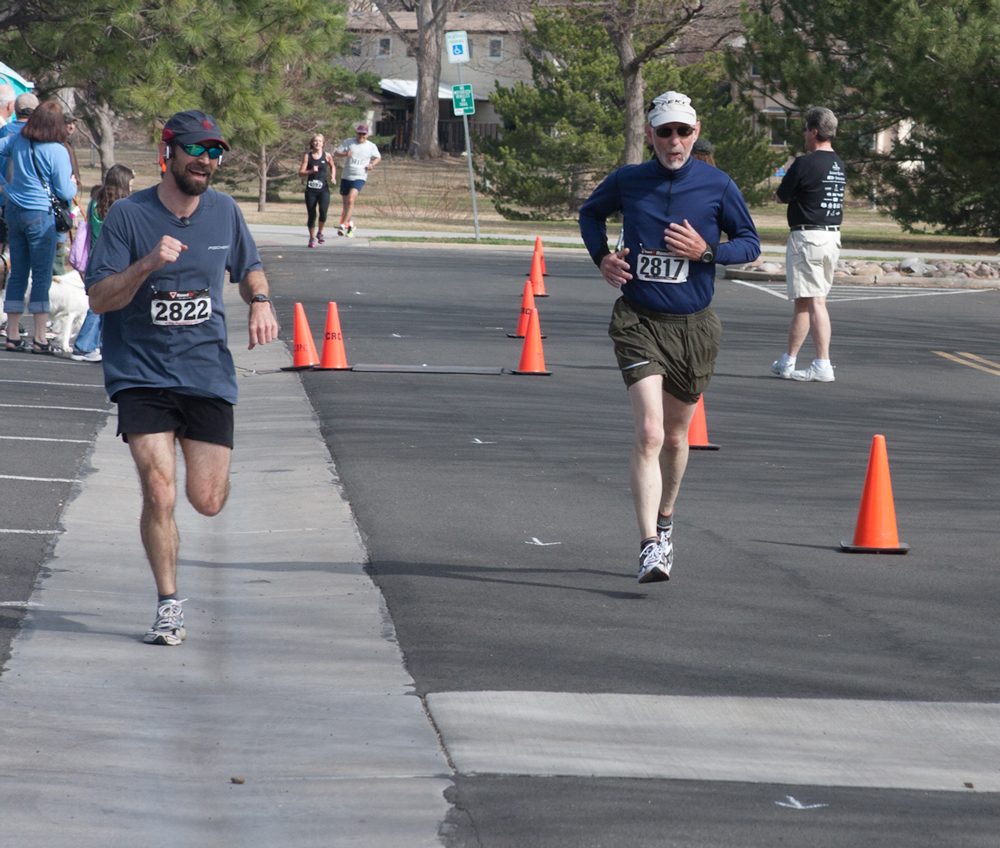
Doug cheers on his dad as he prepares to cross the finish line.
I am exhausted but still smiling as I finish the race.

This race made me realize that if I want to get faster times, I must change my training strategy. I really like going out for long, slow runs, especially on the trails, but I need to mix things up and start including some speedier runs in the mix if I am going to match my pre-surgery time for the Bolder Boulder 10k. I have always finished that race in just under an hour, but based on how I felt on this run, that would be impossible right now. Time to put some more miles on the running shoes.

I am also glad to report that my ostomy caused no issues during the race. The event started at 10 a.m., so I ate my normal breakfast of a protein shake, a banana and a bowl of oatmeal at 6 a.m. I emptied my pouch before heading to the start line and was good to go for the entire time. There was a party following the race and I refueled on some chili and a few cups of popcorn. Yes, I said popcorn! I find I have no issues with this favorite treat of mine if I chew it well and drink plenty of water (24 ounces in this case.)

Speaking of water, I have never been a fan of the hydration stations at races where one stops to slam a small cup of water. Even before surgery, I always got a gassy bellyache from gulping the water down… that is if I didn’t choke on it first because I was breathing so hard. Most of the time I would just drink a little and toss the half-full cup onto the ground or skip some of the water stations altogether. With my ostomy, I am even more conscious of avoiding things that cause me gas pains. Not to mention that I need to drink a lot more water during activity to prevent dehydration. I usually carry a CamelBak hydration backpack on my runs, and decided this would be a good strategy for the race as well. I filled it with just the amount of water that I would need for the race so that the pack was light. This worked well because I could sip small amounts of water through the hose as I ran to stay well hydrated and didn’t get a bunch of air in my stomach.

One less-than-ideal thing I had to deal with during the race was trying a different wafer than my favorite one. Typically, I reserve sampling new supplies for times when I know I don’t have something big going on in my schedule. However, I have recently had some skin issues under the tape of my wafer: little red bumps that are insanely itchy. My stoma nurse is working with me to try to troubleshoot the cause, but in the meantime, I decided to try a sample of a tape-less wafer to give my skin a break. The 5k was on day four of wearing this new wafer. I was worried the sweat might make it fall off during the race, yet I didn’t want to risk irritating my skin by removing it early. By the morning of the race, my wafer was already starting to peel up on the edges. However, with a few little pieces of 3M Medipore tape in strategic places, the wafer held on just fine. Whew!

All in all, the race went well, and I am excited to push my running to the next level. I look forward to adding a few more races to my schedule in the coming months. And I still have my sights on the CCFA Team Challenge Half Marathon in December. I am hoping the shorter races will help prepare me for that big distance. Most of all, it feels great to discover another favorite activity that is once again possible thanks to my ostomy surgery.

Heading to camp

I first learned about the Crohn’s and Colitis Foundation of America’s Camp Oasis when I was stuck in the hospital for 16 days with my final flare-up of ulcerative colitis. I had been researching treatment and surgery options on my laptop from my hospital bed, and somehow stumbled upon a link to a website for the camp. As I was looking through the photos of the children at camp, I was immediately inspired. Knowing how hard dealing with UC was in my 30s, I couldn’t imagine how difficult it must be to have the disease as a child. All the things I took for granted as a youngster, like attending school functions, taking part in school activities like plays or sports, or going to summer camp would all be very challenging. The mission of Camp Oasis is to enrich the lives of children with Crohn’s disease and ulcerative colitis by providing a safe and supportive camp community. As I read about Camp Oasis, I was so deeply moved that I promised myself I would look into volunteering there after I recovered.

In February, I started to research the dates for the camp that takes place in my home state of Colorado. I was happy to discover that I had no work conflicts during one of the sessions and could request time off to be away for a week. I sent in an application, was interviewed, and found out a couple of weeks ago that I was accepted as a volunteer for the camp session for 7- to 13-year-olds in July. Today I went in for some vaccinations that are recommended for all camp staff and volunteers, and I am working on completing my paperwork.

Growing up, I loved being outdoors and my family did a lot of camping. I also took part in some summer camps with Girl Scouts and other organizations where we did nature study, sports, and arts and crafts. These early experiences had a major influence on me and laid the foundations for my love of nature, outdoor adventure, and art. Yet I often wonder: Had I developed IBD at a much younger age, would I have been able to be involved in these things? Thanks to Camp Oasis, many children with IBD do have the chance to take part in such fun, life-enriching experiences. I am eager to help children at camp discover all the amazing things they can accomplish. I can’t wait for July!

Me at camp when I was 11 years old. I am the one in the striped shirt on the far right.

Climbing progress

On Sunday I climbed a few feet above the fourth bolt on the wall at the rock climbing gym, held my breath, and jumped off. I felt a few butterflies in my stomach as I free-fell 10 feet before my rope and harness caught me and brought me to a stop. Doug lowered me to the ground where a staff member gave me a smile and a casual “nice job” nod. I had just passed the test to be able to lead climb at our local rock gym. This was my second such test. I had also taken one in Fort Collins last month at the gym we sometimes climb at with Doug’s father.

In lead climbing, a climber clips their rope into protection placed in the rock (or on the artificial gym-wall) as they go. This “pro” is either: 1) temporary equipment that a climber places in cracks outdoors, or 2) permanent, preexisting bolts drilled into the rock or artificial wall. If a climber falls above the last piece they clipped, they will travel some distance before the rope catches. For instance, if a person falls three feet above their pro, they will fall that distance plus three more feet until the rope catches. Factor in a bit of rope stretch and the total distance could be 10 feet. The climbing gym wants to make sure climbers know how to safely clip their rope into the bolts on the wall and fall properly before they will allow you to lead climb.

Top roping is a different style of protecting the climber in which the person will only fall a short distance because the rope is already anchored at the top of the cliff or wall. When I began climbing again a year after ostomy surgery, I started with top rope climbing. Though I am now leading in the gym, it will be a while before I feel confident to lead routes outdoors again where there are more hazards.

Nothing has been a bigger symbol of my climbing progress as being able to get back on the “sharp end” of the rope. I was fearful of what a big fall might feel like after surgery. Would falling several feet in my harness hurt my stoma? Would the resulting tug make my pouch pop off? As has often been the case when returning to my active pursuits, none of my fears came true, and my stoma and pouching system held up just fine through the tests at the gym.

Lead climbing has not been my only measure of progress lately. While climbing weekly, I am quickly moving up the grades and getting on some overhanging routes (steeper than 90 degrees). When I returned to the rock gym five months ago, I didn’t even try to do any marked climbs — I just grabbed any hold on the wall. Soon after, I was only using the “on route” holds, but sticking to routes in the 5.7 range. Last month I ventured into the 5.8 and 5.9 territory, and last weekend I did my first 5.10-. I am feeling powerful and strong with not the slightest pain in my core.

When I got back into climbing, I told myself that I would be happy doing 5.7 routes for the rest of my life if that was all my body could handle. All that mattered was that I could climb again. However, I now see that these restrictions won’t be necessary. By conditioning my body, progressing slowly to build the required strength, and always wearing my six-inch-wide hernia belt, I am quickly returning to my pre-surgery climbing abilities. I look forward to warmer days when I can start climbing outdoors on a regular basis and head out on some much longer routes. And, of course, I’ll share some of those through videos!

Craving normalcy (feat. new video)

In the initial months after ileostomy surgery, all I craved was normalcy. Life as I knew it had completely disappeared. Gone were the days of getting up and going to the office to work on a variety of enjoyable challenges like writing nature-education curriculum and leading hikes. In my free time, there were no more hiking, snowboarding or running adventures anywhere on the horizon. Instead, life revolved around the wiggly red stoma on my belly. My days played out around endless worries and looked something like this:

7 a.m.  How am I going to get my appliance on while my stoma is spewing liquid output everywhere?

9:30 a.m. Okay… got the appliance on. Wait, is that skin showing between my barrier ring and stoma? Geez, maybe I should do it over. My output will certainly eat away my skin if it touches that exposed 1/8 inch. But will it destroy my skin more if I pull the wafer off so soon? I better just do it to be on the safe side.

10:30 a.m. I can’t believe it took me over two hours to get an appliance on and this second one still doesn’t look that great. I need to call Doug and vent about it or I will cry for hours.

10:45 a.m. I need to drink some water. I am already way behind on my liquids today and I haven’t eaten breakfast yet either.  I am really not hungry, but Dr. Brown said I need more protein. Is a protein shake and eggs enough?

11:30 a.m. I have only been up for a few hours and I am already tired. Better go take a nap. Am I always going to have to sleep this much?

1:30 p.m. Is that just a regular itch or is it from output touching my skin? Man, this incision hurts. I am not hungry, but I need to eat with my pain pills. I better have some lunch. When are these pain pills going to kick in? Drat, maybe I should have just sucked it up and not taken the pills. What if I become addicted to them?

2 p.m. Why am I watching this stupid TV show? Shouldn’t I be doing something productive? I am just too tired. Dang, I forgot to order those Hollister samples again. I am too tired to do that too. I can’t believe I am about to take another nap. I am supposed to be going for a walk right now, not sleeping.

3:30 p.m. The neighbors must be wondering what happened to me. I am walking so slow and hunched over, but it hurts too much to stand up straight. Is this two-block walk through the park really all I can muster? I can’t believe how much this hurts. This used to be my warm-up walk before I ran five miles, and now I can’t even cover this short distance. And I’m walking as slowly as a turtle.

4 p.m. I miss Doug. I am so lonely stuck here by myself. When is he coming home from work?

5 p.m. Doug is home! Doug is home! Doug is home!

6 p.m. Is this too late to be eating dinner? I am supposed to eat before now, but that isn’t very handy. Is four weeks post-op too soon to eat steamed broccoli if I chew it really, really well? I am so hungry for veggies. What if I get a blockage? Or horrible gas?

7 p.m. Wasn’t that just the 12th time I emptied my pouch for the day? When is this output going to slow down! It is like water. Have I had enough liquids to drink to offset that?

9 p.m. Okay, time to take a shower. Can I get this appliance wet? I better tape plastic wrap all over my belly just to make sure it stays dry and doesn’t peel off.

10 p.m. Time for bed. I should lie on my right side all night just in case I leak. Don’t want to get stool into my open wound.

11 p.m. My back hurts. I sure wish I could lie on my left side but I am too afraid.

12 a.m. Better get up to empty my appliance just in case.

2 a.m. Better get up to empty my appliance just in case.

4 a.m. Better get up to empty my appliance just in case.

7 a.m Thank goodness it is morning but I don’t want to get up. I am going to lie here and cry for a while. Will my life ever be normal again?

And so it went for the initial couple months after surgery. I was overwhelmed and depressed that my entire life now seemed to revolve around my stoma. I tried and tried to picture what things would be like when everything settled down, and I actually learned how to manage my ostomy, but it seemed impossible. I couldn’t see beyond the hard times I was facing in those moments. It was particularly difficult to imagine how I could possibly ever do outdoor sports like snowboarding again.

I wish I would have had a crystal ball back then. Had I, I would have seen that I shouldn’t have worried so much. My ostomy output would settle down as my body adapted. I would figure out my systems and become more efficient with them. My incision would heal. Someday in the not so distant future, my ostomy would feel like a regular part of my life as I returned to work and went on outdoor adventures again. In the crystal ball, I would have seen the point I am at now when everything is so much easier. The normalcy I craved after surgery has been restored to my life.

Last Sunday was a beautiful powder day in the mountains, and Doug and I headed up to go snowboarding. I decided to film the day’s events and create a video showing a typical day on the slopes with my ostomy. I realize everyone’s experiences are going to be a little different regarding their emptying schedule, when they eat, etc. What I hope to show is that once a person adapts to life with an ostomy and gets their own particular systems down, life can feel wonderfully natural again.

Running ahead of osteopenia

Realizing that today is the Winter Solstice and has the shortest daylight period of the year, it is a fitting time to write about my recent nighttime jogging adventures with Doug. Just about every evening after work, we have strapped our headlamps to our noggins and hit the wide dirt trail near our house. Running by headlamp is a unique experience. There was one night that we saw four glowing eyes in the distance, and I froze in my tracks thinking they belonged to a couple of mountain lions coming down from the mesa near our house. As the animals approached, I was relieved to see that they were happy canines out for an evening stroll with their owner. Another night we saw a coyote trot across the trail, forming a silhouette against the dusky sky. We went right over to examine the tracks he left in the snow. Last night I got dizzy as giant snowflakes were illuminated by my headlamp, giving me the feeling that I was moving forward through outer space. Whether the sky is moonlit or pitch-black, temperatures are balmy or frigid, or clouds are misting rain or dumping snow, we will be out there. Lately, running and other exercise has taken on a new importance.

A couple of months ago, I went for my yearly physical. Because of my prednisone use over the past few years, my physician scheduled me for a bone density test. Within a week, the results came back showing that I have osteopenia, which is weakening of the bones and can be a precursor to osteoporosis. My doctors at the hospital last fall had warned me that this would be a possibility since I had been on such high doses of steroids while trying to get my flare under control, so this news wasn’t a huge surprise to me. Still, it was not something an active person like myself wanted to hear.

I first discovered the amazing healing powers of prednisone about a year after being diagnosed with ulcerative colitis. A bad flare had led me to the ER where I was prescribed a 40mg taper of the steroid. I couldn’t believe how fast it worked. Within 4 days my symptoms completely cleared up. I was even able to climb the 14,255-foot Longs Peak two weeks later. However, foreshadowing what would happen when I took prednisone in the future, my symptoms returned when I got down to 10mg. My doctor added another tapering dose which finally ended the flare up. Over the years, it seemed like each time I needed prednisone, it became less and less effective. During my final flare, even high doses did little to control the severe ulcerative colitis.

As surreal as it can be to run the trail near my house a night, it is even crazier to think that such a small period of time on steroids could have had such a long-term effect on my body. I can’t remember the exact dosages and times I was on prednisone over the years, but the following list provides my best recollection:

  • July 2007- a 40mg taper over about a month’s time and then a few more weeks added when the flare returned
  • August 2008: a 40mg taper over about a month’s time
  • April 2009: a 20mg taper over two week’s time
  • August 2010: started a 40mg taper and ended up being on varying doses of oral and IV steroids for the next 3.5 months, with the highest dose being 80mg

After tallying these times up, it turns out that 6-7 months of my 39+ years of life was spent on varying dosages of steroids. It doesn’t seem like much in the grand scheme of things, but was enough to effect my bones. I know that each of those doses was necessary to get my disease under control at the time, but I am glad that, barring any other health issues, I will not need to take prednisone anymore.

This brings me back to the topic of running at night. Because I am no longer on steroids, my physician thinks that my osteopenia might be reversible with calcium and vitamin D supplementation as well as at least 30 minutes of daily weight-bearing exercise like running. In three years I will be tested again and hopefully it will show less bone weakness. In the middle of the winter when days are short, running at night provides a convenient way for me to get exercise. Though heading to the gym is also a possibility, I have always enjoyed the simplicity of grabbing my running shoes and heading right out my front door.

In years past, I would come up with all kinds of excuses as to why I couldn’t stick to my workout routine in the winter… it was too cold, too icy, too dark and my schedule too busy. But those rationalizations no longer sit well with me. Excuses do not strengthen bones.

Running by headlamp.

Healing the mind as well as the body

I was talking to a good friend on the phone the other day and he was commenting on how happy I look in my Ostomy Outdoors videos. He is absolutely right! I am completely elated to be doing all the things I love again. Some days it seems like I walk around immersed in a complete sense of wonder over how good I feel. To be ill for years and then get a second chance to be healthy again is an amazing thing, and the resulting smiles, laughs and even tears of joy are the real deal.

However, when I was recovering from surgery, there were some times that those smiles were nowhere to be found. About five weeks after my operation, I got lost in a mental funk. I had some complications that had sent me back to the hospital a couple of times after the original surgery, and I had started to worry about all the additional things that could possibly go wrong. On top of that, I seemed to be spiraling into sadness in general. I had trouble sleeping and completely lost my appetite… one morning it took me two hours to eat a hard boiled egg. I didn’t feel like talking to my friends and would lie in bed in the morning, dreading the thought of getting up and starting the day. Usually a motivated person with a gazillion projects on the horizon, I became listless and had little interest in doing anything. Longing for the days before UC, I would curl up in a ball and sob until I couldn’t cry anymore, only to repeat the emotional breakdown a few hours later.

These feelings completely caught me off guard because I was sincerely happy with my decision to have surgery and was completely pleased with the results. I had no regrets whatsoever. Yes, I had gone through some complications, but I knew that the most important thing — my actual ileostomy — was functioning perfectly. I had so much to be thankful for. I had the best surgeon imaginable, my stoma was a gem, my pouch stuck wonderfully, I had only experienced one appliance leak due to wound drainage getting under the wafer, and food was traveling through my ileostomy without a hitch. How could I be so satisfied in one sense but still so sad in another? It made absolutely no sense to me.

Continue reading “Healing the mind as well as the body”

Hand jams and high steps: outdoors on the rock (feat. new video)

Five days ago at our local crag, I stood at the base of a short, easy (5.6) route, looking up and assessing the possible moves and thinking about how my body might handle them. This outdoor climb (on real rock!) looked easy and had obvious holds, but it was still much different than the indoor routes I had been training on. In the gym, the wall is peppered with holds and any time one of the routes (marked with colored tape for various difficulty levels) would get too hard for me, I would simply grab a hold marked with another color to make it easier. It was a different world outdoors. Here, the holds were spread out with far less to choose from than in the gym.

Until that moment, the last time I had been outside on the rock was in July of 2010. Doug and I had taken a nine-day trip to a climbing area called City of Rocks in Idaho. Amazingly, this trip fell right in the middle of the only true remission I ever had in my 10-year history with Ulcerative Colitis. I remember walking to the outhouse in the dark to administer my maintenance dose of Rowasa and wondering if I even needed it. I would check my toilet paper whenever I went to the bathroom, certain there would be blood on it. Astonishingly, for the first time in a very long time, it looked normal. Every time I got to the top of a cliff on that trip I remember pondering how amazing I felt. I seriously thought I might have somehow been spontaneously cured.

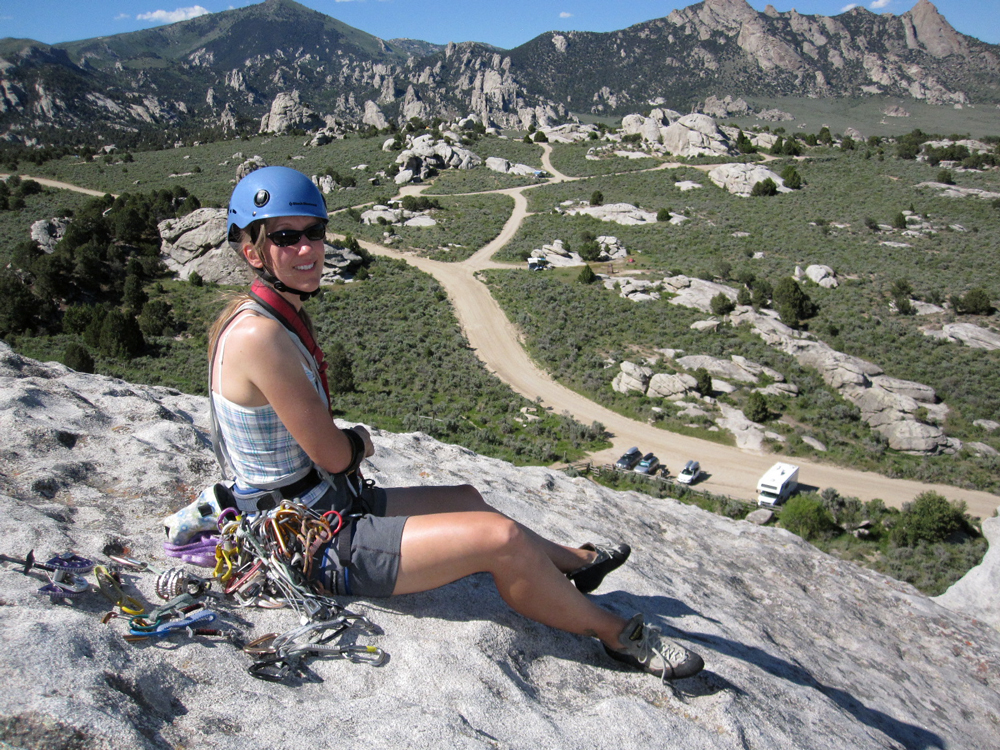
Enjoying remission on top of a route at the City of Rocks in July 2010. This was one of the last climbs I did before falling ill with the final severe UC flare that led to my surgery.

Sadly, that joy didn’t last. Two months later my final raging ulcerative colitis flare came on and I found myself lying in a hospital bed instead of sitting on top of a cliff. When I was ill it took a ton of effort just to bend over and pick something up off the floor. I sometimes thought my climbing days were over for good.

But they weren’t. One of the main reasons I chose to have a permanent ileostomy surgery was because I felt that it would give me the best chance of returning to climbing. Still, it was a long road to get back to the rock, and the strenuous nature of the sport made me apprehensive and cautious. It took a lot of time to heal, get strong (I’m still working on that) and gain confidence, but the moment had finally arrived to attempt my first outdoor route after the operation.

Many months had gone by since I last sat at the base of a cliff lacing up my rock shoes in anticipation of an ascent. This time, as I began to climb, I barely recalled what it felt like to dance up a route with the sun warming my back and the wind gently blowing my hair against my face. I had forgotten how amazing it was to have my mind focused only on the cracks and crimpy holds in front of me and nothing else. These things had once been so beloved and familiar to me, and though they now felt foreign, I could sense my body waking up and remembering with every reach, jam, and high step. My passion for climbing had been rekindled, and this was only the beginning.

If you’re new to Ostomy Outdoors, don’t forget to check out all the other adventure videos we’ve put together for you.

Part eight in a series: I am thankful for online friends

I am thankful for online friends

I am not sure what words I typed into the search engine to stumble upon Charis Guerin’s Inspire.com website, but it was one of those lucky moments of fate. I was just entering a horrendous flare up of ulcerative colitis, and was surfing the internet to read about the experiences of people who were going through the same thing. As I dove into the story that flashed up on my screen, I could not believe how much I had in common with the young woman who wrote it. She was strong and active and into fitness just as I was. At the time, she even had a job that very similar to mine where she worked on kids’ programming– only at a historical site instead of a natural area. A year before, an ulcerative colitis flare had hit her hard… so hard that she had gone through surgery to remove her colon.  I was so inspired by her story that I decided to contact her.

This was the first time in my life that I had reached out to a complete stranger about a health issue, and it felt really weird to pour my heart out and list all my unpleasant symptoms to someone I did not know. I can’t remember what I wrote exactly, but I am sure it must have sounded like a pretty desperate plea for help because within a short time, Charis emailed me back. As my disease quickly worsened, and I found myself in the hospital facing the possibility of surgery, Charis’s encouraging emails and phone calls helped get me through some very uncertain times.

As I continued to write Charis over the course of the year, I discovered that she was facing hard times herself as her j-pouch failed and she recently decided to undergo permanent ileostomy surgery. We have supported each other through all these health twists and turns and her friendship means a great deal to me. I hope I can be there for her during these tough times as she was for me. Right in the middle of of all these big challenges for Charis, she has started a successful new Facebook project called FullFrontalOstomy to help those with IBD and/or ostomies reach out to each other. This speaks volumes about how strong and inspirational she is. I hope that someday I get to meet her in person. What do you say, Charis? The 2012 CFFA Team Challenge Half Marathon or maybe at the UOAA conference in Florida?

Since reaching out to Charis, I have made so many more amazing friends through the internet and continue to every day.  I am extremely thankful for online communities where people can reach out, connect and get support. These forums, web sites, Facebook pages etc. allowed me to meet so many other people who were going through the same challenges and who were willing to talk openly about them. As an ostomate and/or person fighting IBD, you need a community where conversing about output or gas-filled pouches is as easy as discussing the weather. You need a place where talking about a new ostomy product feels as natural as talking about the latest release by your favorite band. You need to surround yourself with people who don’t blush when the topics of urgency, diarrhea or bloated and painful stomachs come up. Without online friends to talk about these things with, life can feel very lonely. I am thankful everyday that the internet has allowed people with ostomies and/or IBD to find each other and converse so easily.

With this post, I wrap up my series on the things I am thankful for. Of course, there are oodles of other things that I am extremely grateful for that I have not listed. Still, when I look over the list of the things I have written about over the last week, I quickly realize that the vast majority of the posts are about people. This isn’t surprising. When it comes down to it, people often make the biggest positive impacts in our lives. I will be forever thankful for the countless ways that these individuals, and so many others, have changed my life for the better.

Happy Thanksgiving!

Part seven in a series: I am thankful for my friends

I am thankful for my friends

Friendship can be such an intangible thing. It is the warmth that surrounds you when someone you care about is around. It is the spark that ignites when you realize you have things in common with another. Friendship is the security of confiding in someone you trust or the comfort in knowing a person is always there for you. When I was in the hospital sick and at home recovering from surgery, I felt friendship everywhere:

It lived in the cards and flowers that filled my room and the funny pictures my friends drew me.

It was found in a visit from a friend who, after getting a desperate email from me the day I found out I might be facing surgery, drove across town on her lunch break to show me her ostomy. It was also in her long and thoughtful responses to several more frantic emails in the ensuing weeks.

It waited in a care package of chocolate and other goodies sent across the country from friends I had worked with long ago and hadn’t seen for years.

Friendship resided in the emails that poured into my inbox. Many of these messages were never returned because I was so exhausted. That didn’t matter; my friends just kept sending more.

It was found in the conversations I had with friends who called to cheer me up, or left in voice mail messages when I couldn’t answer the phone because: A) I was sleeping, B) I was talking to a doctor or nurse, C) I was in the bathroom, or D) I was sleeping some more. (Ditto on the statement above about not always returning those messages, and double ditto on my friends leaving more anyway.)

It sat in the stack of People and US Weekly magazines a friend brought me so I could laugh at the ridiculous stories and focus less on being sick.

It demonstrated itself in the bravery of my friend, who is a world-class germaphobe and hates to even touch doorknobs, taking a trip the eighth floor of the hospital to see me. Twice. And she even ate dinner with me in the common area in my hospital wing on one such visit.

Friendship existed in the moments when my friends understood that I was too tired to see them at all.

So yes, friendship might be intangible, but my friends made sure there were tangible signs of it everywhere to help me make it through the hard times. I am so incredibly thankful for my friends… they mean more to me than my sometimes-quiet nature would ever reveal. I don’t think I could have made it through all this without them.

Purposely missing from this post is a mention of the friends who I may not have met in person, but have developed lasting friendships with online. Stay tuned…

Part six in a series: I am thankful for understanding coworkers

I am thankful for understanding coworkers

One of the hardest things about facing ostomy surgery was knowing I was going to be away from the park where I work for a long period of time. I had already missed several weeks due to my ulcerative colitis flare, and now I was going to be out for roughly eight more weeks. I work with a small group of people, and I knew it was going to burden my coworker’s schedules to fill in the gaps my absence would leave.

However, I had no sooner mentioned surgery than everyone was offering to cover for my programs and even switch their days off. One thing I was going to miss was a holiday festival for young kids that I usually coordinate. I tried get as much done in the brief period of time I returned to work before surgery, but ended up leaving many loose ends for my coworkers to sort out. When I was in the hospital, they sent a photo of themselves preparing for the event. They were all sporting funny faces with craft supplies hanging off their ears and trying to make it look like absolute chaos. But it wasn’t. My coworkers did a stellar job carrying out the event, and filled me in on all the details via email.

Some might prefer to not get emails from work while recovering at home, but that wasn’t true for me. I love my job and missed being there. I wanted to hear about the amazing stars that were out at the astronomy event at the park or the cool shelters the kids built at one of our nature-play programs. My coworkers frequently sent me notes to say hi, pass on well-wishes from volunteers, ask how I was doing and fill me in on all the latest happenings. It made me very happy and reminded me of the normal world that I would soon return to.

When I did go back to work and had serious lifting restrictions, my coworkers went out of their way to help. It was a bit of a pain asking for assistance with lifting every little thing, but they were always willing to move tables, carry taxidermy animal mounts up from the basement, and haul around boxes of program supplies for me. I loved it when I was carrying something really light and they still ran over to grab it from my arms.

Another difficult thing with IBD and ostomies is knowing how much information you want to share and with whom. This seems especially true at work. When I was away from my job with my ulcerative colitis flare and for surgery, I didn’t tell my coworkers much about my condition due to to fear of the stigmas surrounding it. In retrospect, I realize my reluctance to talk about it made things not only harder on myself, but also more difficult on my fellow staff members. The park where I work has a large crew of caring volunteers, and many of us are good friends. During the time I was in the hospital, these volunteers wanted to know what was going on, yet I had only given my coworkers rather nebulous facts to pass on. (I said, I have an auto-immune stomach condition. Can’t get more nebulous than that, right?)

I had told my boss a bit more information, but had asked him not to share it. I am sure it was an awkward time for everyone, and one of my few regrets surrounding my UC and surgery experiences is that I wasn’t more open about it at work from the beginning. It was silly of me not to share more. After all, if I were getting surgery on my heart, knee, or back, I certainly would have told everyone without a second thought. I work with a very compassionate group of people who would have been completely understanding and supportive. I am glad that they were so patient with me as I processed the events and finally became comfortable talking more openly. I am thankful to work with such a great group of people.