One of the questions I get most often from readers of my blog is why I chose to have a permanent ileostomy instead of trying j-pouch surgery. Though I have mentioned a few of the reasons in other posts, I decided to address this topic in a little more detail. The point of this post isn’t to tell you that one surgery type is better than the other. They are both very good options. My goal in this writing is to share the thought process I went through to make my choice.
In the course of my illness, all my symptoms, colonoscopies, and genetic testing pointed to Ulcerative Colitis and not Crohn’s. This made me made me a candidate for either surgery type. At age 38 during the time of my surgery, why would I choose to live with a “bag” for the rest of my life?
It wasn’t a decision I took lightly, and I gathered all the information I could. This began when I was still in the hospital, facing the possibility of emergency surgery. The very kind and helpful general surgeon who would have done my surgery had I continued to decline, visited my room almost every day to check in and patiently answer my seemingly endless questions. He introduced me to the words “ileostomy” and “j-pouch” and gave me a great foundation of information to build on.
Snow is soon to fly in the mountains, and my peak ascending opportunities are going to be more limited for a while. I have turned my attention to getting back into running, something I have been neglecting while preparing for and carrying out all of our backpacking and summit trips this summer.
I have decided I want to begin training for the 2012 Crohn’s & Colitis Foundation’s Team Challenge half marathon. I know I won’t be ready by this December, so I plan to work up my strength and endurance and then join the organization’s formal training group next fall. I am super excited. I did several 5K and 10K runs, including one trail running race in my pre-surgery days, but never a half marathon.
In the past, some of my worst ulcerative colitis flares happened when I was training for races. I believe running aggravated my colon. I knew where all the restrooms were on my running routes. Sometimes on routes where no bathrooms were available, I can remember speeding up on the last mile, bursting through my front door and barely making it to the bathroom on time. On trail runs, I used to bring toilet paper and supplies in my waist pack to dig an emergency hole in case I really had to go. Gone are those days! My appliance adheres really well through exercise with no leaking issues to date. As long as I empty before I head out on runs, I will be good to go for hours.
I was looking through a little spiral-bound book that I kept my journal entries and notes in during my hospital stays. I thought it was interesting that last year around this time I was keeping a log of my bowel movements in it to report to the doctors and nurses in the hospital during my final flare. Now I am starting up a running log. What a change!
A log entry in my notebook on day nine of my hospital stay in the fall of 2010.Keeping track of my running distances and miles as I begin training again in the fall of 2011.
Last year at this time, I was just beginning my downward spiral into my final severe Ulcerative Colitis flare. Each day of the next few months will be an anniversary of something UC-related, and the flashbacks to those harder times will be abundant: there are the dates of my multiple ER visits, the admission for my 16-day hospital stay, my first Remicade infusion, the day I came to realize that surgery was my best option. It seems like reminders of my past illness are lurking around every corner. But then so are reminders of my amazing recovery.
Healing physically and regaining strength follows a fairly logical and direct path; recovering emotionally is a bit more circuitous. Sometimes it is hard for my brain to grasp all that has happened in the past 12 months. How in the world did I make it through the tough events of the year to get where I am now? It all seems to have gone by so fast, and I don’t believe my mind has fully processed everything yet.
Many new ostomates wonder how to deal with their output on hikes, as we usually have to empty our appliances every 4-6 hours. The answer is to dig a “cathole.” This is the term commonly used by backpackers for a hole to bury feces in. Because this is a very important skill for any outdoor enthusiast with an ostomy (or IBD) to have, I created a short video to cover some of the basics.
I am guessing that I have dug around 500 catholes in the backcountry in my lifetime. As an ileostomate, I am increasing that number at a rapid rate. Gone are the pre-ulcerative colitis days of having 1 or 2 bowel movements in a day. Now I consistently empty my pouch around 6 times in 24 hours. On the trips when I don’t use closed-end pouches, that equals 48 catholes on a 7-day trip! Knowing how to properly dig a cathole to protect the environment and water sources is crucial.
On a three-day backpacking trip this past weekend, my husband and I finished our fifth and sixth 14ers (a peak above 14,000 feet) since the beginning of July. Most summers before this, I was lucky if I did one or two. I have definitely caught the 14er fever. Hiking these peaks has provided me with the perfect opportunity to get outdoors and challenge myself physically while still babying my abdominal muscles. Indoors, I do a battery of physical therapy exercises that safely strengthen my core. In concert, these two activities will prepare me for the more rigorous demands of technical rock climbing in the future.
While hiking these peaks, I have been amazed at how quickly I am progressing and getting my strength back. While I walked the first one at a turtle’s pace, I am now hiking the peaks briskly and with little fatigue. All these successful peak hikes have also made me realize how well I have adapted to my ileostomy. Managing my appliance on the trail using both closed-end and drainable pouches has become second-nature. Moreover, changing my wafer outdoors, which is one of the things I was most fearful of, has proved to be very similar to doing it indoors except that I must pack out the trash (and the views while changing are more spectacular).
However, one aspect of my ileostomy that still baffles me is figuring out how much water to drink. One function of the colon is to absorb water. When it is removed, the small intestine is able to adapt and take on some of this role, but not as well. Because of this, ileostomates must drink more water to avoid dehydration. It has not been unusual for me to drink 8+ quarts of water on some of my all-day hikes. Up to this trip, I have not had any issues with dehydration. However, conditions were different on this excursion. The temperatures while making the strenuous uphill hike to camp were in the 80s which is warm for the elevation we were at. Despite drinking almost 3 quarts of water (some of which included a sport drink mix) and eating plenty of snacks along the way, I got to camp with a headache and bad nausea. Before we proceeded to empty our backpacks and set up our tent, I sat in the shade and drank some more fluids. In about an hour, I felt better. I upped my water intake over the next two days and did not run into the problem again.
“How about going ziplining,” our friend suggested. My first thought was, Absolutely! That sounds fun, I have always wanted to try it. My second thought was, Wait, what about my ostomy? How will my pouching system hold up to zipping through the air in a harness attached to a cable? Not to mention that there won’t be any restrooms for three hours. What if my pouch explodes or leaks? Maybe I should hold off.
Some fears keep you alive– like being afraid to climb higher on a route because it is above your ability, or being terrified of a river crossing because you know it might sweep you off of your feet and send you into the rapids. But there are also those fears that don’t have such dire consequences. The ones that pop into our heads and stop us from doing things that would actually be rewarding and good for us.
I recognized that the fears that were trying to stop me from going ziplining were of the latter variety and purged them from my head. I knew I could go 4-5 hours before draining my pouch– even longer if I pushed it a bit and let my appliance fill up a tad more. I knew the harness would likely cause no problems and that I was strong enough for the adventure. There was no reason not to give it a try.
We signed up for a 5-stage tour through the tree tops at the Crested Butte ski resort. One of the rules was that you couldn’t carry anything in your hands, so I guzzled a bunch of water to avoid getting dehydrated. Then we met with our guides and harnessed up. Much to my delight, the bulky, adjustable one-size-fits all harnesses still worked fine with my pouch. The upper part of the hip belt sat well above my stoma, and the harness barely touched my appliance.
One of the hardest things in recovering from surgery and getting back into outdoor activities is knowing how to pace yourself. There are times in the months after surgery when there are clear lifting restrictions and guidelines, which provide easy-to-understand parameters for your activities. However, once those restrictions are lifted and you are feeling ready to get back to your normal sport routines, the path isn’t as clear.
Though it may seem like I am doing a lot of outdoor activities since surgery, I have paced myself very slowly. I started out with many short walks. When those felt good, I moved on to longer and steeper excursions. On the hike to Mt. Elbert covered in this video, my legs got extremely tired on the hike out, and I thought perhaps I had overdone it. Still, within three days, my sore muscles had completely recovered–a sign to me that the hike, though strenuous, was not at a level that pushed me too hard. By the next weekend, my muscles were feeling great and ready for a new adventure.
The following is a list of additional things that I am doing to prevent injury:
I always wear my Nu Hope hernia prevention belt when I do any outdoor activity beyond a short, flat-terrain day hike when I am carrying no significant weight (say 10-15 pounds).
I have my husband, Doug, help me lift my heavy backpack on to my shoulders. Once it is resting on my hips, I am better able to handle the weight without straining my abdominal muscles.
I use hiking poles to help with my stability as I get stronger.
I leave for hikes extra early to allow myself the ability to hike at a slower pace with more frequent breaks.
I pay very close attention to my body. So far I haven’t witnessed anything more than normal post-workout muscle aches. However, if I feel something more significant, I will back off and give my body more time to adjust to the next level of activity.
I am working with a physical therapist to strengthen my core muscles using very mild and low-impact exercises that are safe for the level of healing I am at.
My goal for the fall is carrying out a week-long backpacking trip with a few peak ascents. Hopefully with my training regime, I will be ready for this challenge.
I hope everyone had a great holiday weekend. In between working full time, I have been planning, packing up for and carrying out successful hikes of a few of Colorado’s famed 14ers. This hasn’t left much computer time for blogging. Stay tuned for an entry and video highlighting these ascents soon!
Until then, suffice it to say that so far my ostomy has caused me no issues in returning to the things I love again. I spent a lot of time in the hospital and at home during recovery wondering how in the world I was going to get back into outdoor activities with a stoma and appliance. I have finally discovered the simple answer to this question: just get out there and do it! Of course, you must keep in mind what is sensible in your healing progression, but beyond that, the answers of how to how to deal with your ostomy while you are out there will present themselves as you go. The will to succeed and enjoy your favorite activities again will go a long way in helping you overcome any challenges you might have.
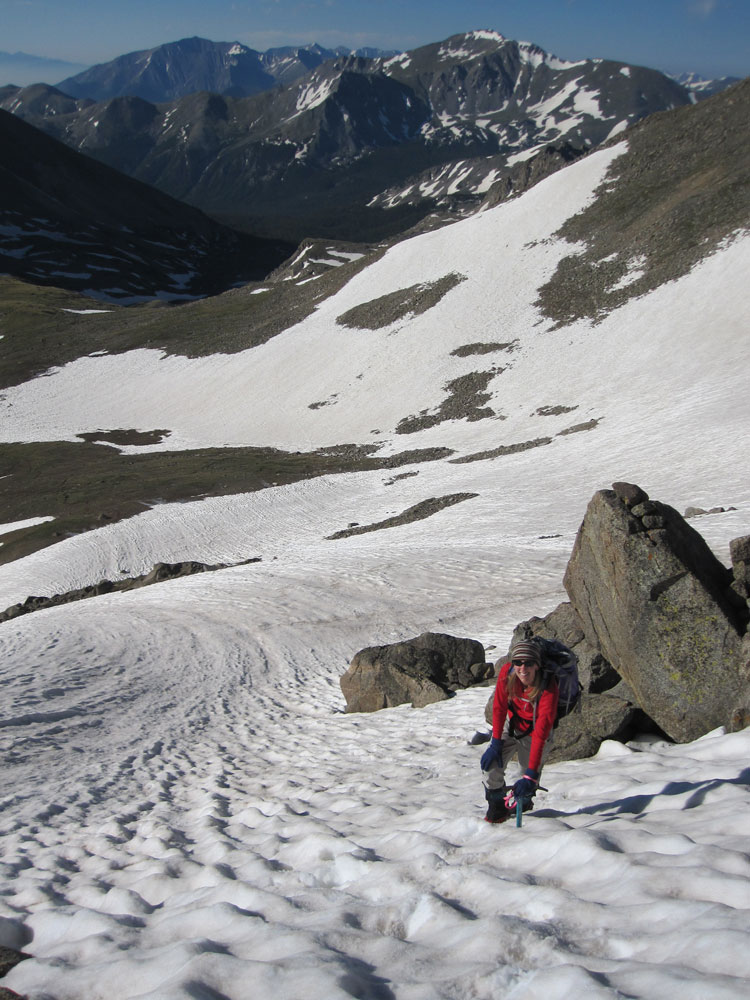
Scaling the upper flank of Mt. Harvard, a Colorado 14er, on July 3, 2011.
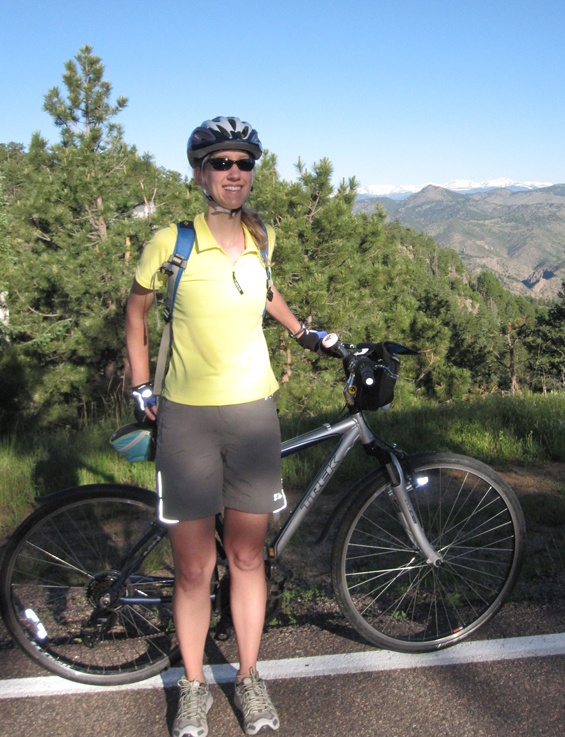
Today was Bike to Work Day in Denver. I work up in the foothills, and my daily commute is 26 miles round-trip with roughly 2000 feet of elevation gain. Though I did successfully complete this lengthy excursion for this event last summer, I figured it would be a bit too much after surgery when I am not yet at full strength. Instead, I drove to the park-and-ride 5 miles from work, and made a shorter trip on my bike from that starting point. It ended up being perfect. The route had just enough uphill to work my muscles and get my heart rate up without making me too exhausted. As seems to be the case with all outdoor sports I have been trying so far, I had absolutely no issues with my appliance or ostomy. I wore my usual combo of a Nu Hope Cool-Comfort hernia prevention belt under Comfizz briefs to hold it in place. Over this, I wore the same chamois-padded mountain biking shorts I always wore before surgery. This may sound like a lot of layers, but I find it very comfortable, and I love the way my core muscles feel supported.
Actually, the funniest moment of the trip happened before I left the house. I sometimes get phantom urges where it feels like I have to take a BM even though it is physically impossible with my colon gone and everything sewn up. I got these sensations a lot in the first month after surgery; now I only feel them occasionally. Well, this morning as I was making breakfast and packing up when I witnessed one. Forgetting completely about my ostomy, I thought, “I better really try to go the bathroom before I leave, or I will be miserable holding it on the ride with no toilet possibilities on the way.” Then I remembered that this most definitely wouldn’t be an issue and laughed out loud! These are the moments when I really love having my ileostomy instead of ulcerative colitis!
Biking was not my only sport-related accomplishment this week. I also went for my first jog. I hadn’t really planned my grand entrance back into running. I figured my body would tell me when it was time. Well, last Monday, I gazed out the window and got this overwhelming urge to run. And so I did.
As my feet began to rhythmically hit the ground, I paid close attention to my abdomen. One of my silly fears with running was that my insides were going to shake like a maraca with all the space left where my colon once was. But, no, there were no strange sensations in my abdominal cavity. In fact, everything with running felt really natural, as if I had only been away from it for a few weeks and not almost a year. I went at a slow jog and interspersed it with walking as needed. I ended up going three more times during the past week, the last of which is filmed in the following video.
What an amazing week of outdoor adventure it has been. We are still working on the video for our backpacking trip last weekend, as there is a lot of footage to sort through. We hope to get it on the site in the next week.
Until then, we created a short film covering a fun day-hike Doug and I completed along with Doug’s dad and our good friend. Shadow Canyon, leading to South Boulder Peak and Bear Peak in Boulder, Colorado’s famed Flatirons, has always been one of my favorite hikes. It is a challenging ascent that links up two peaks, and has around 3000 feet of elevation gain in a little over 3 miles. I have been day-hiking a bunch to get strong again, and figured I was finally up for something more strenuous. And was I ever! I could not believe how great I felt on the entire hike. Everyday I realize more and more how my diseased colon had held me back. Now that it is gone, I am blissfully getting used to my new “normal” and loving life!
There were a couple of new things to deal with on this excursion. One was scorching temperatures. The high today was 90 degrees–definitely my warmest hike since surgery. I had to really stay on top of hydration and ended up tanking up on water before getting to the trailhead, drinking about 4.5 liters of water on the actual hike and then guzzling another 1.5 liters when I returned home. I am finding that avoiding dehydration on the trail is not that difficult. It just takes planning to make sure you carry enough water, and then some self-discipline to make sure you drink, drink, drink.




 Ostomy Outdoors