My Week at Camp Oasis

An hour into my drive home I watched the red-orange landscape around Gypsum, Colorado, transition into the craggy grey of Vail Valley. My mind shifted from busy camp schedules and activities to inward contemplation.

I had just spent the last eight days volunteering as a cabin counselor at the Crohn’s and Colitis Foundation of America’s Camp Oasis, and I had much to process. The hours of uninterrupted thinking time that now lay before me was exactly what I was craving. I turned up the tunes and let my mind go back to all the moments of camp.

My camp experience began with a full day of orientation before the kids arrived. We learned the policies of the camp, information about all the activities and the schedule, and how to help campers with common issues such as homesickness. I had been a little nervous at home, but felt much more prepared after these sessions. I also had a chance to get to know all the other volunteers who were helping out in a variety of roles ranging from cabin counselors to medical staff to kitchen help.

One unexpected thing for me at camp was that I seemed to be the only volunteer cabin counselor who had IBD (as far as I could tell through conversations anyway). Many of my friends who help out at Camp Oasis at some of the locations out east have talked about shared IBD experiences among the counselors. The camp in Colorado is only two years old. I would imagine that in years ahead as campers get to be the age where they can volunteer as counselors, there will be more cabin volunteers who have lived with Crohn’s and Ulcerative Colitis. Whether or not they had IBD, all the volunteers I worked with were absolutely amazing. They gave their time because they wanted to help chronically ill children have the time of their lives at camp, and they did so with enthusiasm and devotion.

Roundup River Ranch, the camp at which the Colorado Camp Oasis is hosted, is a beautiful facility with some of the most energetic, capable and dedicated staff I have had the pleasure of working with. The medical personnel were incredibly caring and the kitchen staff worked tirelessly delicious meals that were enjoyed by all the campers, even those with food intolerances and allergies. The staff camp counselors put vast amounts of time, passion and energy into making sure the kids had the best experience possible. The cookhouse, cabins and medical facility were top-notch. The beds even had Tempur-Pedic mattresses which had been donated.
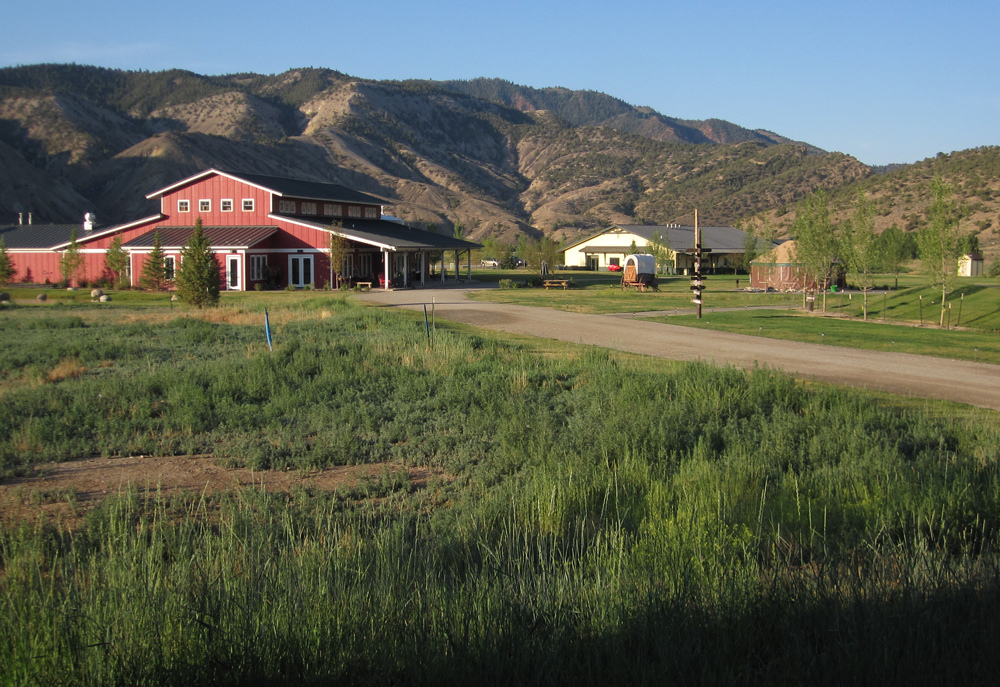
A view of Roundup River Ranch including the cookhouse and medical building.

I even had a chance to experience the excellent medical facility, called the Depot, at camp myself. On the second day, I came down with a low-grade fever, horrible sore throat and cough. The doctors and nurses felt I just had a cold virus of some sort, but put me up in a private room set aside for ill staff for 24 hours. I was incredibly bummed to miss a day with the campers, but knew I needed the rest. I was reunited with my group and, though still not back to 100%, felt much more energetic for the rest of the week.

I also went over to the medical facility to change my ostomy appliance. I was a little concerned about monopolizing the bathroom in my cabin quarters, so I talked to the nurses and they recommend I come over to the Depot to change. This was nice, since I am not the fastest at my appliance swaps. The skin around my stoma is in beautiful condition, but achieving this takes some time for me. Per recommendations from my WOCN and the home health nurse I worked with after surgery, I  have a meticulous routine that includes a small piece of Duoderm, an Eakin Cohesive Seal, and even a little stoma paste. I can sometimes spend 30 minutes changing out appliances with these steps, especially if my stoma starts spewing. I greatly appreciated having a private place to carry out my skin care routine at camp.

I was a counselor in a cabin of eight 12- and 13-year-old boys. The camp had ended up with a shortage of male staff and volunteers, so each of the boys’ cabins had two female counselors and four male counselors. Most of the camp counselor staff at this camp are paid and there for the whole summer, and volunteers augment the paid staff. Of the six counselors in my cabin, two of us were volunteers. This was nice because there was much expertise, and I never felt like I was left to handle a situation that I wasn’t prepared for. There was always a regular staff person close by to help out.
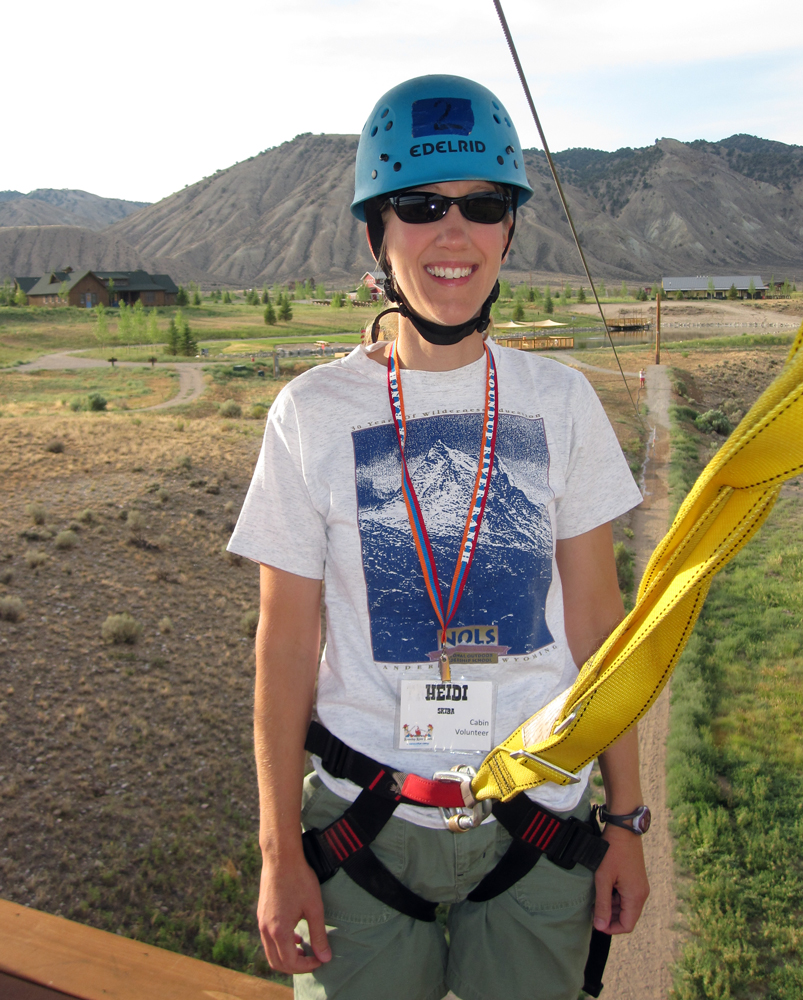
I got up bright and early one morning to try out the zip-line during a special session set aside for volunteers. It was high! As I stepped off, I was reminded of how the campers were willing to try so many new and challenging activities.

The boys in the cabin were such a great group of kids. Though I struggled a bit with conversation at times (not knowing much about sports teams and being inept at quoting movies–both popular with this age group), I loved working with the kids and cheering them on at all their activities and playing silly cabin games like Mafia and Ninja. Days were filled with all sorts of fun activities like archery, arts and crafts, climbing and zip-lining, horseback riding, boating and fishing. A highlight of the week for me was the talent show. The kids came up with magnificent acts, and I was blown away with how much the children encouraged and cheered each other on while they were watching the performances. It was absolutely beautiful.
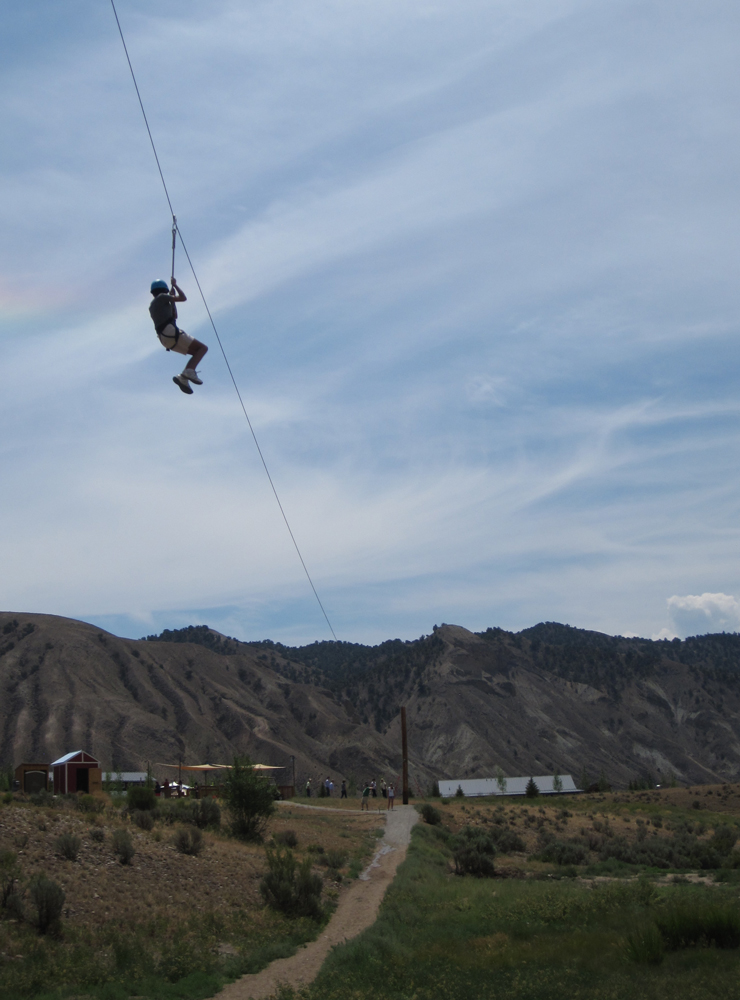
The camp’s zip-line.

One of my favorite parts of camp was quietly listening to the children share stories with each other. One day I heard three boys at lunch encouraging a camper who worried that he might not be able to have a career in the military because he had Crohn’s. The other boys were telling him he would be able to do anything he set his mind to. I also heard the children talking to each other about surgeries and medications, belly noises and going to the bathroom a lot. Another counselor in my cabin saw some of the kids showing each other their surgery scars. This is the magic of Camp Oasis; the children are given the opportunity to take part in a fun camp experience while building friendships and bonding with others who truly understand what it is like to have the same chronic illness.

Every night right before bed, each cabin took part in an activity called cabin chat which provided a time to talk and reflect as a small group. The cabin counselors posed several thought-provoking questions for the campers to answer in a quiet and safe atmosphere. These questions were never directly related to illness, but many of the campers answered with things that tied into having Crohn’s or Colitis. Counselors also had the opportunity to answer the questions. During one cabin chat a few days into the session, a question fit well with my experience of having UC, so I shared that I had the disease. I really have no way of knowing if it made a difference to the children. However, I had many conversations about camping, climbing, skiing and canoeing with the youngsters (which were popular topics with several of the boys). Perhaps in some small way the children realized that having ulcerative colitis has not stopped me from leading a full life.

On the final evening of camp, the children made a “web of gratitude” where they came up and told everyone the things that they were thankful for by adding a strand of yarn to a circular frame. Listening to the things that the children shared brought tears to my eyes. It was clear how much this camp experience had meant to them, and I was so happy that I had been part of it.

My three-hour drive home was not nearly enough time to process all the things I had learned at camp… all the inspiration I was feeling… and the amazing memories that will be part of me forever. When I got home I talked to Doug about it for so long that I nearly lost my voice. I don’t know when my work and vacation schedules will allow me to volunteer again, but someday I hope to head back to camp. Volunteering at Camp Oasis was one of the most valuable things I have done. I would highly recommend it to anyone.
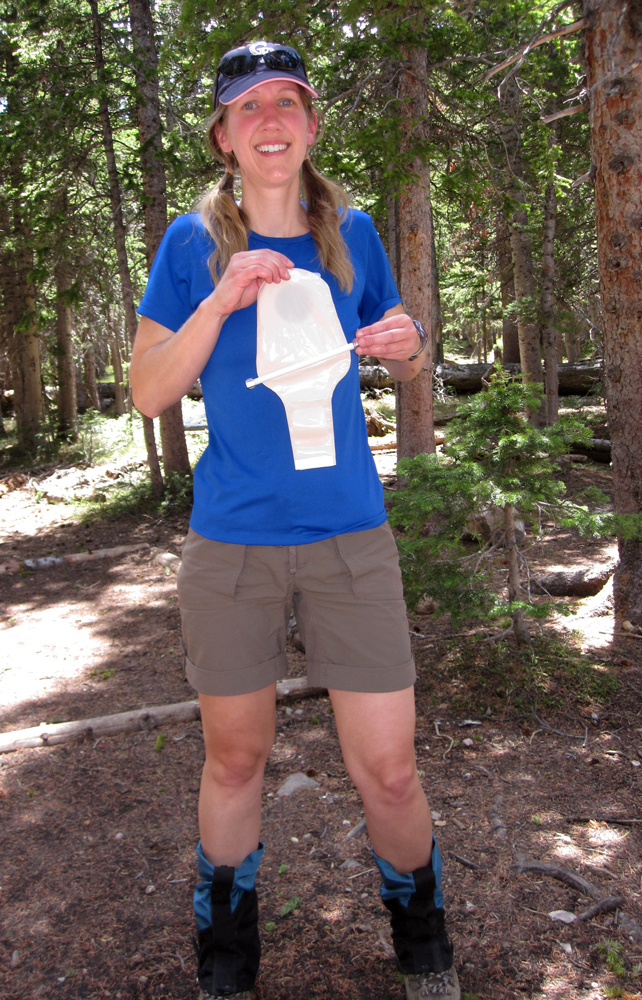
The One Pass Ostomy Draining Device: a great product for the outdoors

Usually it is the big flashy things like climbing ropes, packs or tents that become my most coveted outdoor gear. Lately however, a much simpler and unassuming piece of gear has become one of my favorites.

A couple of months ago UPTT Inc. sent me a One Pass Ostomy Draining Device (OPODD) to try on my adventures. Due to my hip injury, I had to put off testing the device outdoors until a three-day backpacking in Rocky Mountain National Park in June. This, however, did not stop me from trying it indoors. The OPODD is an instrument with two flat rollers that clamps onto your pouch when you want to empty. With one downward motion, the device pushes all pouch contents swiftly out of the tail. Though it took a few tries to get used to the OPODD, once I had the hang of it I found myself reaching for the tool again and again. It is especially useful on those days when my output is thick and difficult to push out of the pouch. One quick swipe of the device and the output is forced out — no matter what its consistency.

I liked the device so much that I was soon using it every time I emptied at home. Though I usually leave the device at home because I seldom carry a purse, the slim design of the OPODD makes it easy to fit in a handbag or tote to be carried anywhere you go.

The OPODD clamps on the pouch. Emptying the contents only takes one smooth downward swipe.

After trying it out, I was convinced that the OPODD was great to use at home. Now it was time to take it into the wilderness with me. Ever mindful of my pack weight, I am very picky about what I choose to bring on backpacking trips. Something has to be highly useful to make the cut. It didn’t take long to realize how happy I was to have the OPODD along on my first backpack adventure of the season. In the middle of cooking dinner on our first night, the sky darkened and big heavy raindrops spilled from the sky. We swiftly donned our rain gear and dashed under the trees with our dinner. Despite being covered by tree branches and Gore Tex, my clothing soaked up the dampness and my teeth began to chatter from the chill. Leave it to my ostomy to decide that this was the best time to produce ample amounts of output. I had to make a trek to the camp privy in a full-on rain storm.

When I got to the backcountry restroom facilities (a pit toilet sitting out in the middle of the woods with no walls or roof), I quickly grabbed my OPODD, clamped it on my pouch, slid it down and had the contents emptied within seconds. Normally it would have been hard to manually work output to the tail-end of my pouch with such cold hands, but maneuvering the device was easy even with the chill-induced clumsiness.

Heading to the privy with my OPODD on a very chilly evening.

That night, the handiness of the OPODD proved itself again. When I do strenuous exercise such as backpacking during the day, my output often slows down or stops almost entirely. That means everything comes out later — often in the middle of the night. Getting up at 2 a.m and walking five minutes away from camp alone is unnerving.  Sitting down to empty my appliance by headlamp while surrounded by miles and miles of pitch black wilderness  spooks me out. It is one of those times when I swear twigs are being stepped on all around me, and I imagine mountain lions behind every boulder. Pulse racing and goosebumps fully engaged, I want to purge the contents of my pouch as fast as possible and get back to the tent. This particular night, I ended up having to endure this experience a couple of times. It was wonderful to be able to clamp the OPODD on my pouch, slide the contents out quickly and return to the comfort of my sleeping bag and the company of a snoring Doug.

My positive experiences that first day made the device completely worth its weight — and that is really the only issue with bringing the OPODD on outdoor trips. For those who try to backpack on the ultra-light side, the OPODD weighs in at 3.6 ounces. Not heavy by any means, but when one is trying to get their pack weight as low as possible, every ounce counts. Personally I feel that the extra weight is a small price to pay for the ease the device adds to emptying my pouch in the wilderness.

The only challenge I noticed with the OPODD was that it couldn’t slide over the Velcro at the end of my Convatec Pouches. This didn’t end up being an issue though. I would just push the output as far as the Velcro with the OPODD and then drain out the rest manually. This actually worked great because it prevents any output from getting on the device.

You can’t see my OPODD, but it is tucked in my pack as I head out on a backpacking  trip in the Mt. Massive Wilderness two weeks after the one in Rocky Mountain National Park. I plan to bring the OPODD on every wilderness excursion in the future.

As I continued to test out the OPODD, I  realized that it was going to become an indispensable piece of outdoor gear. Two weeks after the Rocky Mountain National Park trip, Doug and I were out in the backcountry again on a hike up Mt. Massive which included two nights of camping in the wilderness. This time the challenge was mosquitoes which swarmed around me every time I tried to empty.  One plus of having an ostomy is that you don’t have to expose your bum when emptying like you would when having a normal bm. Still, the skeeters were happy to attack the uncovered skin on my hands instead. The speed at which the OPODD allowed me to empty prevented me from getting many itchy bites.

From cold hands, to scary dark nights and blood-thirsty insects, the OPODD came to the rescue and allowed me to empty quickly and easily. I never plan to hit the trail without it again.

No Slowing Down for My Ostomy

Here are some clues that my schedule has become crazy busy lately:

  • This morning I tried to brush my teeth and put my socks on at the same time. It didn’t go well.
  • Dust bunnies are currently breeding out of control in all corners of my home. I am very glad they are peaceable creatures.
  • The two minutes it took for my oatmeal to cook one morning this week sounded like the perfect time to squeeze in some blogging.
  • I’ve seriously thought about putting on my running shoes while doing errands and chores to see if I can cut my time or get a personal best. I can fold a basket of laundry and put it away in five minutes. I am going for three.
  • I ate spaghetti with sauce from a jar for dinner three times this week.

It is hard not to over-schedule when I am feeling well. Everything sounds fun, and before I know it, I have filled my days with so many activities that I barely have time to sleep. I am still having hip pain, but it has lessened some. My orthopedist can’t find any cause other than a slightly deep hip socket joint that may be causing my bones to rub a bit. Regardless, he thinks it is something I will just have to live with. I can do that. My physical therapist is also working with me on hip alignment issues that could also be part of the problem. The good thing is that both of these individuals think it is fine to run and hike. Despite things hurting a little bit, I am thrilled to be out moving again and I am taking full advantage of every opportunity that presents itself. Doug and I have already gone on two three-day backpacking trips this month, and our summer is only getting started. Breed away dust bunnies… I am going to be ignoring you for a while.

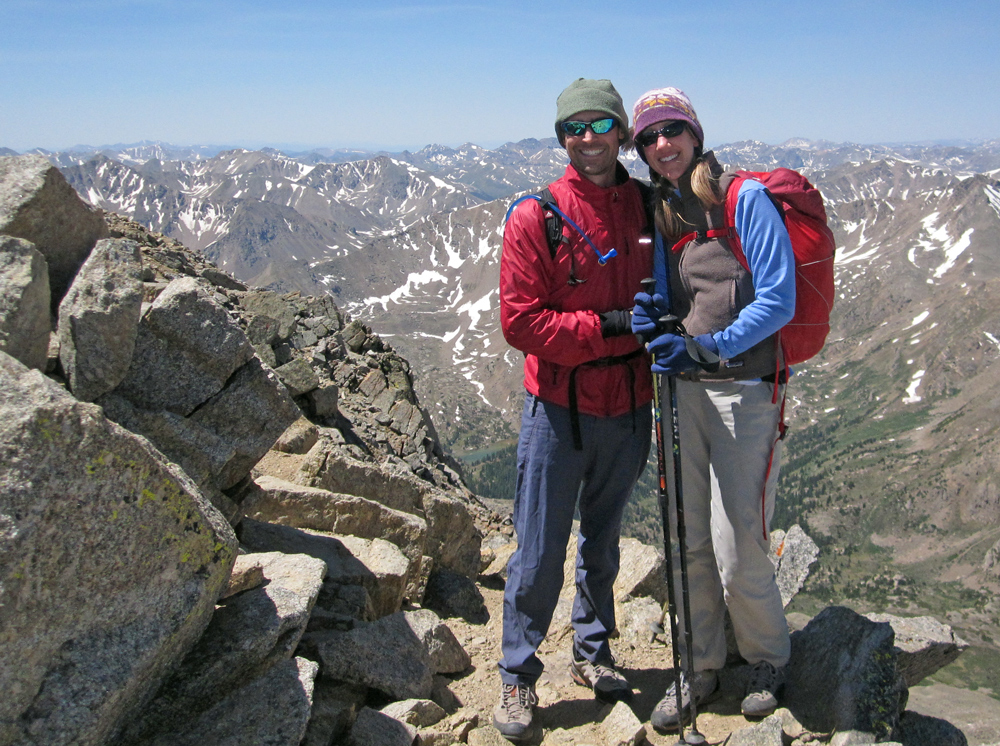
Doug and I on top of Mt. Massive on our second backpacking trip of the season.

I remember wondering if I would ever be able have crazy hectic marathon-like days with an ostomy. Would I be able to manage it in a tight schedule? What about having enough time to empty? Could I eat at any hour of the day? This week was my busiest since surgery, and I am happy to report that insanely full days are completely possible with an ostomy.

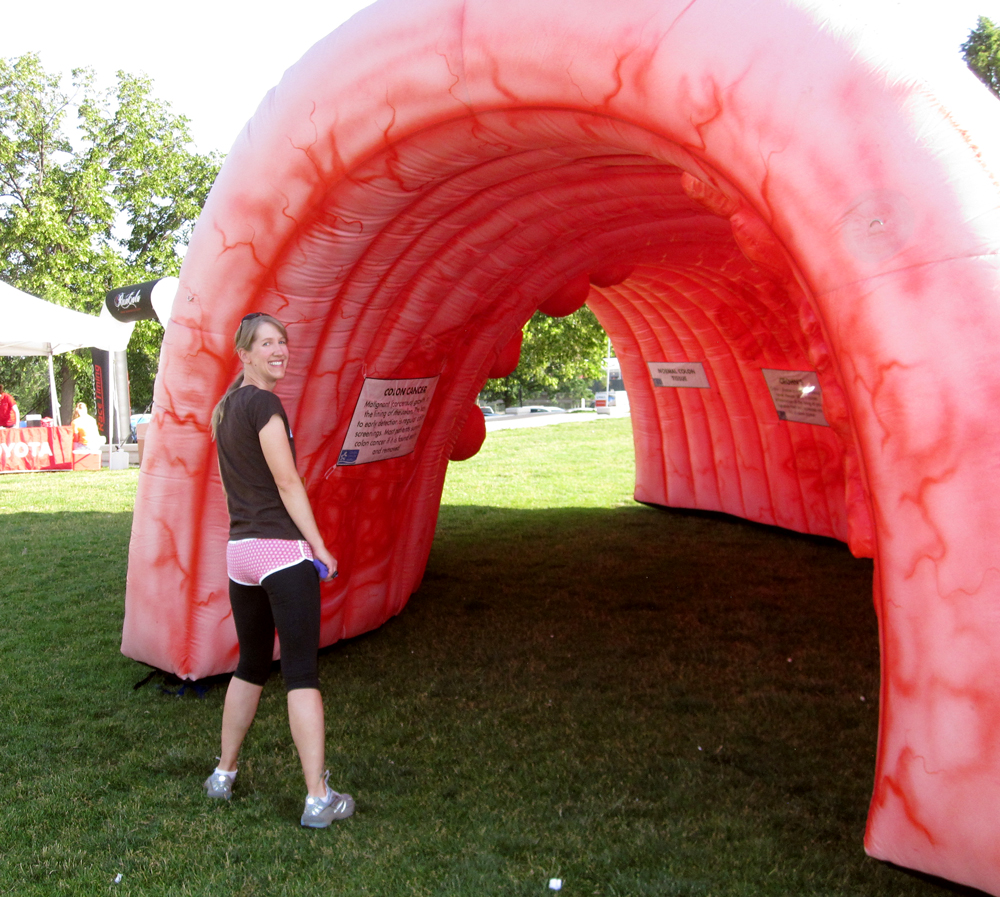
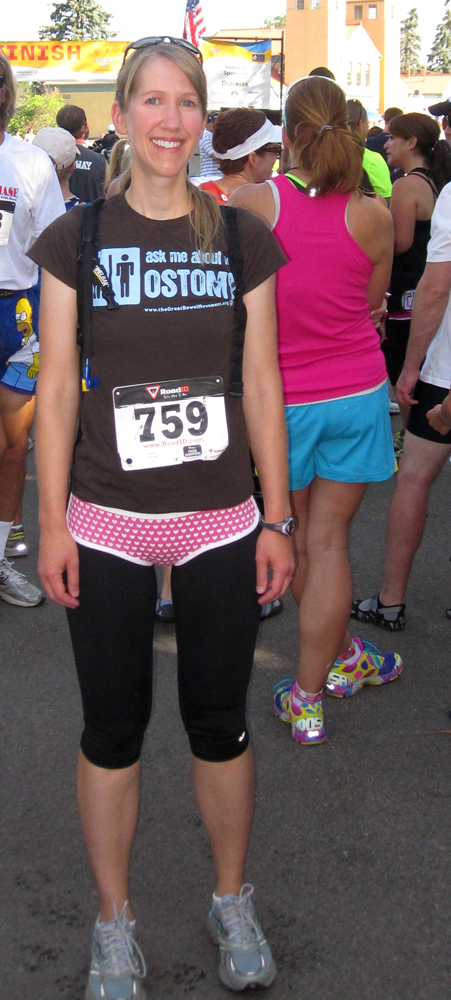
On Saturday, I got up at 5 a.m. to go to City Park in Denver to run the Undy 5000. This is a run sponsored by the Colon Cancer Alliance. Proceeds from the race go to pay for colon cancer screenings for the underserved. We have been in the middle of a record heat wave in Colorado, and the high temperature for race day was 103 degrees. I tanked up on water, said hi to some of the people from my local ostomy association who were volunteering at the event, and headed for the start line. The heat was oppressive and I got nauseated during the run despite staying well hydrated. It was definitely not the day to push it, so I enjoyed a more leisurely pace and finished the run in roughly 31 minutes. Even with the heat, my ostomy appliance stuck fine. I indulged in some post-race treats and beverages, perused the booths and then headed home to take a shower and get on to the next activity of the day: a 9+ hour work day.

Showing off my undies in front of the inflatable colon at the Colon Cancer Alliance’s annual Denver Undy 5000.
Sporting my ostomy t-shirt from thegreatbowelmovement.org at the start line for the run.
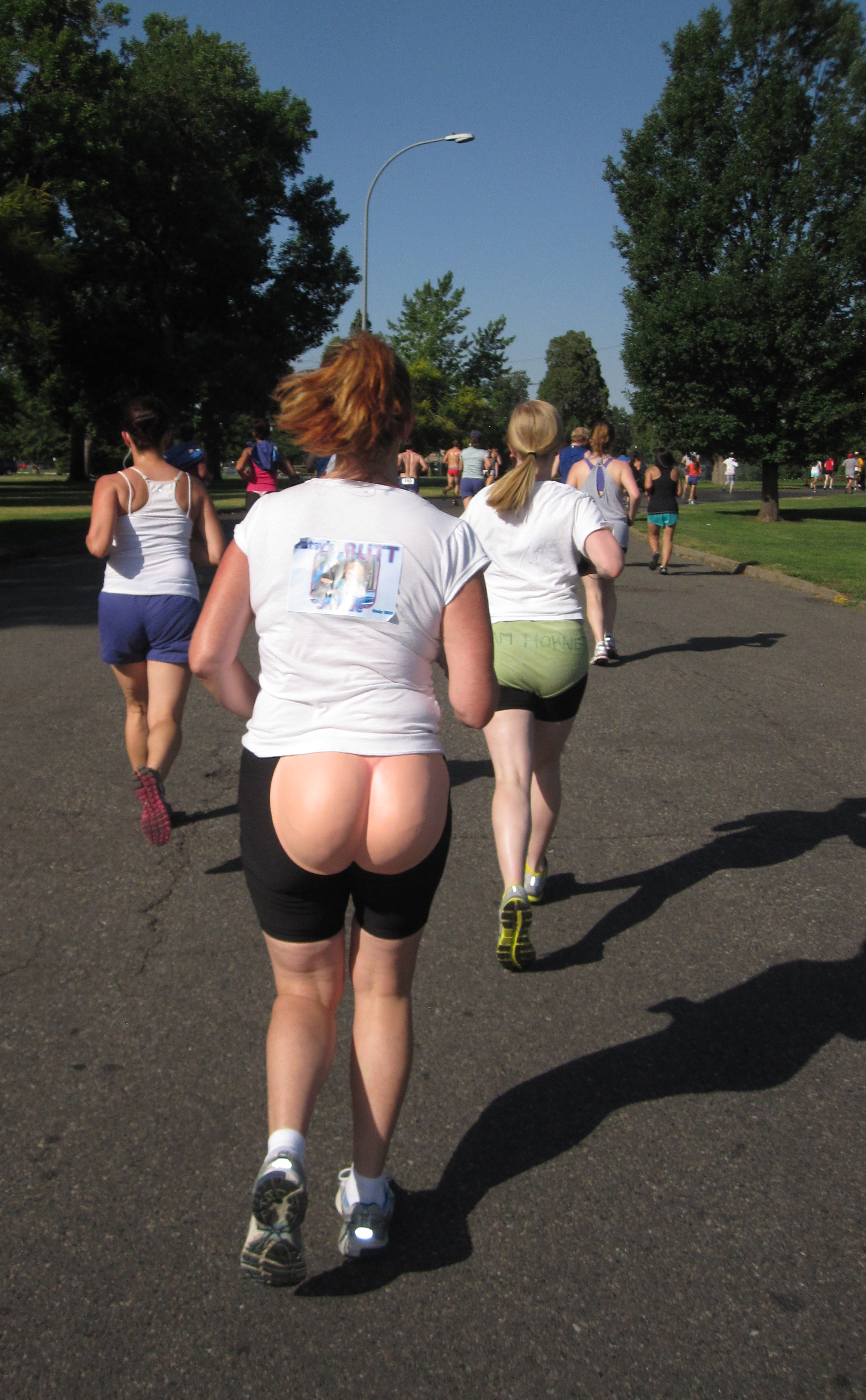
Everyone gets in the spirit of the Undy 5000 by running in their underwear or other fun bum-related costumes.

Soon I was up in the foothills leading a Jr. Ranger event at one of the parks in the Open Space System where I work as a naturalist. I spent the next 4 hours in 90-degree heat running through a meadow helping youngsters catch insects and teaching about the amazing diversity of bug life in the park. After a quick sandwich-dinner and a practice music session with my coworkers, I told stories and played my guitar as part of an evening sing-a-long and storytelling program for the campers. When we finally packed everything up to head back to the trailhead, it was almost 10 p.m. I had gone full blast from roughly 5 a.m. until 10 p.m. and my ostomy did not slow me down one bit. The only thing that was challenging was staying hydrated, but I had brought a huge personal water container along to the park since there was no potable water there. I drank over 8 liters of water that day.

The next morning Doug and I were up early to head to a friend’s going away pool party. We swam for several hours in the morning and then had a delicious BBQ in the afternoon with burgers, brats and corn on the cob. (I am fortunate in that my ostomy tolerates possible problem foods well when I eat them in conservative amounts, chew a lot and drink plenty of water.) Later that evening we headed back to the pool. I had never been in the water for such a large percentage of a day since having surgery, but my wafer did just fine—even with numerous trips down the water slide and many cannonball jumps.

Doing laps on the water slide at my friend’s pool party.

The crazy week continued. Monday included a doctor’s appointment and an evening dinner with Doug’s parents. Tuesday was filled with work and then my local ostomy association meeting in the evening. I collapsed in bed at 11 p.m. only to get up at 4:30 a.m. for our local Bike to Work Day. It was another scorcher, but the temps weren’t too bad so early in the morning. I rode my bike 7 miles from my house into Golden, and then continued for another 6.5 miles up into the foothills to the park where I work. That part of the ride included 1,900 feet of elevation gain. That evening, I rode back home, ate dinner and went right to bed.

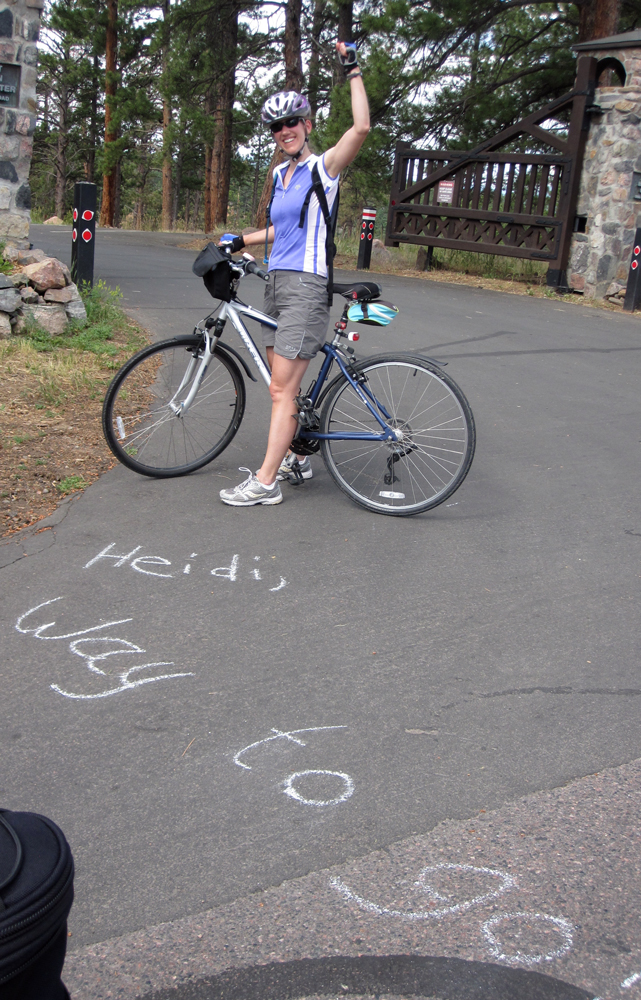
Arriving at my destination after 1,900’ feet of elevation gain during our local Bike to Work Day. My amazing coworkers left encouraging messages for me along my route.

As I type this, I am on the plane traveling to visit my parents for several days in Washington state. This wasn’t the aircraft Doug and I were scheduled to be on (and we certainly weren’t supposed to be in the first class section where we now sit). Our plane left Denver an hour late and we missed our connection to Seattle which also meant we missed the last flight to the small town of Walla Walla where Mom and Dad live. Suddenly life became a bit spontaneous as we had to completely rearrange our plans. The airline put us in first class for our next flight, gave us meal vouchers and are covering our lodging in Seattle until we can catch another flight to eastern Washington in the morning.

Through all these unexpected twists, I hardly even thought of my ostomy. My main curiosity was how my very first trip through airport security since surgery would be. I was fully expecting to have to say something about my ostomy to the TSA personnel. However, I didn’t mention it and went through the metal detector uneventfully like everyone else. I did get asked to run my baggage through the scanner again, but only because I failed to realize that I was supposed to remove my laptop from my luggage. Security didn’t even ask me about the scissors in my ostomy changing kit in my carry-on (which are allowed according to TSA because the blade is under 4 inches long). We shall see if Seattle airport security goes as smoothly with my ostomy.

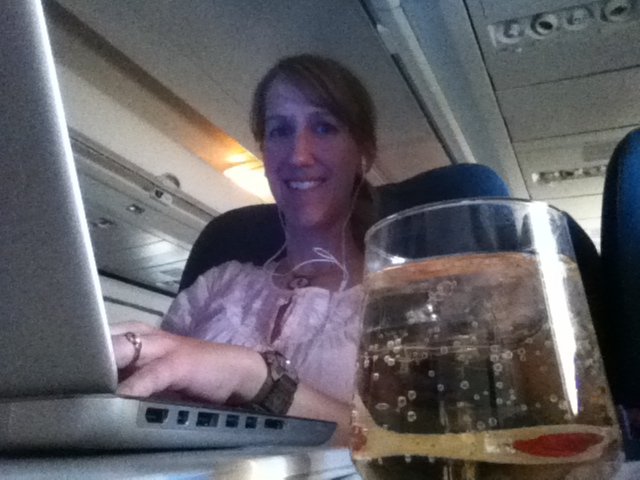
Blogging while enjoying the surprise first-class seat assignment on the plane.

As soon as I get back home, I have four evenings after work to unpack from this trip and get my things ready for the next adventure: The Crohn’s and Colitis Foundation of America’s Camp Oasis where I will be volunteering for a week as a camp counselor for children ages 7-13.

Through all these activities, my ostomy has faded into the background. I change my appliance twice a week, empty when I need to, eat when it fits in (many times as late as 9 p.m.), and drink a lot of water in the heat. Other than that, I can honestly say I don’t think about it a whole lot and it is not an inconvenience in my life. The longer I have my ostomy, the more I realize how normal everything feels with it– even during the busiest of times and when dealing with last minute changes in plans.

As great as it has been doing so many fun things this month, I know I can’t keep this pace up indefinitely. The dust bunnies will start to haunt me, a personal best at the time it takes to clean the shower will suddenly not sound so cool, and I will want to pull a cookbook off the shelf and actually make something decent for dinner. I am craving lawn chair time with an iced tea and good book instead of a huge “to do” list of things to pack for the next race, bike ride or outdoor trip. My ostomy hasn’t slowed me down one bit, but I think it is time to put the brakes on myself. Well… after the climbing trip we just scheduled for the end of the month that is.

Skin sleuthing

No more itchy-scratchy. I recently healed a rash under my wafer that had been plaguing me for about four months. In the process, I discovered that figuring out the cause and solution to ostomy skin problems can take some serious detective work. Solving my stubborn case involved some help from my stoma nurse, medication, a wacky new wafer method, and a touch of inspiration from a childhood memory.

I grew up with two brothers, and sometimes we would get into spats. When these unfortunate events happened, I could handle hair pulling, pinching, being kicked and even getting spit at. However, there was one method of sibling warfare that I absolutely dreaded: the snake bite. This involved having my forearm gripped with two hands while the skin was twisted in opposite directions at the same time until a painful sting ensued. A well-executed snake bite would leave my arm red and throbbing.

On several occasions since getting my ostomy surgery, I was certain that my wafers were giving me snake bites.

When I was healing up from surgery and researching ostomy appliances and sports, I read that some people have trouble with their wafers sticking in warm weather due to sweating. As I got back into outdoor activities, I fully expected that this would be the main wafer issue I would have to deal with when doing active sports. However, this ended up not being the case at all; my wafers adhered well through any activity. Instead, I was faced with an entirely different problem related to my ostomy appliance and strenuous sports.

When I was hanging out at home in the months after surgery, I had absolutely no issues with my wafers causing any skin issues. However, once I healed up I started biking and hiking, it seemed like my wafer would get pulled in one direction as I moved, while the skin underneath wanted to move in another. The Coloplast wafers I wore for the initial months after surgery were made out of a fairly non-pliable plastic, and would leave a circle of painful blisters on my skin right around the outer edge of  the wafer from this tension. I decided to experiment with a different brand.

I tried Hollister and then Convatec and found that the Convatec ones seemed to move the best with my body contours and movements. I had no further skin issues with my wafers for the first 10 months when I was mainly hiking, snowboarding and biking. Then in January, I started to do activities with more extreme movements, like yoga and climbing, on a weekly basis. All of a sudden, my wafers felt like they were giving me snake bites again–especially near my hip bone.

I have a narrow body, but my stoma measures 1.5 inches at its widest spot. This forces me to use larger sized wafers. When I put a wafer on, it extends past my midline incision scar on one side, and over my hip bone on the other. As I would do high steps while climbing, and twists and bends in yoga, my wafer would pull at my skin at the top of my belly and also near my hip bone. At first I tried protecting my skin with various brands of skin prep, but none made any difference. I tried to stand up while putting on my wafers and made sure I wasn’t pulling the tape part too tight while placing it on my skin. Neither of these things helped. As I was experimenting, I soon realized I had a bigger problem: a very itchy rash began to develop under the tape in the location where my skin had been pulled. Over a matter of weeks, the rash spread to other areas under the hip-bone-side of my wafer.

It was time to seek some help from my stoma nurse. After hearing about my symptoms, she felt it could be a yeast infection and recommended anti-fungal powder. I tried this for three weeks with no improvement.

In the meantime, I started to wonder if perhaps I had developed an allergic reaction to the tape part of my wafers. I really hoped this wasn’t the case. I didn’t want to have to change my ostomy system. I loved the way my wafers stuck so well through sports and swimming, and all my hernia belts and pouch covers were designed to work with my system. I thought an allergy was unlikely though, since there was no rash under the entire left-hand side of the wafer. If I had an allergy to the tape, I assumed it would show up under the entire tape part. Just to rule it out though,  I decided to try Convatec’s tapeless wafers for a couple of weeks. My skin did not clear up and continued to get worse.

It was around this time that I recalled another memory. Several years ago, long before my ostomy surgery, I had a nasty, itchy rash that started on my knee and soon spread to my arms and legs. I went to a dermatologist and was diagnosed with bacterial folliculitis. The doctor felt that I had probably nicked my leg shaving and had some hair follicles get infected which eventually spread to follicles on other areas of my body. It took a while, but it finally cleared up with antibiotics.

The rash I was dealing with under my wafer looked exactly like that rash. To top it off, I now had a little area of rash on my stomach far away from my wafer. My stoma nurse recommended that I talk to my doctor to get a prescription for antibiotics. My doctor agreed that it looked like folliculitis, and I began to take Keflex. Within a week of starting the antibiotics, the rash that I had been dealing with for several months completely disappeared. Finally the mystery had been solved! I deduced that the pulling of my skin under the tape had damaged it and allowed a bacterial infection to set in. Without the Keflex, I am positive my rash would not have gone away.

The problem was, I soon felt the familiar sting of my skin being pulled under the tape when I would bend. I knew I had to change the way I was doing things, or my skin would be damaged again and the whole cycle would start over.

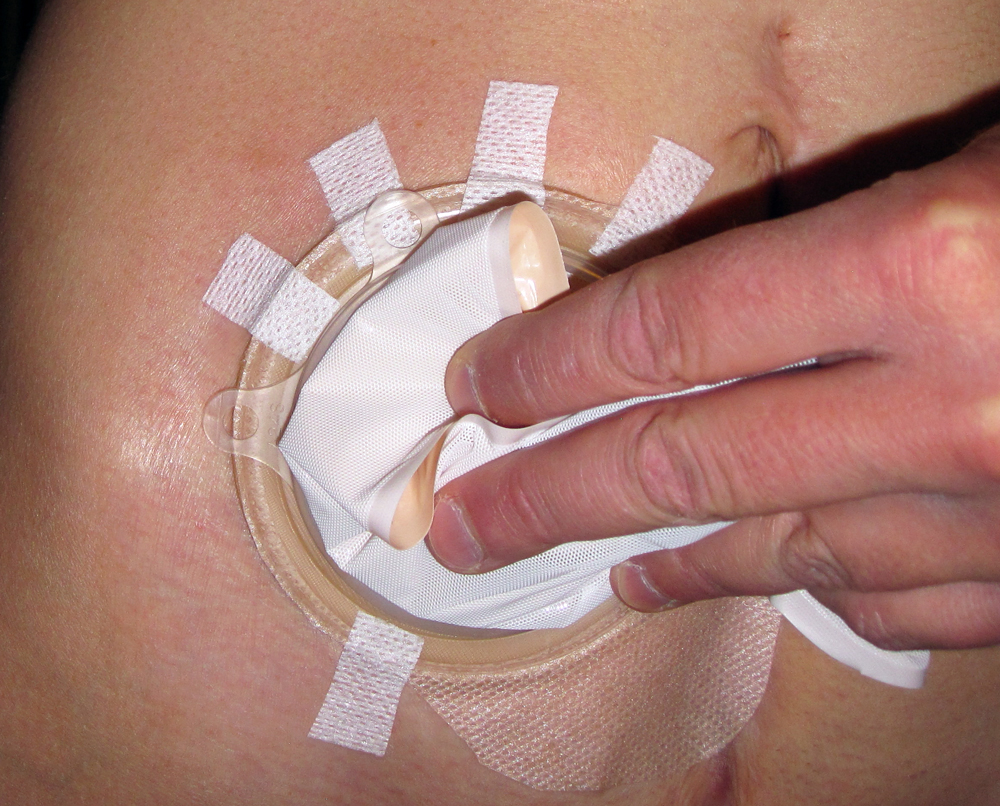
To attempt to solve the problem, I tried something a bit unusual. I continued to use my regular Convatec wafers, but cut off all the tape on the right half. The inner circle of Durahesive material seemed to stick just fine without the tape part, but I reinforced it with little strips of 3M Medipore tape in a few strategic spots for added confidence. My skin has always liked Medipore tape, and it is very stretchy so the strips did not place tension on my skin. When I was done, my new tape and wafer method looked a bit like the sun with rays of tape sticking out.  I nicknamed it the “sunburst method.” I have now been using this method for two months and it has been working great. My skin is super happy with no more tape snake-bites and no more rash! It has held on perfectly through rock climbing, running a 10k, swimming, and even a recent three-day backpacking trip in warm weather.

This photo shows my new “sunburst method” for attaching my wafer. I trim the manufacturer’s tape away on the hip bone side of my wafer and replace it with strips of 3M Medipore tape. You can see the shine mark where my hip bone is. This new taping system completely avoids this area and my skin is no longer irritated under tape when I climb, do yoga or take part in other sports with a lot of stretching and bending movements.
Two months after starting this new taping method and my skin is still healed and happy. Unfortunately, I never took a photo of the rash. Picture hundreds of tiny red raised bumps under where the wafer tape would have been on the left side and you will get the idea.

From eating to product selection to skin care–when you first get an ostomy, everyone tells you that your situation is going to be unique and that you will have to experiment to figure out what works for you. I am only now beginning to realize how unbelievably true this. I wouldn’t be surprised if my sunburst-wafer method was a disaster for someone else even though it worked for me. The point is, make sure to try different things. Don’t settle for supplies and methods that aren’t working well for your individual needs. Keep sleuthing and find the solutions that make living with your one-of-a-kind body and ostomy comfortable.

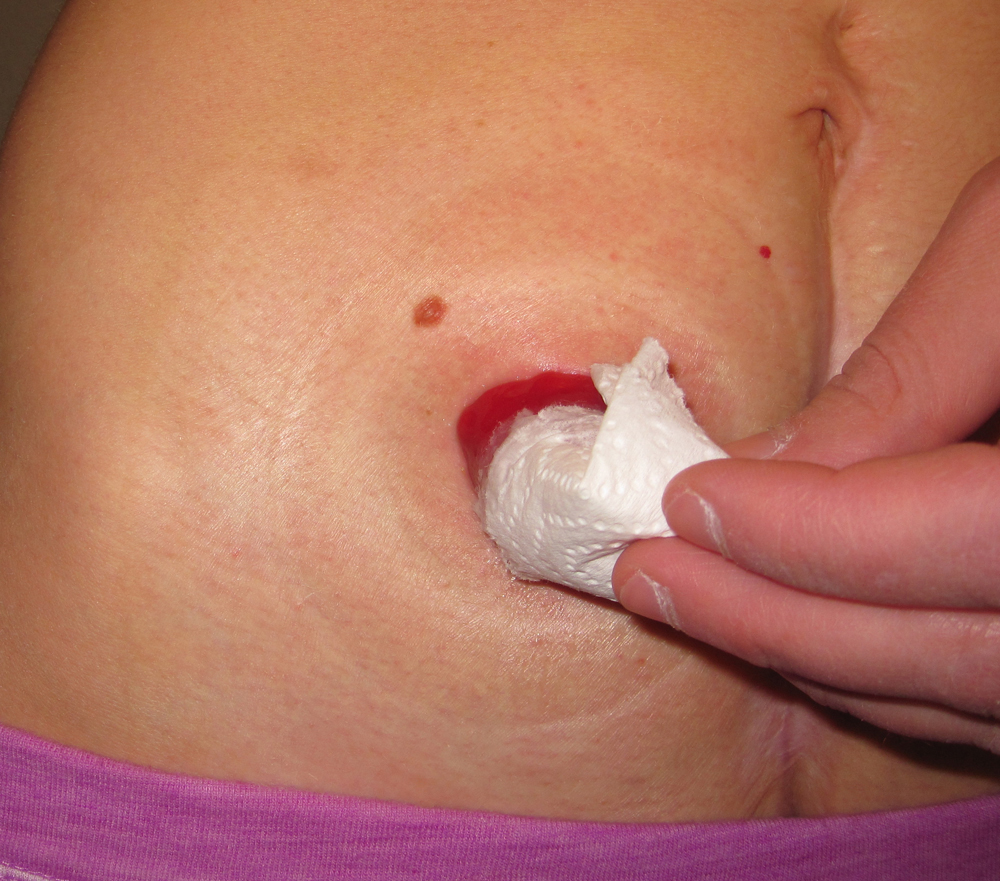
When I was a kid I didn’t like snake bites, but I did like Nancy Drew books. Nancy would just finish solving some tough case when a new and interesting one would come her way. I have felt a bit like her lately. Now that I have solved the mystery of the itchy rash, what case is next? Last weekend while changing my appliance on the backpacking trip I just mentioned, I noticed a 1/4″ white ulcer-like depression on the side of my stoma about 1/2″ from its base. It looks just like a canker sore. My surgeon and stoma nurse both think it is trauma related, so I am experimenting with cutting my wafer differently to see if it helps. Hmmm–s0 far I haven’t noticed much of a change, but maybe if I try…..

Let the sleuthing fun begin!

Trading disappointment for delight at the Bolder Boulder 10K

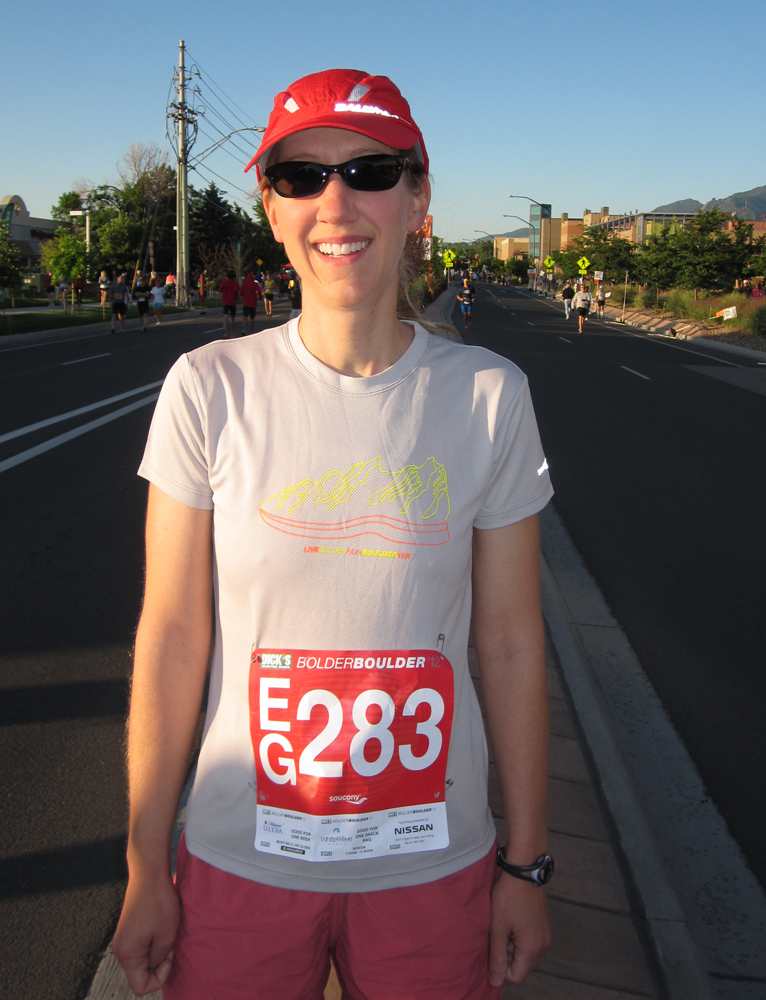
Disappointment is one of the emotions I have the hardest time dealing with. As I was standing at the start line of the Bolder Boulder 10K on Monday waiting for the gun to go off, I wasn’t sure how to prepare my mind for the letdown I was sure to have at the finish line. I knew before I even began to put one foot in front of the next that I had no chance of matching or beating my results from the last time I did this race in 2009. I hadn’t run for at least a month and had just found out from my physical therapist a few days before that I had some major pelvis misalignment issues that were likely causing some of my pain and injury. Though he didn’t say I shouldn’t do the race, he did say I should take it easy and stop to do some exercises and stretches along the route. I had no idea what a taking it easy pace would even be. Did that mean I should jog? Walk? I had never done a race where I wasn’t running as fast as I possibly could.

Making my way to the Bolder Boulder starting area at 6:30 a.m.

I was still pondering these questions when the shot fired. I took off at a pace between a jog and a run, but still the questions lingered. What time would I be satisfied with? An hour? Two? Though I don’t have a competitive streak when comparing my performance with others, I am fiercely competitive with myself. Ever since recovering from ostomy surgery, I had wanted to prove that I could do as well in this race as I had before getting so sick.  I knew that was impossible with my current painful hip, but there had to be some sort of goal, right?

As I ran down the street and watched the people in my wave pass me one by one, I realized that this race wasn’t going to be about reaching any pace goals. It was about simply being there. After all, just weeks ago Doug had picked up my race package for me. At the time, I couldn’t even make myself open it. I didn’t want to see the running bib that I was sure I wouldn’t be wearing due to what was thought to be a stress fracture in my pelvis. Yet luck had veered my way.  The x-ray had been a misread and I had been given the go-ahead to run while undergoing further tests for other pain causes. Here I was immersed in the event that I had wanted to do so much, and all I could focus on were things I had no control over. I couldn’t make my injury go away, and I couldn’t magically make up for a month of lost training time. I could, however, adjust my outlook.  As I ran under the banner marking mile two, I flicked an attitude switch in my head from the side that read  I am so bummed that I am not going to get the time I hoped for to the one that said I am so amazed to be running through the streets of Boulder surrounded by beautiful views, music on the street corners and onlookers handing out treats to the runners like bacon, cotton candy, and marshmallows.

I much preferred the second attitude and decided to keep the switch there for the remainder of the race. (I did, however, avoid catching any marshmallows. I had already had my fill of those the day before after consuming six of them to slow output before my appliance change.) At every mile marker, I stopped to do the exercises the physical therapist had recommended I do during the race. I knew that these stops were sabotaging my time, but I no longer cared. When my hips started to hurt slightly at mile four, I slowed down the pace. I had no worries. No expectations. In the past, I would never have veered off course to become a target for child with a Super Soaker. Never before had I taken advantage of the offers for high fives from sideline spectators. I don’t remember looking at the stunning vistas of the Flatiron rock formations along the race route in previous race years. At the slower pace, I took all this in.

Every other time I ran the Bolder Boulder, I finished in just under an hour. This time, when I looked at my watch at 59 minutes, I still had a little over a half mile to go. Just for old times’ sake and knowing that I was close to the end of the race, I picked up the pace and ran as fast as I could for that last half mile. I felt strong and vibrant as I entered the stadium and sprinted the final half lap to the finish line. Other than amidst the marshmallow-catching antics earlier in the route, this was the first time I thought of my ostomy during the entire race. I thought of  all the things I had gone through since last entering that stadium in 2009, and how lucky I was to be back to health and running there again.

As I crossed the finish line, the letdown and disappointment that I was sure would greet me there had been replaced by delight. And when I finally looked down at my watch to see my time, 1:06:33, I was even more blown away. That was only about eight minutes longer than my 2009 time. This was certainly enough to please my self-competitive side — well, for the most part. In the stands after the race, there was a moment when I lamented to Doug that had I not been injured, I would have really nailed it. He reminded me that I was injured and that I did nail it. Oops, that little attitude switch had gotten bumped into the wrong place again. I put it back to the “here and now” slot, slathered myself with some sunscreen and sat back to watch others racers jubilantly cross the finish line — including a banana, gorilla, coyote, bear ,and unicorn. Hmm… maybe my goal for next year should be to run the Bolder Boulder in costume.

Resting in the stadium with Doug after the race.

A long restless night

Darn that almost-to-be supermoon. Its bright light made me think it was morning and it is barely 2 a.m. Jolted awake by hip pain, I was hoping it was almost time to get up and start my day.  Instead, I am faced with some long anxiety-filled hours before the alarm clock is due to ring. It has been a while since I have been up at this hour in pain, but in the past few weeks this scenario has become a regular occurrence.

At this late hour, I am scared, hurting and my mind is having trouble being positive. If you have read some of my recent posts, you know that I have been dealing with recurring hip pain, and that I had an x-ray that showed a possible pelvic stress fracture. However, the  orthopedic surgeon I saw wants me to have an MRI to rule out a few other things rather than simply dismissing my troubles to the probable stress fracture. One of the main reasons he suggested this is because my hips had been hurting a lot at night which could be a red flag for some more serious conditions. The orthopedist said that if my pain happened to ease up significantly before the MRI date, I could actually cancel the appointment. Unfortunately, the pain is not mellowing — it is getting worse.

I try really hard to not be one who dwells on the what ifs, but sometimes expecting that of myself is downright unrealistic. After all, my body hasn’t exactly proven itself trustworthy in that regard. So what is the big fear that has me hanging out in my recliner in the wee hours with a mug of Sleepytime Extra tea instead of snoozing blissfully in my bed? I am scared that I might have osteonecrosis. A major risk factor for this gem-of-a-condition (of which I am experiencing just about every symptom)  is a history of being on high doses of prednisone. I took up to 80 mg per dose when I was in the hospital during my final UC flare. My doctor assured me that the MRI that I am having this Monday is very good at picking up this disease and that he will let me know as soon as possible if anything shows up.

Until then, I am allowing myself the liberty to freak out a little. The results of my test will probably come back showing that everything is fine and that I am just dealing with a stress fracture. But in some strange way, ruminating over one possible worst case scenario at 2 a.m. on a Friday night is helping my brain cope with the uncertainty — because even in my mind’s wost imaginings, I can see glimmers of hope and the realization that I will be okay regardless of any struggles that lie ahead.

With that reassuring thought, I am going to head back to bed, armed with some mindfulness meditation exercises to help me relax and hopefully get some sleep.

Drawing my way out of the doldrums

My first mainly sedentary week has been hard mentally. I wish so much that I could go for a hike or run, but just walking around the grocery store makes my hip throb with pain, so that is not going to be a reality any time soon. I went swimming at the gym and did an upper-body weight workout. Both of those activities went okay, but it feels like all the amazing  progress I made working out with my personal trainer is going to slip away.

When sadness and anxiety start to take over and I can’t deal with the stress using exercise, I often turn to my nature journal to lift my spirits. Somewhere in those moments when I am looking closely at the pattern of veins in a leaf, and my pen is moving over paper recording what I see, my mind finds peace. Expect to see many drawings in the weeks ahead!


Good news: no more crutches!

For the past three days, I have been nervously awaiting my appointment with an orthopedic surgeon to find out about the injury I mentioned in my last blog post. I am so used to going to the doctor for digestive- and colon-related issues. It felt a bit unsettling to go in for something entirely new like a bone problem. And I was even more anxious because the pain had gotten a little worse over the past couple of days. It had been especially intense at night — even keeping me awake for several hours.

At the clinic, the orthopedic surgeon looked at my x-rays and examined the area of my injury. He thought the stress fracture was small enough that I could ditch the crutches (unless I was having pain) and just take it easy. He said soon I could try some light exercise such as swimming or maybe easy biking, and to listen to my body and stop something if it causes any discomfort. However, because I have been experiencing the worsening pain at night, he wants me to get an MRI in 7-10 days to rule out a few things that could be more serious.

I was so ecstatic as I walked out of the doctor’s office sans crutches. I have a huge appreciation for those who have dealt with them for long periods of time. Using crutches is incredibly tiring, and it was difficult to rely on others to constantly carry my stuff or bring me things. It is next to impossible to have anything in your hands with crutches. My coworkers joked that they were going to get me a cowbell to ring every time I needed help. Thanks goodness I won’t be needing that.

Bye bye crutches!

So I am relieved with the circumstances for now and will cross my fingers that nothing strange shows up on the MRI. I know I will still have to cancel some activities in the upcoming month or so as I heal up, but I am confident that the plans I made for later in the summer will stay intact even if I have to tone them down a notch.

For this weekend, sitting in the grass with my sketchbook still sounds just about right.

Turning 40

I couldn’t stop smiling as I sat in the stands at Coors Field. I was attending a Colorado Rockies game for my 40th birthday, and the evening had been amazing so far. Planning to ride our bikes to the stadium (to avoid traffic and the parking fee), Doug and I had parked our car about a mile away.  Just as we were about to unload our bikes from the roof rack, a massive storm blew in and we watched lighting streak across the Denver skyline as hail pummeled our car. Once the storm ended, we jumped on our bikes and cruised downtown, breathing in the wonderful spring smell of rain-soaked ground and blossoming trees.

We arrived at the stadium an hour early, so we stopped to enjoy drinks at the Irish pub next door. I was halfway done with my Strongbow Cider when the waitress surprised me with a free birthday shot. I have no idea what was in the fruity purple concoction, but she assured me it didn’t have gluten in it, so down the hatch it went. This was a little more than I would normally drink on a mostly empty stomach with my ostomy, but hey, it was my birthday. Time to throw caution to the wind. My stomach wasn’t empty for long. As soon as we walked over to the stadium, I indulged in one of my favorite treats. I hardly ever eat hamburgers due to having celiac disease (and the fact that they are not that healthy), but Coors Field has a special gluten-free concession stand. Soon I was in my seat, huge burger in hand and eagerly anticipating the game.

Nature even provided some pre-game entertainment for my birthday. Perched on the balcony railing above me, a male house finch was singing his heart out. Over and over he belted out his melodious tune, and I kept thinking that there had to be a female baseball-fan-of-a-finch listening somewhere in the stands. I hope he finds her. There are certainly many great places to tuck a nest in the stadium and then the pair can watch every home game as they raise the next generation of Rockies-loving finches.

If this amazing start to my birthday evening wasn’t great enough, things got even better. The Rockies were clobbering the opposing team in one of the best games I had the pleasure of watching. In between watching unbelievable plays, my mind cycled through memories of being at the stadium so many times before.

It was on a previous visit to Coors Field that my final UC flare first made itself known. I am sure many IBDers know the feeling of thinking they have finally found the magic bullet of probiotics, diet and medication to keep their illness in control, only to have their body fail them yet again. It was during a night similar to this one that I was having fun watching the Rockies when one such disappointing moment came. I got up to use the restroom during the 7th inning stretch and noticed a tiny speck of blood from my intestines on the toilet paper. My heart sank. I left the bathroom and tried to focus on the rest of the game, but all I could think about was the fact that my four-month remission was over and my UC was back. At the time, I had no idea that those initial specks of blood would turn into the massive flare that would cost me my colon. When I look back at my photos from that evening, I see a woman who is blissfully unaware of the major life change that is about to happen. If you would have told me that night that I would have an ostomy a few months later, I would have said you were out of your mind.

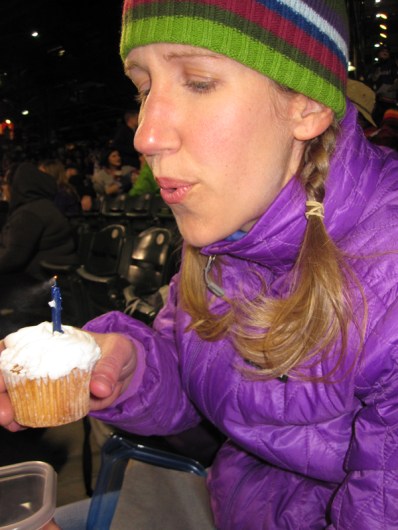
Sitting in the stadium on my 40th birthday, I realized that I still had no idea what was around the corner. But if there is one thing I have learned in my 39th year, it is that this uncertainty is okay. Tomorrow would be on its way soon enough, but right now I was enjoying watching the players slide into bases and hearing Doug yell GO TODD at the top of his lungs every time Todd Helton was up to bat. Right now I was having fun singing Take Me out to the Ball Game and seeing the people around me laughing and goofing around with their friends and family. Right now I was smiling as I blew out the candle in my birthday cupcake and made my wish for the year. Right now I was happy that my ostomy had allowed me all these moments.

For me, turning 40 wasn’t something to be sad about. It wasn’t about all the things that I hadn’t done or about goals not yet achieved. Turning 40 was about celebrating all the things I had done. It was about lightning and skyscrapers, house finches on balconies, bike rides through puddles, baseball players getting out of pickles and every other great memory I have from that day and all of those before.

Let the races begin!

Last Sunday I went with Doug and his dad to run the Journey Quest 5k in Fort Collins, a fundraiser for the Shared Journeys Brain Injury Foundation (SJBIF). The organization provides programs that help people with acquired brain injuries regain independent, satisfying and productive lives. This was my first 5k race since my ostomy surgery 16 months ago. The overall time I achieved in this run would determine my wave for the 10k Bolder Boulder, which I plan to run on Memorial Day.

Getting ready for the run.

I started running again last summer, but have mainly been working on endurance by going on longer runs. Since I have not been focusing on speed, I wasn’t sure what to expect my finishing time to be for this race. I have never been a very fast runner. My speed has been in the nine-minute mile range in just about every 5k or 10k I have done. Therefore, when I set my goal for this run, I simply hoped to at least match my time from the last 5K I did prior to surgery, which I completed in 29:43.

I felt fairly strong and crossed the one-mile mark in nine minutes and then the two-mile mark at 18 minutes. Despite the decent start, I really struggled in the final mile. There were a few times I had to tell myself that I needed to ease up because my lungs and heart felt like they could barely keep up with what I was trying to make my legs do– I simply could not breathe. I relaxed the pace a bit, crossed the finish line and realized that I actually shaved a handful of seconds off my last 5k with a time of 29:19. I was happy with the result, but could not believe how hard the race felt. I have never been so utterly exhausted during or after a 5k. Doug and his dad met me at the finish line after running great races too (Doug came in second in his age group, 40 to 49), and I couldn’t even talk from lack of breath. Doug’s mom caught us each on camera as we ran the race.

Doug heads out from the starting line.
Doug cheers on his dad as he prepares to cross the finish line.
I am exhausted but still smiling as I finish the race.

This race made me realize that if I want to get faster times, I must change my training strategy. I really like going out for long, slow runs, especially on the trails, but I need to mix things up and start including some speedier runs in the mix if I am going to match my pre-surgery time for the Bolder Boulder 10k. I have always finished that race in just under an hour, but based on how I felt on this run, that would be impossible right now. Time to put some more miles on the running shoes.

I am also glad to report that my ostomy caused no issues during the race. The event started at 10 a.m., so I ate my normal breakfast of a protein shake, a banana and a bowl of oatmeal at 6 a.m. I emptied my pouch before heading to the start line and was good to go for the entire time. There was a party following the race and I refueled on some chili and a few cups of popcorn. Yes, I said popcorn! I find I have no issues with this favorite treat of mine if I chew it well and drink plenty of water (24 ounces in this case.)

Speaking of water, I have never been a fan of the hydration stations at races where one stops to slam a small cup of water. Even before surgery, I always got a gassy bellyache from gulping the water down… that is if I didn’t choke on it first because I was breathing so hard. Most of the time I would just drink a little and toss the half-full cup onto the ground or skip some of the water stations altogether. With my ostomy, I am even more conscious of avoiding things that cause me gas pains. Not to mention that I need to drink a lot more water during activity to prevent dehydration. I usually carry a CamelBak hydration backpack on my runs, and decided this would be a good strategy for the race as well. I filled it with just the amount of water that I would need for the race so that the pack was light. This worked well because I could sip small amounts of water through the hose as I ran to stay well hydrated and didn’t get a bunch of air in my stomach.

One less-than-ideal thing I had to deal with during the race was trying a different wafer than my favorite one. Typically, I reserve sampling new supplies for times when I know I don’t have something big going on in my schedule. However, I have recently had some skin issues under the tape of my wafer: little red bumps that are insanely itchy. My stoma nurse is working with me to try to troubleshoot the cause, but in the meantime, I decided to try a sample of a tape-less wafer to give my skin a break. The 5k was on day four of wearing this new wafer. I was worried the sweat might make it fall off during the race, yet I didn’t want to risk irritating my skin by removing it early. By the morning of the race, my wafer was already starting to peel up on the edges. However, with a few little pieces of 3M Medipore tape in strategic places, the wafer held on just fine. Whew!

All in all, the race went well, and I am excited to push my running to the next level. I look forward to adding a few more races to my schedule in the coming months. And I still have my sights on the CCFA Team Challenge Half Marathon in December. I am hoping the shorter races will help prepare me for that big distance. Most of all, it feels great to discover another favorite activity that is once again possible thanks to my ostomy surgery.