Next time?

Wow! That looks like fun I thought as I gazed up at The Ridge at Loveland ski area on Sunday and saw three skiers floating down an area of untracked powder. If only we had time to get up there. Doug and I were planning on leaving the ski area early to avoid the nightmare traffic jams that always happen on ski weekends when everyone is trying to get back home to Colorado’s Front Range. Getting to the area where these people had been skiing involved signing a waiver down at the lift ticket office and then riding the new Loveland Ridge Cat. We figured it would take at least an hour to get our pass and then ride all the necessary lifts to get to the area where the snowcat picked skiers up. Not to mention that the snowcat stopped operating at 2:30 p.m. We would really have to rush to catch the last ride.

That seemed like a lot to do for one run, and I almost shrugged it off  thinking it wasn’t worth the hassle. Anyway, we had passes to the ski area and there was always next time, right?

As I sat there in the snow looking up at the snowy ridge, I had this horrible nagging feeling that maybe there wouldn’t be a next time to do that run. I hate having depressing thoughts like that, and I really do try to stay positive as much as I can. However, sometimes the downer feelings sneak in and this was one of those times.

This Thursday, I am going in for an MRI of my left hip. I have been experiencing a rapid worsening of pain in the joint. What started out as a dull ache in the beginning of January has now changed to a sharp pain whenever I lift my leg in a certain position. The joint is starting to hurt when I walk and it feels alarmingly like the avascular necrosis (AVN) in my shoulder. Though I am definitely staying hopeful, I am also scared of what the MRI might reveal. If the results came back showing AVN, I am pretty sure snowboarding black diamond runs on The Ridge would be out of the question.

I suddenly had this incredible drive to get up there and to the run right away. There was no time to waste! Who cared about getting stuck in traffic. Doug and I raced down the mountain, got our passes for the Ridge Cat and made our way up the lifts to the loading zone for the vehicle.

This isn’t the first time since being diagnosed with AVN that I have had these sorts of thoughts. Last Friday I went to a two-hour Zumba dance party at my gym. Doing salsa moves, jumping around and swinging my hips was so much fun, and I smiled the entire time. Still, the dreaded thought once again entered my head: Would this be the last time I would get to dance so hard? Just in case, I closed my eyes and focused on the lovely sensation of my body moving to the music. Don’t ever forget how amazing this is I thought.

A couple of weeks ago I went to the rock climbing gym. My orthopedic surgeon had said it was okay to still climb as long as I followed some restrictions, avoided doing anything that elicited pain, and didn’t push too hard. I started tentatively–not knowing how my shoulder would handle things. Soon I realized that if I only climbed with my arms in front of me and did not do any moves where I was reaching far out to the side or back, I was fine. On the last climb of the day, I paid close attention to how strong and powerful I felt when to reaching up for a hold and making my way to the next one. Would there be a time in the near future when I couldn’t remember what that felt like due to decreased mobility?
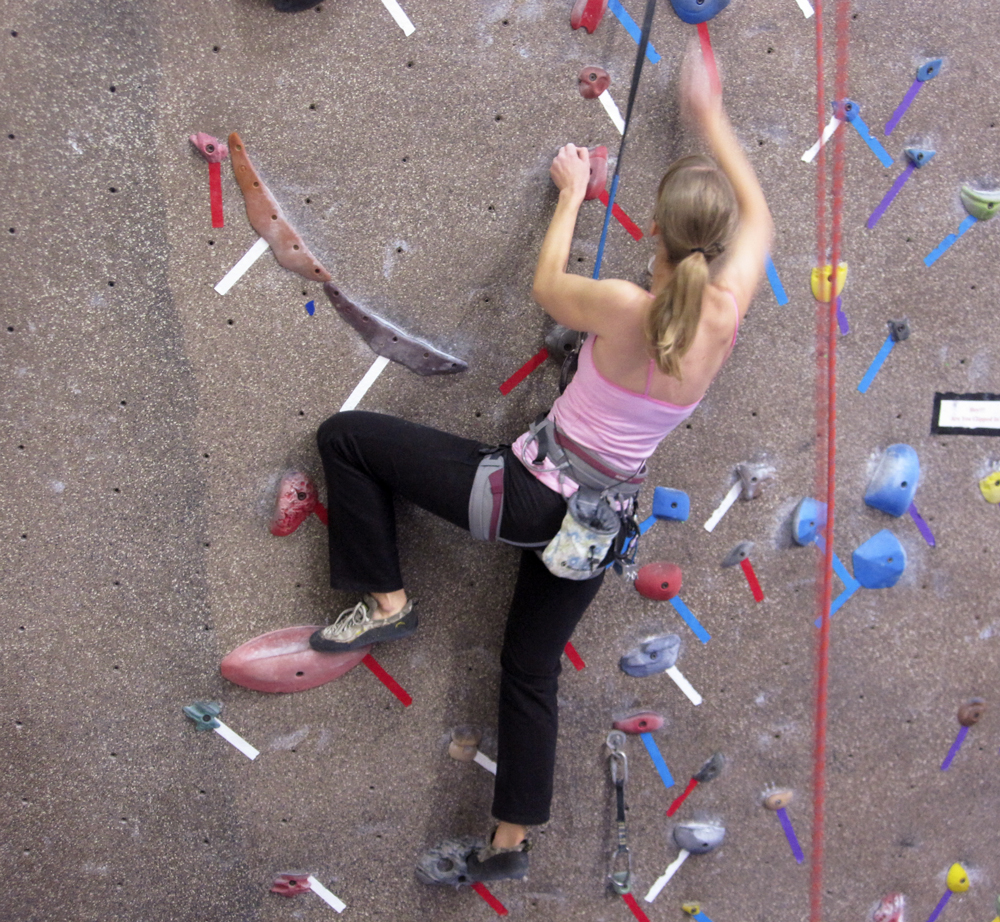
First time climbing after my avascular necrosis diagnosis and still going strong.
My first time climbing after my avascular necrosis diagnosis. I was being cautious, but still felt strong.

On New Year’s Eve, I went ice skating with my brother-in-law’s family. As everyone went back to the warming room to take off their skates, I stayed behind and did a few laps. Once again I closed my eyes and tuned into the feeling of my legs gliding over the ice hoping to commit it to memory in the event that I wouldn’t be able to do it again.
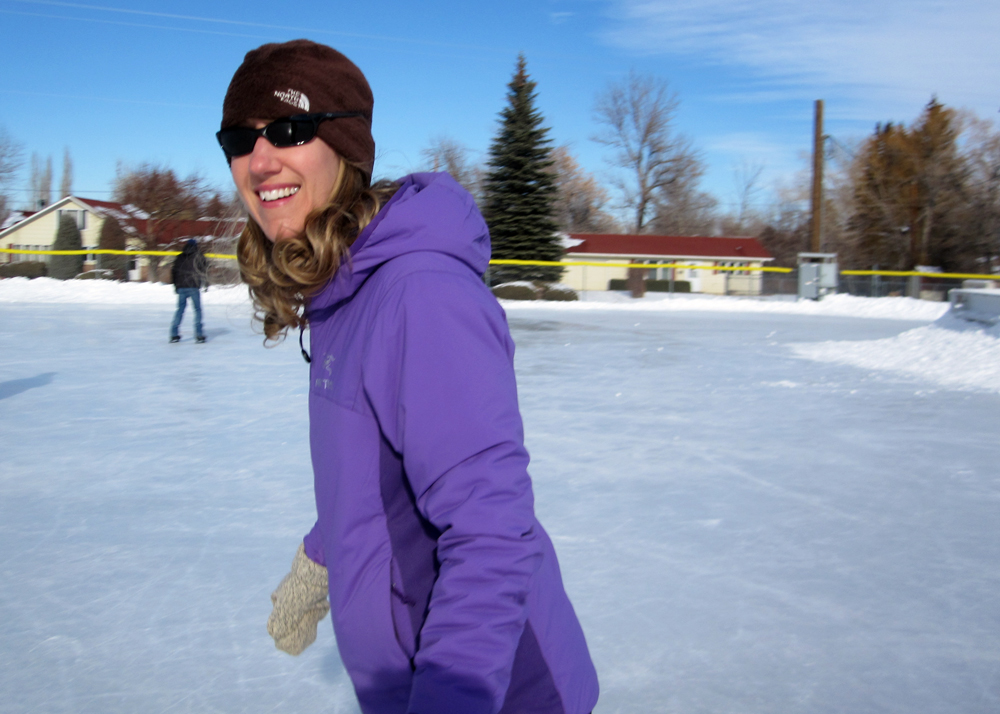
Ice skating on New Year's Eve.
Ice skating on New Year’s Eve.

As I sat on The Ridge looking out at the gorgeous snow-capped peaks in the distance, I thought back to the climbing, ice skating and zumba instances and once again wondered if this was the last time I would be clicking my boots into my bindings and flying down a black diamond run. Sure, these thoughts were rather melancholy and I wished I could have been thinking about happier things. However, there was one silver lining to having these feelings: they made me want to soak up the moment and savor every bit of joy that was found there.

I tilted my board towards the fall line and began to slide down the slope. As I picked up speed, I listened to the wind rush past my ears and felt snow crystals touch my smiling cheeks. I felt my body turn into this amazingly coordinated machine and bend and sway with the subtle nuances of the terrain. With years of practice, it knew the exact pressure I needed to exert on the board to make it arc gracefully through the powder. I felt the sensations in my feet as I rolled from my heel-side edge to toe-side and heard the noise of my board slicing its way through the snow. I felt agile, giggly and content and wished that slope could have gone on for at least ten more miles.

I don’t know what Thursday’s test will reveal. Maybe I will have AVN in my hip. Perhaps the pain is just from a tweaked tendon. Whatever the results–that was one heck of a snowboard ride! Perhaps we all need to delight in those amazing moments as if there will be no next time.
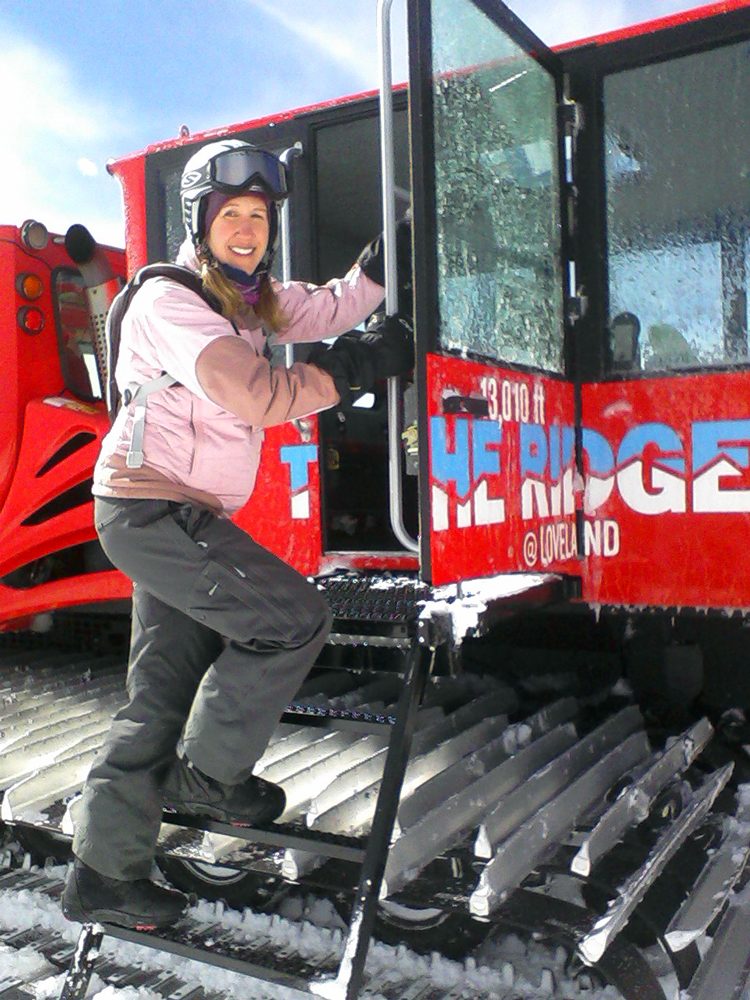
Boarding the Loveland Ridge Cat
Boarding the Loveland Ridge Cat.
Unloading from the Ridge Cat. The individual behind me had just reminded us that all the terrain served by the snowcat was expert only. No turning back now!
Eagerly anticipating the run. The individual behind me had just reminded us that all the terrain served by the snowcat was expert-only. No turning back now!

The Phoenix magazine now available online

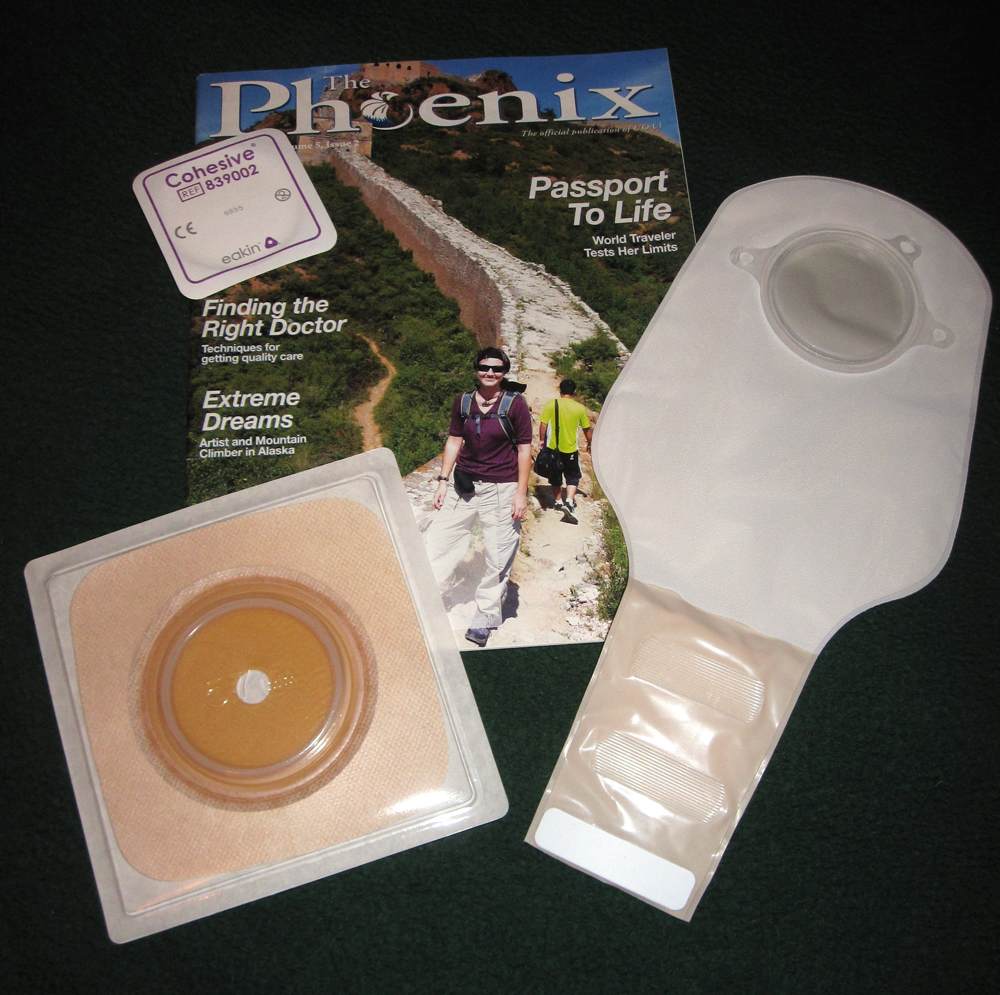
Beyond great doctors and following the treatment plans they prescribe, one of the things I find most important when dealing with difficult medical conditions is maintaining a sense of hope.  I simply have to be able to believe that the possibility of a good outcome exists, even if I know the road to get there might not be easy or certain. When I was facing ostomy surgery, one of my biggest sources of hope was The Phoenix magazine, the official publication of the nonprofit United Ostomy Associations of America. The minute I stumbled upon it online, I subscribed and bought all the back issues. I eagerly read every word of every issue. Along with a vast array of educational articles about products and managing an ostomy, there were countless inspirational stories about people with ostomies who were out there living life to the fullest. I learned about a woman who had hiked the Appalachian Trail and another who had visited China. I found out about a climbing guide in Alaska who had an ostomy and another individual who had climbed Everest. Reading about these people was as important as figuring out how to get my wafer to stick: they allowed me to visualize what my life could be like in the future. They gave me hope.

Last fall, I began contributing to The Phoenix myself by wring the quarterly Ostomy Outdoors column. This is certainly something I never would have visualized as being part of my future while lying in my hospital bed a couple of years ago! Life is full of beautiful surprises and being able to help people through the same magazine that provided so much inspiration for me is humbling.

Whether you are facing surgery, just recovering, or a seasoned ostomate, each issue is full of great articles on supplies, skin care, stories about others who have had ostomy surgery and so many other topics. And now it is even easier to view the publication! The UOAA is offering an online subscription for only $19.95. Find out more information and get a free preview of the online winter issue at the following link.

And speaking of hope — I hope to never let a season go by where The Phoenix doesn’t show up in my mailbox. It is such an invaluable resource for me.

Phoenix-post-web-version
The Phoenix magazine is as important as wafers, pouches and barrier rings when it comes to my life with an ostomy.

The My Hip T: a great product for ostomy pouch coverage

I have always been a bit of a gear junkie. I like having just the right backpack, sleeping bag or outdoor clothing for the specific adventure I am embarking on. This plethora of outdoor gear often comes at the expense of other things. For instance, our home furnishings are a hodge-podge of hand-me-downs. Living room color scheme—what’s that? New couch or climbing gear? The climbing gear wins every time.

I have found that just as I like the right piece of outdoor gear for a given objective, so do I like to have specific ostomy products for different circumstances. I love my Ostomy Secrets swim wrap for trips to the pool. My Vanilla Blush undies are really comfy under my jeans for everyday wear. Comfizz boxers are my favorite item for holding my ostomy pouch and hernia belt in place when I rock climb. Each of these products is unique, and I wouldn’t want to be without any of them. I always promised myself after surgery that I would not hold back on getting the ostomy items I needed to make me feel comfortable and confident—even if it meant cutting other things out of the budget.

Recently, I had the opportunity to try a product that has a very unique niche in my wardrobe and has become one of my favorite ostomy-related clothing items: the My Hip-T.  I had never heard of this product before, but last summer the designers of the My Hip-T sent me a few samples at no cost to test out and provide feedback. They have customers who wear the My Hip-T to cover ostomy pouches as well as diabetic insulin pumps and wanted my thoughts and feedback on the product. After testing the garment out, I loved it so much that I have wanted to write a blog post about it for some time. A deluge of difficult news lately put a damper on wanting to write about much of anything, but I am feeling more at peace with all the things that are happening and am ready to blog about all my favorite ostomy subjects.

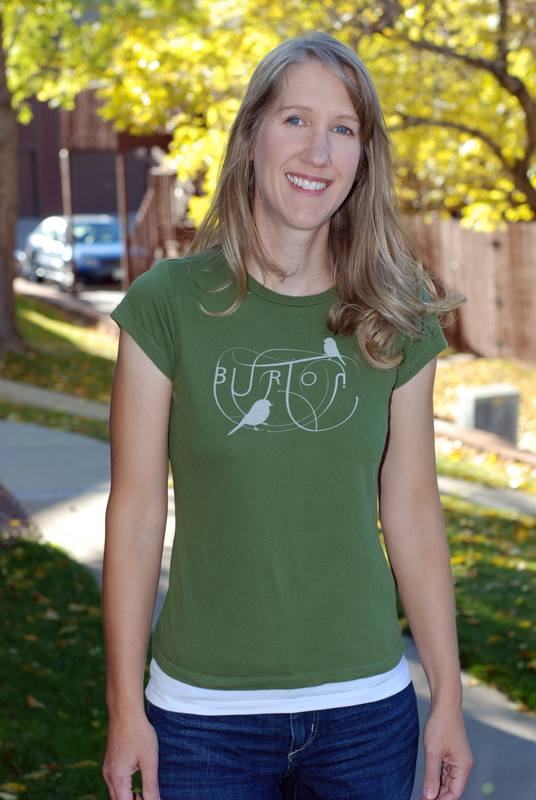
Showing off the grey colored My Hip-t.
Showing off the grey colored My Hip-T.

As ostomates, we often hear about many of the products that are designed specifically for life with a stoma. However, there are many mainstream items out there that are very helpful too. The My Hip-T is a stretchy cotton wrap that is actually designed to help conceal the bum exposure and muffin top that so often occurs with lower-rise jeans. The tube-top-like garment goes over the upper portion of your pants and ends up looking like a nice layer when worn under a shirt.

Since surgery, many of my favorite shirts have ended up at the back of my dresser drawer because they are just a little too short length-wise and expose the part of my ostomy pouch that sticks out above the waistband of my pants. The My Hip-T has allowed me to re-introduce so many of these much-loved items back into my wardrobe.

I generally do not have good luck with the regular ostomy wraps that are designed to wear under jeans, skirts and trousers. My stoma is located lower on my belly, and the bottom of my ostomy pouch extends past the bend in my leg. When I try to wear an ostomy wrap to cover my entire pouch from top to bottom, it always rolls up near that crease in my leg. As it rolls up, it cuts off the flow to the bottom half of my pouch. The My Hip-T is different. Because it is designed to be worn over the top of your jeans, it clings very well to the fabric and stays in place. The My Hip-T fits snugly around my hips without being too confining and does not block the flow of output from reaching the bottom of my pouch.

Ostomy-specific wraps that are designed to be worn under my pants often cut off the flow in my pouch due to the crease in my leg.
Regular ostomy-specific wraps that are designed to be worn under my pants often cut off the flow to the bottom of my pouch when they roll up at the crease in my leg.

When I want to be absolutely sure my ostomy pouch won’t show when I reach for something and my t-shirt rides up, or if I am wearing something form-fitting, I usually wear higher-waisted ostomy underwear. They do a great job at hiding my pouch without rolling up, and I wouldn’t want to be without them in my clothing quiver. However, sometimes it is nice to wear my comfy non-ostomy undies and just let my ostomy pouch flop over them. The problem with this is that it leaves the top of my ostomy pouch exposed above my pant’s waistband. The Hip-T has given me another option for smoothing out and concealing my pouch when I don’t feel like wearing ostomy-specific underwear. It is so easy to throw one on at the last minute and have confident coverage. If I am traveling, I automatically put one into my luggage. I know that no matter which jeans or shirts I packed, my pouch will be easily concealed with the My Hip-T.

When I wear t-shirts with shorter hem lines, my pouch often shows above my jean waistband.
Th My Hip-T provides coverage for my pouch.
The My Hip-T provides great coverage for my pouch.
When worn under shirt, the My Hip-T looks just like a layering piece without all the extra bulk.
When worn under a shirt, the My Hip-T looks just like a layering piece without all the extra bulk or warmth.

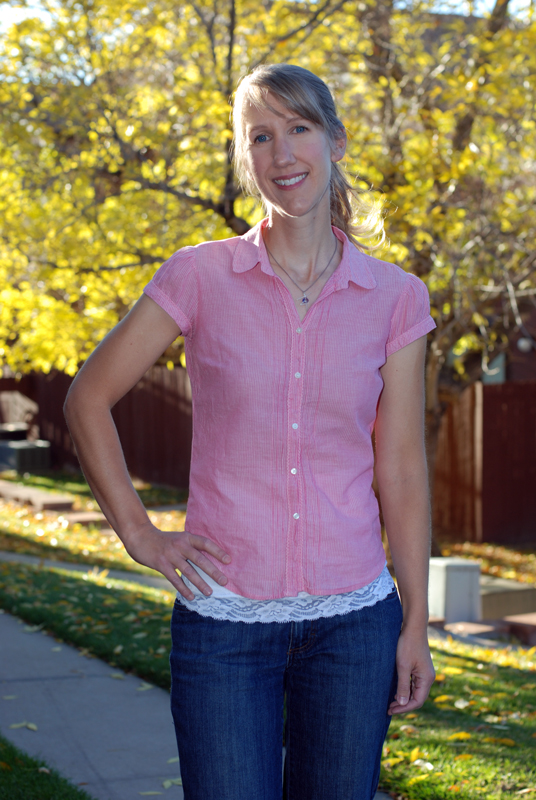
My Hip-Ts are made out of a thick spandex cotton fabric. It is soft and looks just like a layering t-shirt or tank under my shirt but without the added bulk or warmth of a whole second layer. The product comes in basic colors, prints or an option with lace on the bottom. The one with lace looks pretty with some of my dressier shirts.

The My Hip-t comes in a version with lace on the bottom edge.
The My Hip-T comes in a version with lace on the bottom edge.

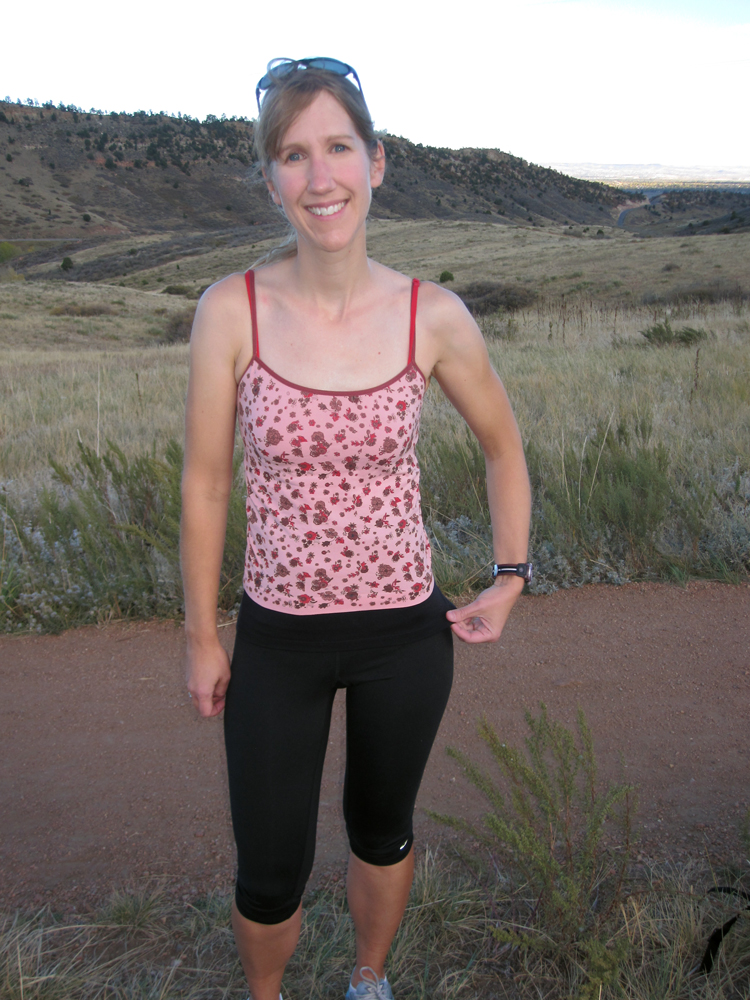
As soon as I discovered how handy My Hip-Ts were for everyday wear, I decided to give them a try for active outdoor sports. I wore one over my running tights on a trail run and was pleased with it. It held my hernia prevention belt in place well and kept my pouch from flopping around. It concealed my pouch well with my running tights and tank.

I always wear a Nu-Hope hernia prevention belt when I run.
The My Hip-t held my hernia prevention belt in place well and helped conceal it-- even in form-fitting running clothing.
The My Hip-t held my hernia prevention belt in place well and helped conceal it — even in form-fitting running clothing.

Overall, I am impressed by this piece of clothing. At $19.95 each, the price of the My Hip-T may seem a little high at first glance, but the quality is great and mine have held up well through multiple washes. It is also made in the USA. The product can be purchased in a two-pack which reduces the cost per item. My Hip-Ts can be found at: www.shophip-t.com.

Thanks to the My Hip-T, I won’t have to part with some of my favorite t-shirts and blouses that had hemlines that didn’t work well with my ostomy.  However, that doesn’t mean a trip to Goodwill still isn’t in order. Hmmm–maybe it is time to get rid of that dress that I sewed to wear at my friend’s wedding back in the late 1990s!

Prayers for a friend

I had been planning all week to write a post today about a great product I tried out, but my mind isn’t in it. Yesterday, I found out some devastating news. One of our friends, who happens to be my age, is battling brain cancer.  In a matter of 24 hours, he went from thinking he just wasn’t feeling well to being rushed off to emergency surgery and getting the shocking diagnosis.

After finding this out, Doug and I drove to a quiet place to talk and reflect on it all. We cried for the unimaginable fear and uncertainty my friend and his wife and young daughter are facing right now. We reflected on how strong our friends are and how much we love and care about them. Doug and I talked about our own love and life together, knowing full well that what is happening to our friends can happen to anyone. There are simply no guarantees. I spent last night in a strange swirl of vivid dreams featuring my friend and his family, doctors, and my own family. I woke up knowing that my mind is going to be struggling with all of this for a long, long time. I am sad, angry at the unfairness of life and hopeful that my friend will recover.

It is strange how life seems to “package” experiences sometimes. I have been thinking so much about uncertainty lately due to my own health issues (which now seem like a minor inconvenience compared to what my friend is going through).  I have been thinking about how necessary it is to live in the moment and take things day by day. Last week, my employer brought in an amazing speaker at one of our annual staff meetings. He talked about leading an authentic life and the things that make us happy.  I had been reflecting a lot on the message of that talk since hearing it—trying to figure out how his words fit into my own experiences and what they meant to me. It just became more clear. One of his key points was how important relationships and people are in our lives. More and more I am coming to the realization, that for me at least, life isn’t about getting off to exotic locales, or climbing this peak, or hiking that trail. Sure those things are fun, but when it comes down to it, the things that give me the most joy in life are spending time with those I love and helping other people in the ways I am able.  I feel that I am in the beginning stages of shifting my life to better reflect these priorities.

So give those you love a big hug today. Call that friend. Write that letter. Help out another person. And if you are willing, please say a prayer for my friend and his family.

A new year!

Happy New Year everyone!

Ouch! It has been an achy start to the New Year for me. No, not because of avascular necrosis (AVN), but because I went sledding yesterday. Doug and I are up in Wyoming visiting his brother and family for the New Year holiday. Even though there is not much snow, we took our sleds out to the local hill and tried to make the best of it. On my second trip down the hill, I spun out of control and hit a rock with my shoulder and twisted my back. Fortunately it wasn’t my bad shoulder. After taking a little break, we all found a better hill and spent the afternoon building jumps and zooming down the slope. I am sure I could have found a more gentle activity, but I hadn’t been sledding in years and it was so fun. And the doctor did say I shouldn’t sit on the couch waiting for things to get worse, right? I hardly thought about AVN all day and that was a blessing.

In between fun activities up in Wyoming, I had some time to look back and reflect on 2012. Other than the bad news at the end of the year, 2012 was simply amazing. It was the first year I really got into the swing of things with my ostomy. Having one now feel so routine that I barely even think about it most of the time. I also thought about the goals I had set for this past year. I was successful in reaching some of them and was unable to attain others. Here is a summary of those goals:

  • I want to do a better job of keeping in touch with my friends and family.
    I worked hard on this one, but there is always room for improvement. Having a more introverted personality, I am not much of a phone-talker. In keeping with my love of writing, I usually prefer to email and write long letters to those closest to me, but when I do call my family and friends, I always feel so uplifted. I need to add more phone calls into 2013.
  • I want to continue sharing my thoughts on this site.
    When I started this blog in the spring of 2011, I had no idea how large a part of my life it would become. The comments and emails I get from everyone mean so much to me. You are all so inspirational! I also could not foresee how important this blog is to my own emotional health. Writing here helps me process the events in my journey with IBD, my ostomy and now AVN.
  • I want to get back into working on art.
    This is an area where I fell short. I LOVE doing art,  yet there was seldom time this year to squeeze it in between work, my outdoor and fitness endeavors and blogging. On the bright side, I did write and sketch in my nature journal quite a bit this year. Seeing that this is my favorite activity of all my art-related pastimes, I am super psyched that I was at least able to do this.
  • I want to go on a climbing road trip.
    Doug and I did go on a two-week-long rock climbing trip, and it was the highlight of my year. I have trouble finding the words to describe how amazing it was to be out on the rock again with Doug day after day. Memories of that trip are going to fuel me through any hard times that lie ahead with AVN.
  • I want to run in the Crohn’s and Colitis Foundation of America’s Team Challenge Half Marathon next December.
    When I developed hip pain in the spring, I took this goal off my list. I didn’t feel that my body was up for it. Though this was very disappointing, I was happy to follow the Team Challenge adventures of several of my fellow bloggers. To all of those who participated this year: Good job! I loved reading about your Team Challenge successes.

So what is on the goal list for this year?

I have only one: to try to live in the moment as much as possible each day. I know goals are supposed to be more specific than this, but being in the moment is one of my biggest challenges. I am a person who has always planned for the future and worked hard to achieve the things I longed for in life. It seemed reasonable that if I did a and b it would at least somewhat lead to c. Barring a few surmountable obstacles, life felt like it was in my control. Lately, things feel a little different. With a chronic health condition, there are so many more variables involved. It can really make it hard to visualize the future.

In light of this, I decided that the perfect goal for the upcoming year is to focus on the present. There are so many beautiful moments in each and every day. In fact, this trip to Wyoming has been full of them:

  • Sitting down yesterday afternoon to write stories with Doug and his brother and then hearing my niece read them out loud, carefully sounding out each new word.
  • Taking a nap and having a contentedly purring cat curled up next to my chest.
  • Flying over sledding jumps and giggling like a little kid.
  • Dancing with my niece in the kitchen to Katy Perry tunes.

So here is to a great 2013! I may not know what the year will bring but I do know that by focusing on the present, I won’t let any of the joy it holds slip by unnoticed.

Catching air on the sled hill.
Catching air on the sledding hill.

Dealing with the anxiety of a new condition

Happy holidays everyone! I hope that you are having a joyous season and are looking forward to the New Year.

After a rough week, some holiday fun is exactly what I needed. I had several days off from work, and got out to do some active things to get my mind off my recent avascular necrosis (AVN) diagnosis. On Saturday, I did a Rainier training hike up Bear Peak in Boulder, CO, with Doug and his Dad. The hike gained over 2,000 feet of elevation in roughly 3 miles and provided a great workout. I found that my pack did not bug my shoulder as long as I tightened the hip belt enough so that the weight was carried mostly on my hips (thank goodness for a great stoma placement that sits below my pack’s waist-belt).  I usually use two hiking poles, but skipped using the left-hand one so that shoulder wouldn’t have to work too hard.

Hiking with one poll while resting my left shoulder.
Hiking with one pole while resting my left shoulder.
Goofing around and testing out my shoulders on the summit of Bear Peak.
Goofing around and testing out my shoulders on the summit of Bear Peak (8,461 feet).

The next day I went to the gym for some Zumba (minus most of the arm motions) and then did a leg workout on the weight machines. On Christmas Eve Doug and I spent a little time up in Boulder where we enjoyed lunch at an Italian restaurant. When we got home, I baked gluten-free cookies in various fun shapes including trout, dinosaurs, and Christmas trees. Next day, on Christmas, we met Doug’s parents at Loveland Ski Area, and I also called my parents in Washington to wish them happy holidays from the lodge. It was a bluebird day on the slopes, and the fresh overnight snowfall made for some awesome boarding. I was concerned that pushing myself up into a standing position on my board after falling or sitting would hurt my shoulder, but it felt okay. My body is a little sore today, but that is to be expected as it was my first day of snowboarding this season.

Enjoying Christmas at the lodge with hot cocoa and cookies.
Celebrating Christmas at the lodge with hot cocoa and one of my homemade cookies.
The sun sets as Doug and I get some final runs in.
Enjoying the mountain light after a long day on the slopes.

When I was recovering from ostomy surgery and was dealing with grief and anxiety, I found that keeping busy and getting out to do things with my family and friends helped me feel better. I am finding the same thing is true as I deal with the uncertainty of a new condition.

That said, I have also found that the anxiety levels that have come with my diagnosis of avascular necrosis have felt 100 times worse than what I experienced with ulcerative colitits and my ostomy. I think this is due to several things. First, other than anti-inflammatory meds for pain and physical therapy to help maintain range of motion, there aren’t really any treatments to pursue at this time to halt the progress of my specific case of AVN. From my previous life experiences, when I had an injury or illness, there were always steps to be taken to try to heal the condition and help things improve. It feels very new and foreign to me to have a condition that likely won’t heal and is degenerative.

The stats also aren’t as promising with AVN as they were with my ostomy. Before my ileostomy surgery, I had heard that over 90% of people who had the operation for UC were happy with the results. (I certainly am!) Though there hasn’t been much research on steroid-induced shoulder AVN, I did find a few prognosis statistics in online medical textbooks and journals:

  • 55% of those with humeral-head AVN from steroids get it in both shoulders
  • 76% of those with shoulder AVN also get it in the hips (and 2/3 of that 76% get it bilaterally)
  • 90% of those with AVN in the shoulder due to steroids eventually have it show up in another joint

Third, I am having trouble finding hopeful tales out there of people who have had steroid-induced AVN and went on to lead athletic lives. If you have had AVN related to prednisone and went on to climb, snowboard, backpack, etc., or know someone who has, please email me! When I was getting ready for my ostomy surgery, though there were horror stories out there, I was able to find at least some websites related to the athletic things people were still able to do without their colons. I am trying to find such inspiration for AVN.

Recently, I realized that I needed to get some help to deal with my heightened level of anxiety that came with the recent diagnosis. I couldn’t concentrate on anything, and I was a tearful, scared mess. After my fourth sleepless night in a row, I tried to lift a glass and found I was shaking so badly from anxiety that the water was practically sloshing out over the sides. I sat the glass down, and immediately emailed my primary care doctor. I must have reached her at a good time, because within two minutes my phone rang. We talked for about 20 minutes about the current turn of events and the anxiety. She made me feel so much better and told me that I had dealt with UC and my ostomy so well, but that this was likely just one thing too many for my mind to deal with. After our conversation, I decided to give some medication a try. She also recommended combining the drugs with counseling and meditation, so I have an appointment with a counselor in January and am taking a refresher course for mindfulness meditation in a couple of weeks.

I have always been very thankful that anti-depressant and anxiety medications are available. I know many people who have been helped with these drugs. However, this was my first experience taking them and, just like with my ostomy surgery, I found myself wrestling with stigmas. In my circles especially, where my friends and I are into holistic treatments and solving things through diet and exercise, I really had to fight to not judge myself for needing to take this medication and for being unable to solve my problems in a more natural way. But I also knew I was miserable and that the path to wellness isn’t always so simple. It is important to use all tools available. I am hoping that counseling, medication, meditation, exercise, physical therapy and the support of my family and friends will form the perfect combination to get me through this.

With that said, I promise that I will get back to writing about more things ostomy soon. Before finding out about the AVN, I was working on a post about some great ostomy wraps. Stay tuned for that and my continued Rainier-training adventures.

Searching for the hopeful Heidi

It  has been a hard couple of days. I wish I could find my usually positive and hopeful self right now, but the only emotion I seem to be capable of summoning up is dread. I spent several hours last night curled up crying on the couch and probably shed enough tears to fill about three ostomy pouches (yes I was rehydrating). I tried to think on the bright side and I kept telling myself that things could be worse, but I simply could not turn off the waterworks.

One of the things I am trying to deal with are the why me thoughts. I had tried so hard to make good decisions in the course of my ulcerative colitis illness. One of the reasons I wanted my ostomy so much, and made my decision to get one rather quickly once my disease turned severe, is that I wanted to avoid  possible side effects of the serious drugs. A lifetime of weak bones or joint pain sounded horrible to me and yet here I am; facing the exact thing I had tried so desperately to avoid. It almost makes me wish I could have had my colon removed the first day I heard the word ulcerative colitis.

I also can’t help blaming myself. There was a point about five months before my disease turned severe when I discussed progressing to the next tier of medications with my GI medical team. I was only experiencing mild UC symptoms at the time, but constant small-scale blood loss from my intestines had made my iron reserves low and we were having trouble managing them at the correct levels. I had been taking mesalamine and doing Rowasa enemas and they had been controlling most of my issues well. However, they were not stopping the constant intestinal bleeding.  I was told about Imuran as one possibility and had bloodwork done that confirmed I could take it. I  was also told about a probiotic called VSL#3. My choice was to try the VSL #3 and avoid the immunosuppressant at that time.

A short time after starting the VSL #3, I went into the most beautiful remission imaginable and had no UC symptoms whatsoever.  It felt like a miracle. Unfortunately, the vacation from UC was a short one.  Soon I was hit with my most severe flare ever. I was going to the bathroom 20-28 times a day and could not stay hydrated or maintain my weight.  I was in rough shape and was admitted to the hospital and put on a high dose of IV steroids to try to get the flare under control.

Now I can’t help wondering if I had chosen the Imuran five months earlier: Would I have avoided those emergency high-dose steroids and the AVN mess that I now find myself in?  I know these thoughts probably aren’t productive. In a way though, it feels like my brain has to chew through these questions to find peace and realize that, yes, I made the best decisions I could at the time.

Above all else though, my biggest issue and the one that had me sobbing at 2 a.m. is fear. I am absolutely terrified of what might be ahead.  I was frightened by my UC diagnosis and was anxious about my ostomy surgery, but the AVN diagnosis takes things to a new extreme. I know I only have it confirmed in one shoulder now, but I am actually having a hard time finding stories of steroid-induced AVN where it only affected one joint. I am trying to stay optimistic, but the uncertainties are daunting.

When I saw a counselor to help me cope with anxiety after my ostomy surgery, she gave me some mind exercises to try. One of these was to picture myself sitting in my favorite place outdoors with clouds floating through the blue sky above. She said whenever I had a worry, I should visualize taking it and sitting it on one of the clouds. It was important to acknowledge the fears, but it was also necessary to let them go and not be weighed down—the clouds could hold the weight.

So I thought it might be good to list some of my fears and “put them on the clouds.” Some are small worries, some are larger, but all of them are weighing me down. They are listed in no particular order.

  • I am afraid my joints are going to die one by one and that I am going to experience endless pain and surgeries.
  • I am afraid that if the disease progresses, I will never be able to backpack, climb or snowboard again.
  • I am afraid this might worsen and that I won’t get to attempt Rainier this summer.
  • I am afraid that Doug is going to miss out on so many things if my AVN got really bad.
  • I am afraid that someday I won’t be able to work at the park naturalist job that I absolutely love.
  • I am afraid it would be hard to empty my ostomy appliance while healing from shoulder replacement surgery.
  • I am afraid I will cease to have inspiration for one of my huge passions in life—my Ostomy Outdoors site—because I will no longer be able to go on adventures. Ditto for my Ostomy Outdoors column in the Phoenix magazine.
  • If I couldn’t work, I am afraid I won’t be able to afford health insurance.
  • Without health insurance, I am afraid I wouldn’t be able to get any necessary surgeries.
  • Without the necessary surgeries, I am afraid I would be doomed to a life of pain.

Just a few tiny concerns, huh? I know that I will work through these fears in due time and that the Heidi that is so full of hope is close by. In fact, I am pretty sure I know where to find her. As soon as my schedule clears, I plan to head up to the mountains and search for my more happy and positive self. I am certain that that part of me is up there, skipping along the trails or zooming down the snow slopes and that soon we will reconnect.

A fear becomes reality

The appointment yesterday started like so many others: weigh-in, check oxygen levels and blood pressure, and review my symptoms with the nurse. Then the orthopedist came in. We talked a bit about my recent shoulder pain and everything seemed as I would expect for an orthopedics appointment. Over the years, I have had a fair number of doctor appointments related to sports injuries. My recent MRI of the shoulder had shown tendinosis with some bone-marrow swelling in the head of my humerus. I really thought this was all due to overuse and that the doctor and I would soon start talking about all the exercises I needed to do to get the joint strong again and to reduce the swelling.

However, I soon realized that the conversation was taking a strange turn; the doctor wasn’t asking me any questions about the sports I had been doing. Instead, he was asking me about past medications. A sickening wave of intuition swept over me and made my stomach knot up and hands tremble. As I described my history of ulcerative colitis and prednisone use, I knew the words that were going to come out of his mouth as he turned to the screen and began to flip through the layered images from my MRI. He stopped and pointed to a specific spot on one of the pictures and broke the news. I have avascular necrosis — the bone in my humeral head is dying. Avascular necrosis was the one possibility that had frightened me so much about my hip pain last spring. That joint ended up being healthy on the MRI. This time, I was not so lucky.

As the appointment progressed I learned some things about the disease. Though doctors don’t understand exactly why, prolonged corticosteroid use can stop the blood flow to certain bones. Without an adequate blood supply, the bone tissue dies. I never felt that I was on prednisone for a huge amount of time — a total of 180 days scattered throughout the four years I was officially diagnosed with ulcerative colitis. Some of that time was comprised of month-long tapered dosages of 40 mg or less. However, I was on a dosage as high as 80 mg for a few days when I was hospitalized with UC during my final flare. The problem is, even if you are only taking a high dose of prednisone for a short period of time, it takes a long time to taper off the stuff which means it is going to be in your system for a while. Even after I had decided I was done with UC drugs and wanted to pursue surgery, it took me over three months to get down to zero mg of prednisone. By that time, the damage had already been done.

The progression of avascular necrosis can’t be predicted, so I don’t know if the joint will get worse, and if so, how long it will take. I am starting to have a similar pain in the right shoulder, and the orthopedist said it could also show up in that joint. Oftentimes avascular necrosis will occur bilaterally — for instance, in both shoulders or in both hips. In the future, other joints could be affected too, but there is no way to predict if that will happen.

My case was caught early, so at this point the main treatment is to take anti-inflammatory medication to help reduce the swelling and manage the pain. Not putting a large amount of stress on the joint is important too. Other than that, I just wait and see what happens. Right now, the area affected is not big enough to justify surgery. The orthopedist described some of the surgical options if it does get worse. He was honest with me and said that he has not seen many cases of avascular necrosis in shoulders and he has treated many more cases of it in the hips. He was going to do some research and talk with colleagues about my case. Leave it to my body to take the rare road once again. (My colorectal surgeon always said that I got extra points for creativity because my body often did the unexpected. The trend continues.)

This brings me to one of the bright sides in all of this. This orthopedist was new to me, and I really liked working with him. Not only do I appreciate honesty and the willingness of a doctor to sometimes say I don’t know, but this individual was very personable which I value highly. Somehow, chatting with the doctor about great gluten-free pizza options in the neighborhood or hearing stories about the ranger programs he went on with his family while visiting national parks this summer made me feel better in the midst of the bad-news diagnosis. When I asked the doctor if rock climbing was out of the question, he told me I could still go, but that I should choose routes that relied more on the legs and were less intense on the arms. He said climbing could cause pain in the shoulder, but that not doing it would cause pain here (and he pointed to his head and heart). I thought wow, this doctor gets it. I also asked him about Rainier, and he said I should still go for it as it was a lifetime opportunity. One of his colleagues had climbed the peak last year so he knew what it involved. He said with a smile that I better get training. Oh yeah, and he gave me a list of herbal supplements to try instead of ibuprofen if I wanted to go a more natural route to control the inflammation and pain. The doctor also said numerous times that he was sorry I had to go through all this. A simple phrase, but one that showed compassion.

If all of that wasn’t enough to earn my initial respect, the orthopedist knew a good deal about Crohn’s disease and ulcerative colitis. At one point, I asked him if my hip pain last spring, which showed no cause on an MRI and has mostly resolved with physical therapy, could be an early sign of avascular necrosis in that joint. He said he couldn’t say for sure, but that I shouldn’t worry about it unless the pain gets worse. He pointed out that joint pain can happen with IBD, even after the colon is removed, and the hip issue could be from that.

Still, I left the appointment in a state of shock, and the news took a little while to sink in. I stopped at the health food store and got the supplements my doctor recommended and then went on to Costco for a few items. I made my way through the aisles and dropped the giant-sized packages of Parmesan cheese, soup and toilet paper into my cart. I listened to the employees cheerfully describing the food samples they were handing out, but I could barely understand the words. I wasn’t present — my mind was in the clouds, a mile above the warehouse, trying to comprehend this latest diagnosis, and I felt dizzy and nauseated. I paid for my items, loaded them into my car and collapsed in the front seat and cried.

In many ways, this news is harder for me to accept than getting an ostomy. I knew living with an ileostomy wouldn’t be easy, but I was always confident that I could do everything I loved once I healed up and made it through the initial learning curve. I also knew that an ostomy would likely be my cure for a life without the pain of ulcerative colitis. Knowing that I have avascular necrosis feels different. There really is no end, as there is a chance the disease will progress and that the pain will worsen. And if it does, it will have a big effect on the things I love to do. For the first time in my life, I am having trouble picturing what my future will be. Of course, as with ostomy surgery, there are tales of hope out there. Brett Favre had avascular necrosis and was an amazing athlete.

After my meltdown in the parking lot, I headed home to meet Doug. Though I felt a strong urge to spend the afternoon crying my eyes out in bed, we had already made plans to check out an exhibit on Pompeii at the Denver Museum of Nature and Science. Viewing the exhibit was a moving experience, and seeing the casts of the people that died fleeing from the unexpected eruption of Mt. Vesuvius provided a somber reminder that none of us really know what the next minute will bring. I left the exhibit knowing that it was important to take things day by day and hope for the best.

Heading out to Zumba with my sad shoulder.

And a big part of that is doing what I love. When we returned home from the museum, I got dressed for Zumba and went to the gym to dance with all I had. Then I did something else that fills me with joy: writing on this blog. With each word I typed, I felt better, stronger and less alone. I don’t know what avascular necrosis will mean for my ostomy outdoors adventures, but I do know that you will all be alongside me on the journey.

Lessons from a winter hiking trip

Sometimes after a busy summer season of packing and unpacking for an outdoor trip practically every weekend, I need a break. October and November were quiet months. I did some trail running, but didn’t go on any major adventures. The rest from the hectic pace felt wonderful and much needed.

Another reason I have been taking it easy is that I developed some unusual pain in my left shoulder in mid-October. My shoulder did great on my two-week climbing trip, but a couple of weeks after returning, the joint started to throb and hurt constantly. Ever since I was a teen, I have had off-and-on trouble with tendonitis in that joint and had even been working with my physical therapist over the summer to get my shoulder stronger and resolve these issues. Things had been going splendidly with the therapy, and before my climbing trip, my physical therapist thought I might even be close to not needing another appointment.

Unfortunately, that is not how things worked out. The new shoulder pain is different than what I had come to expect with my occasional bouts of tendonitis. Because of this, both my PT and doctor thought it would be a good idea to get an MRI. The test results showed tendinosis (a chronic form of  tendonitis) and also bone-marrow swelling in the head of my humerus. What this means exactly I do not know. My primary care doctor has referred me to orthopedist, but my appointment isn’t for another week. Of course, my mind once again wants to run to all the scary what-ifs of the situation. What if the marrow swelling isn’t from the tendinosis and is instead  being caused by… (fill in the blank with numerous frightening conditions here). What if I can never rock climb again? Ahhhhhh……

However, if there is one thing UC and having an ileostomy has taught me, it is that dealing with uncertainty is part of life. Instead of letting myself fall into my usual pattern of worry, I am going to try to forget about my shoulder until my appointment next week and focus on the activities I can do. One of these is hiking. Even with a backpack, hiking doesn’t seem to bother my shoulder at all. And on the plus side–hiking is the most important activity I need to be doing right now to train for Rainier.

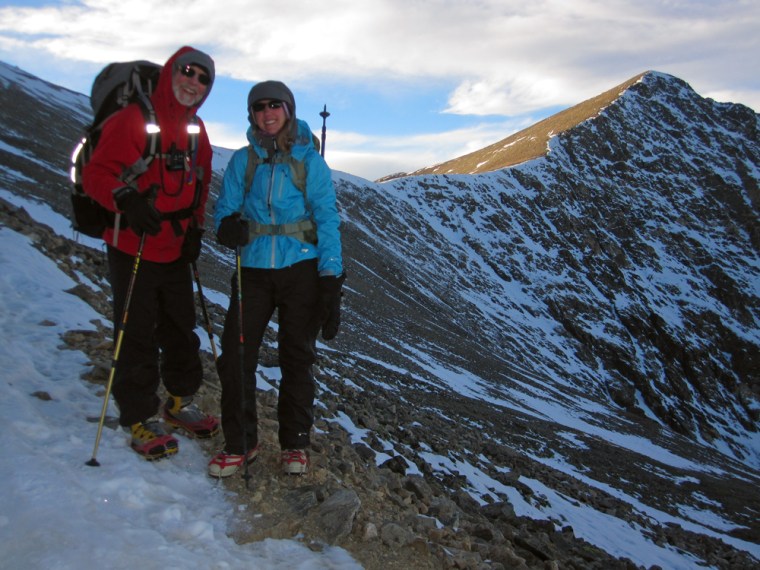
So on Sunday, I set out with Doug and his dad to hike up a peak. Our original plan was to hike James Peak (elevation 13,294′). However, just before exiting the freeway for that destination, we had an idea. Let’s do a 14er instead! The road leading to Grays Peak (elevation 14,270′) was just a few exits up the road. Colorado is experiencing a very dry winter, and with the trailhead access snow-free and avalanche danger minimal, it was the perfect chance to get to the top of this peak.

The high temperature for the elevation we were at was in the mid-30-degree range, but with 30 mph winds, it felt much colder. I had packed 28 pounds of gear, including lots of warm clothes, food and three liters of water (Doug also carried an extra liter for me). I was surprised at how great I felt hiking at such high elevations with this weight. I had been expecting it to feel much harder after not hiking any big peaks since July. We made it to the summit in late afternoon and enjoyed the gorgeous views, including those of close-by Torreys Peak, another 14er. Though we had earlier thought about trying to do both peaks, we realized that the late departure from the trailhead on this spontaneous trip would not afford us enough daylight to get in double summits.

Descending Grays Peak with Torreys Peak in the distance. So close but oh so far.
Descending Grays Peak with Torreys Peak in the distance. So close but yet so far.

My ostomy caused no issues on the hike. I had to swap out closed-end pouches (I prefer these to drainables on peak climbing days) twice during the excursion. At one point on the ascent, I realized that my pouch was getting fairly full. I was behind a ridge that offered some protection from the wind and there was also a tall cairn to duck next to. Doug and his dad were a little ways back on the trail and there was another party about 500 feet behind them. There was no one coming the other direction, so I decided to seize the opportunity to swap out my pouch right there on the side of the trail. I grabbed a small trash bag and fresh pouch out of my pack, ducked behind the cairn, pulled the waistband of my softshell pants down and quickly swapped out pouches. By the time Doug and his dad caught up, I had the used pouch and my other supplies packed up and was ready to keep hiking. I know that on Rainier, I am not going to have much privacy when roped up with teammates on a glacier. It is reassuring to know that I can swap out pouches so quickly and discreetly.

Ducking behind this cairn to swap out my closed-end pouch right along the trail was easy and discreet.
When no one was close by, I ducked behind this cairn to swap out my closed-end pouch right along the trail on the ascent. I also swapped out a pouch on the decent. For that one, I just walked off the trail about 50 feet and turned my back so that no one could see what I was doing. I continue to discover that using closed-end pouches on these types of hikes is a very easy and discreet way of managing an ostomy.

The big challenge for me on this particular hike was the cold and wind. It was even more frigid than during our winter hike up Grizzly Peak last December, captured here on video.

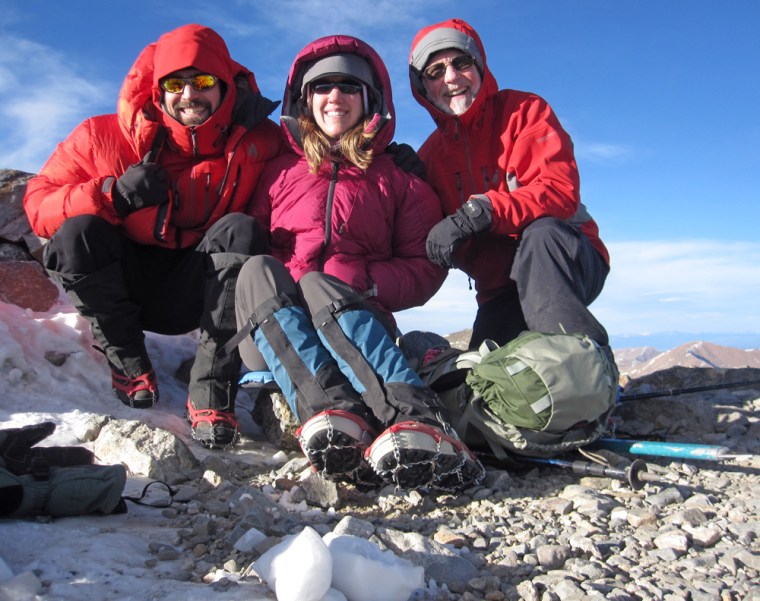
Fortunately, in preparation for Rainier, I had purchased several new clothing items. This was a perfect chance to test them out. One new addition to my outdoor clothing quiver is a super warm down jacket with a hood. I have lighter jackets, but only this one is warm enough for extremely cold conditions. As I stuffed the two pounds of down luxury into my pack before the hike, I really thought it was going to be overkill. However, as  I threw this jacket on at breaks and at the summit, I soon realized it was a lifesaver.

Despite taking part in countless winter camping and backpacking trips, ice climbs and peak ascents over the years (including several since my ostomy surgery), I have never been as cold on a trip as I was on this particular hike. I am not sure why this was the case as I was dressed well and eating and drinking plenty. Regardless, some combination of wind, cold, shade, and my body on that given day had me freezing. On the summit I was so chilled that I could hardly grip anything. I had to use my teeth to zip up my jacket. As I descended back to the car, I kept having the urge to lie down and sleep. I would pass a boulder and think wow, that looks like a comfy spot to snooze for a little while. But then I would see Doug and his dad coming up behind me and would realize I didn’t have time for a nap. I don’t know if I was hypothermic, but if not, I was close. I shudder to think about how cold I would have gotten had I decided not to bring that down jacket.

On the summit with Doug and his dad in my super warm puffy down jacket.
On the summit in my super warm puffy down jacket.

I realize that having an extra-warm clothing item like this during cold temperature activities is especially important with my ostomy. Even though it only takes a couple of minutes to stop along the trail and swap out a pouch, I do have to expose a small section of my belly to the elements. In extremely cold temperatures, it doesn’t take long to lose heat by doing this. Packing conservatively with plenty of warm clothes is of paramount importance.

I can’t wait to head out on our next training hike, and I am starting to compile a list of peaks to attempt that have good winter trailhead access and low avalanche danger. For future training hikes, I will have to progressively increase my pack weight to at least 40 pounds (the expected weight of my pack on Rainier). I guess this means I can bring an extra large lunch next time!

Happy travels! (feat. new video)

Last month, I wrote about a climbing road trip that Doug and I took to Idaho and Oregon. We finally completed a video highlighting the vacation. It is a long film at 30 minutes, but there was a lot to cover on this 17-day adventure.

Getting out and traveling with your ostomy provides some very significant confidence-building opportunities. You have to change and empty your appliance in unfamiliar surroundings and you must learn how to adapt to having an ostomy in unique situations. Unknowns abound with each bend in the road and each new town on the map. Dealing with each of these new situations stretches your comfort zone and leads to growth and tenacity. So, if you are just recovering from surgery, plan a trip if you can — even if it is just a weekend getaway.  If you have had your surgery for a while, get out on a longer excursion and try something new.