A dot marks the spot

It was a gorgeously sunny October day last year when I packed up my harness and backpack and headed out the door. No, I wasn’t going on a hike or climb. In fact, the place I was traveling to wasn’t even outside. As I arrived at my destination, I walked down the sidewalk and through the double sliding door of the building. I made my way to the check-in line by the front desk and felt somewhat self-conscious with my huge backpack sticking out of a bag slung over my shoulder. A few moments later, I entered the crowded elevator, where people gave me quizzical glances. Such gear would be expected at a trailhead, but it was not the norm here. However, today, having my pack and harness was as important as it would have been on any hike or climb. As the elevator door opened on the ninth floor, I nervously walked to the department down the hall to meet my wound, ostomy and continence (WOC) nurse for the first time. It was time to have the site of my stoma marked.

I had been told to wear my favorite pants to the meeting so that the location would match with my clothing. However, I also decided to bring my harness and backpack. With outdoor activities being a huge passion in my life, I wanted to make sure that my stoma location would work as well as possible with my gear.
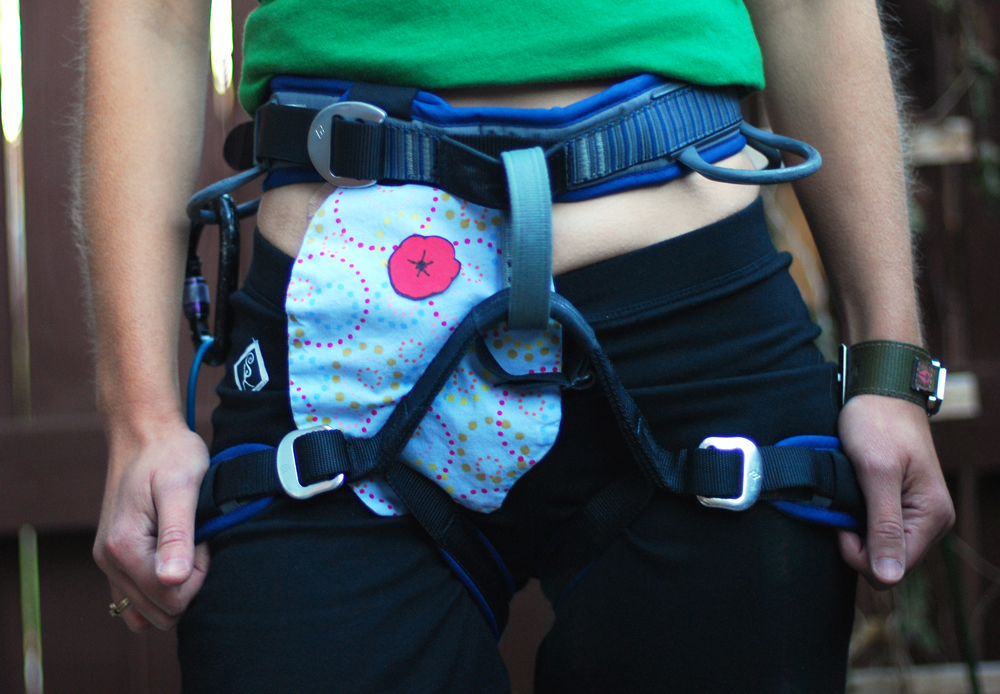
The paper cut-out shows where my stoma is. The location between the waist belt and leg loops prevents the harness from rubbing on my stoma. My belly button sits right under the waist belt.

At the meeting, the nurse shared important information about what to expect with output, eating, activities etc. Finally it was time to get the location marked. I felt a little funny explaining to her that along with making sure the spot worked with my belly and with my clothing, I also wanted to test it out with my harness and pack. Fortunately, she didn’t make me feel silly about my request at all, and soon I had a big blue dot on my abdomen about two inches to the right of my belly button and two inches below. This was a good location because it was below my belt line. This meant that gear or clothing waistbands would not rest on my stoma or prevent output from reaching the bottom of my pouch.

When I got home, I stood in front of the mirror and looked at the mark. I tried to picture what it would look like with a stoma there instead. Suddenly, my decision to have the surgery seemed very real, and I felt excited and nervous at the same time. To further discover how my new stoma spot worked with my clothing and gear, I filled up the ostomy appliance my nurse had given me with applesauce and taped it on top of the blue dot on my belly. I then went out to the garage to dig out every backpack I owned. The one I had taken to my nurse visit was my favorite overnight one, but there was also the brand new day pack I had just bought before I got sick again. I had only used it once. And then there was the large load-monster of a pack that I took on very long trips. Would that one work with the ostomy? One by one, I tried on the packs and they all seemed to rest well above my stoma. I was encouraged.

Continue reading “A dot marks the spot”

What’s in a name? That which we call Wilbur!

A pumpkin portrait of Wilbur.

When I first heard about my friend Charis’s IBD/Ostomy themed pumpkin decorating contest on her great new Facebook site (http://www.facebook.com/FullFrontalOstomy), I knew I had to enter. However, I had no idea what to do for a design. I went to the store and bought a pumpkin and sat it on my table… waiting for something to come to me.

And it did. While changing my appliance at 6 a.m. my stoma started to act up and spew output. I used to get frantic when this happened, but now I am accustomed to it and just chill out for a while, paper towels in hand and let my stoma do its thing. However, the event did spark the inspiration for my pumpkin. I suddenly knew that the round vegetable on the table would provide the perfect canvas for a portrait of my mischievous stoma! That afternoon, I painted my creation.

Continue reading “What’s in a name? That which we call Wilbur!”

Permanent ileostomy or j-pouch: that was the question

One of the questions I get most often from readers of my blog is why I chose to have a permanent ileostomy instead of trying j-pouch surgery. Though I have mentioned a few of the reasons in other posts, I decided to address this topic in a little more detail. The point of this post isn’t to tell you that one surgery type is better than the other. They are both very good options. My goal in this writing is to share the thought process I went through to make my choice.

In the course of my illness, all my symptoms, colonoscopies, and genetic testing pointed to Ulcerative Colitis and not Crohn’s. This made me made me a candidate for either surgery type. At age 38 during the time of my surgery, why would I choose to live with a “bag” for the rest of my life?

It wasn’t a decision I took lightly, and I gathered all the information I could. This began when I was still in the hospital, facing the possibility of emergency surgery. The very kind and helpful general surgeon who would have done my surgery had I continued to decline, visited my room almost every day to check in and patiently answer my seemingly endless questions. He introduced me to the words “ileostomy” and “j-pouch” and gave me a great foundation of information to build on.

Continue reading “Permanent ileostomy or j-pouch: that was the question”

Back to climbing

“The scariest thing for me through this whole ordeal has been the rapid weight loss over the past two weeks. My muscles are gone and when I squat down to the floor to pick something up, I can barely get back up. I feel like I am doing the hardest move on a rock climb just to do some simple movement. I try to do a couple walking laps in the hall everyday to stay strong and keep my legs moving. I just want to be healthy and well again.”

Around this time last fall, I emailed the above update to a couple of good friends while I was in the hospital with my UC flare. I was so weak that it was difficult to do even the most basic things, like stand in the shower or walk up the stairs. I seriously wondered if I would ever be strong enough to rock climb again.

Last night, thanks to the health I regained through surgery, I made my first trip to the rock climbing gym in over a year. At first it felt foreign to put my harness on and tie my figure-8 knot, but once I placed my hands and feet on the holds and began ascending the wall, the movement felt natural to me.

On my first route in over a year

Continue reading “Back to climbing”

From keeping track of BMs to logging the running miles

Snow is soon to fly in the mountains, and my peak ascending opportunities are going to be more limited for a while. I have turned my attention to getting back into running, something I have been neglecting while preparing for and carrying out all of our backpacking and summit trips this summer.

I have decided I want to begin training for the 2012 Crohn’s & Colitis Foundation’s Team Challenge half marathon. I know I won’t be ready by this December, so I plan to work up my strength and endurance and then join the organization’s formal training group next fall. I am super excited. I did several 5K and 10K runs, including one trail running race in my pre-surgery days, but never a half marathon.

In the past, some of my worst ulcerative colitis flares happened when I was training for races. I believe running aggravated my colon. I knew where all the restrooms were on my running routes. Sometimes on routes where no bathrooms were available, I can remember speeding up on the last mile, bursting through my front door and barely making it to the bathroom on time. On trail runs, I used to bring toilet paper and supplies in my waist pack to dig an emergency hole in case I really had to go. Gone are those days! My appliance adheres really well through exercise with no leaking issues to date. As long as I empty before I head out on runs, I will be good to go for hours.

I was looking through a little spiral-bound book that I kept my journal entries and notes in during my hospital stays. I thought it was interesting that last year around this time I was keeping a log of my bowel movements in it to report to the doctors and nurses in the hospital during my final flare. Now I am starting up a running log. What a change!

A log entry in my notebook on day nine of my hospital stay in the fall of 2010.
Keeping track of my running distances and miles as I begin training again in the fall of 2011.

Dealing with Output on the Trail (feat. new video)

Many new ostomates wonder how to deal with their output on hikes, as we usually have to empty our appliances every 4-6 hours. The answer is to dig a “cathole.” This is the term commonly used by backpackers for a hole to bury feces in. Because this is a very important skill for any outdoor enthusiast with an ostomy (or IBD) to have, I created a short video to cover some of the basics.

I am guessing that I have dug around 500 catholes in the backcountry in my lifetime. As an ileostomate, I am increasing that number at a rapid rate. Gone are the pre-ulcerative colitis days of having 1 or 2 bowel movements in a day. Now I consistently empty my pouch around 6 times in 24 hours. On the trips when I don’t use closed-end pouches, that equals 48 catholes on a 7-day trip! Knowing how to properly dig a cathole to protect the environment and water sources is crucial.

Continue reading “Dealing with Output on the Trail (feat. new video)”

Mollydog’s Lesson

Mollydog was always full of crazy antics on our outdoor trips. She liked to hike with 3-foot-long logs in her mouth and knock us off the trail when she passed by. She managed to sneak up to our food stash and wolf down that one special dessert item we were saving for the last day of a trip. Molly loved to sleep between Doug and me with her four legs fully extended so that we were mushed up against the outside walls of our tiny backpacking tent. She relished going for swims, rolling in the mud and then curling up in my sleeping bag.

Muddy Molly on a backpacking trip in Wyoming’s Wind River Range.

This summer, there is an inescapable void. I no longer look over my shoulder when I am hiking to keep from getting whacked, guarding my food at dinnertime is now unnecessary, there is too much space in the tent and my sleeping bag is unusually clean.

Last year on this day, our beloved Mollydog passed away.

Molly joined our small family unit when she was 7 weeks old and took to the trails immediately. For the next 13 1/2  years, we were a party of 3 and were pretty much inseparable. Molly came along on just about every skiing, hiking, backpacking, climbing and canoeing trip we went on. She would often jump in the car as we were packing up, fearing that we might leave her behind. She need not have worried– adventures were always ten times more fun with her along. There were only rare instances when Molly didn’t join us– usually when we were doing long multi-pitch climbs or traveling to an area where dogs weren’t allowed like national parks.

A young Molly heading to the river for a swim.
Backpacking in Wyoming’s Wind River Range.

Continue reading “Mollydog’s Lesson”

A Case of 14er Fever Requires a Lot of Water (feat. new video)

On a three-day backpacking trip this past weekend, my husband and I finished our fifth and sixth 14ers  (a peak above 14,000 feet) since the beginning of July. Most summers before this, I was lucky if I did one or two. I have definitely caught the 14er fever. Hiking these peaks has provided me with the perfect opportunity to get outdoors and challenge myself physically while still babying my abdominal muscles. Indoors, I do a battery of  physical therapy exercises that safely strengthen my core. In concert, these two activities will prepare me for the more rigorous demands of technical rock climbing in the future.

While hiking these peaks, I have been amazed at how quickly I am progressing and getting my strength back. While I walked the first one at a turtle’s pace, I am now hiking the peaks briskly and with little fatigue. All these successful peak hikes have also made me realize how well I have adapted to my ileostomy. Managing my appliance on the trail using both closed-end and drainable pouches has become second-nature. Moreover, changing my wafer outdoors, which is one of the things I was most fearful of, has proved to be very similar to doing it indoors except that I must pack out the trash (and the views while changing are more spectacular).

However, one aspect of my ileostomy that still baffles me is figuring out how much water to drink. One function of the colon is to absorb water. When it is removed, the small intestine is able to adapt and take on some of this role, but not as well. Because of this, ileostomates must drink more water to avoid dehydration. It has not been unusual for me to drink 8+ quarts of water on some of my all-day hikes. Up to this trip, I have not had any issues with dehydration. However, conditions were different on this excursion. The temperatures while making the strenuous uphill hike to camp were in the 80s which is warm for the elevation we were at. Despite drinking almost 3 quarts of water (some of which included a sport drink mix) and eating plenty of snacks along the way, I got to camp with a headache and bad nausea. Before we proceeded to empty our backpacks and set up our tent, I sat in the shade and drank some more fluids. In about an hour, I felt better. I upped my water intake over the next two days and did not run into the problem again.

Continue reading “A Case of 14er Fever Requires a Lot of Water (feat. new video)”

Crossing the expanse (feat. new video)

“How about going ziplining,” our friend suggested.  My first thought was, Absolutely! That sounds fun, I have always wanted to try it. My second thought was, Wait, what about my ostomy? How will my pouching system hold up to zipping through the air in a harness attached to a cable? Not to mention that there won’t be any restrooms for three hours. What if my pouch explodes or leaks? Maybe I should hold off.  

Some fears keep you alive– like being afraid to climb higher on a route because it is above your ability, or being terrified of a river crossing because you know it might sweep you off of your feet and send you into the rapids. But there are also those fears that don’t have such dire consequences. The ones that pop into our heads and stop us from doing things that would actually be rewarding and good for us.

I recognized that the fears that were trying to stop me from going ziplining were of the latter variety and purged them from my head. I knew I could go 4-5 hours before draining my pouch– even longer if I pushed it a bit and let my appliance fill up a tad more. I knew the harness would likely cause no problems and that I was strong enough for the adventure. There was no reason not to give it a try.

We signed up for a 5-stage tour through the tree tops at the Crested Butte ski resort. One of the rules was that you couldn’t carry anything in your hands, so I guzzled a bunch of water to avoid getting dehydrated. Then we met with our guides and harnessed up. Much to my delight, the bulky, adjustable one-size-fits all harnesses still worked fine with my  pouch. The upper part of the hip belt sat well above my stoma, and the harness barely touched my appliance.

Continue reading “Crossing the expanse (feat. new video)”

Celebrating Ostomy Awareness Day on Longs Peak

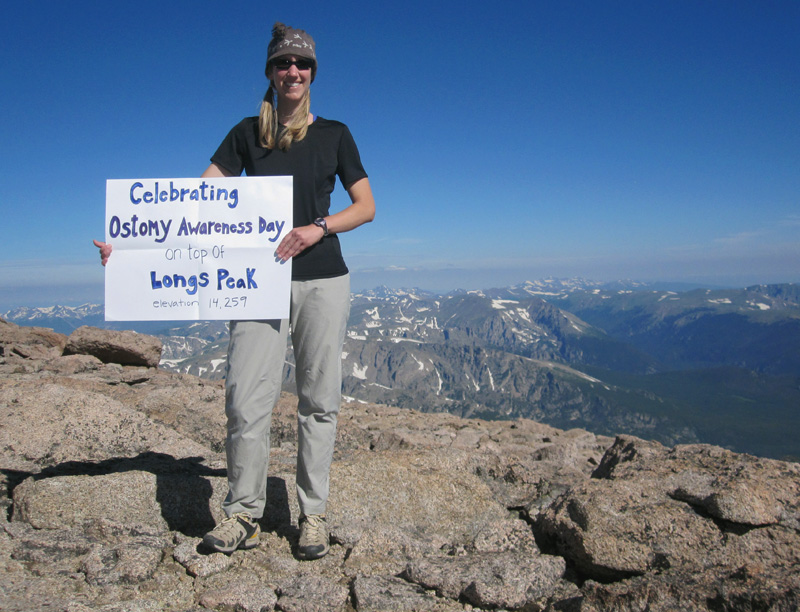
Today Doug, his dad, and I summited the 14,259-foot-tall Longs Peak in Rocky Mountain National Park via the classic Keyhole Route. This was an important ascent for me. I had climbed Longs Peak once before in 2007 and had loved the route. When I was hospitalized for 16 days with my final severe UC flare last fall, I would often walk down to a common area that had huge picture windows facing west and gaze at Longs Peak in the distance. I thought back to the day I stood on its summit, and wondered if I would ever be strong enough to be up there again. Today, I answered that question as I successfully hiked 15 miles with about 5000 feet of elevation gain to reach the summit. This peak was different than the others I have done this summer, as it is graded a class 3 climb. This means that the route has some sections that involve scrambling, or using one’s hands to ascend the rock, yet the terrain wasn’t technical enough to require the use of a rope. There are also areas of exposure where a person wouldn’t want to fall. It felt wonderful to move over rock, and the experience made me look forward to the days when I can climb technical routes again. I just want to heal up a bit more first.

Everything with my ostomy went well during the hike and there is not much to report. I once again used closed-end pouches to eliminate the need to take time to dig a cathole and empty my pouch. This helped ensure that we were on the summit before the afternoon lightning storms came. This ended up being an important detail on this trip, as we dealt with one of the largest lightning storms I have ever witnessed in the mountains later in the afternoon. Fortunately, we had just descended to tree-line when the storm reached its peak intensity and avoided being caught out in the open.

The day before our trip, I discovered that our summit attempt would fall on the United Ostomy Association of America’s (UOAA) second annual Ostomy Awareness Day. I was thrilled! UOAA’s call for this special day is to have “Ostomates Unite and Help Others See Ostomies in a Positive Light!” This is a message that is very dear to me and is one of the reasons I created Ostomy Outdoors.

However, I have to admit that I have not always been as open about having ulcerative colitis or an ostomy as I wish I would have been. Truth is, when I was first in the hospital with my severe ulcerative colitis flare last fall, I hardly wanted to tell anyone about it. Sure, I shared the details with my family and closest friends, but I was less open with others. My coworkers were all curious about why I had suddenly disappeared into the hospital. I sent out vague emails to them telling them I had an auto-immune stomach condition. I was too afraid they might look up ulcerative colitis and see what the symptoms were. Once my hospital stay became lengthier, I did fess up and share the name of the condition. Surprisingly, it felt really good to not have to keep everything to myself, and I found that the people in my life were very supportive.

Continue reading “Celebrating Ostomy Awareness Day on Longs Peak”