The One Pass Ostomy Draining Device: a great product for the outdoors

Usually it is the big flashy things like climbing ropes, packs or tents that become my most coveted outdoor gear. Lately however, a much simpler and unassuming piece of gear has become one of my favorites.

A couple of months ago UPTT Inc. sent me a One Pass Ostomy Draining Device (OPODD) to try on my adventures. Due to my hip injury, I had to put off testing the device outdoors until a three-day backpacking in Rocky Mountain National Park in June. This, however, did not stop me from trying it indoors. The OPODD is an instrument with two flat rollers that clamps onto your pouch when you want to empty. With one downward motion, the device pushes all pouch contents swiftly out of the tail. Though it took a few tries to get used to the OPODD, once I had the hang of it I found myself reaching for the tool again and again. It is especially useful on those days when my output is thick and difficult to push out of the pouch. One quick swipe of the device and the output is forced out — no matter what its consistency.

I liked the device so much that I was soon using it every time I emptied at home. Though I usually leave the device at home because I seldom carry a purse, the slim design of the OPODD makes it easy to fit in a handbag or tote to be carried anywhere you go.
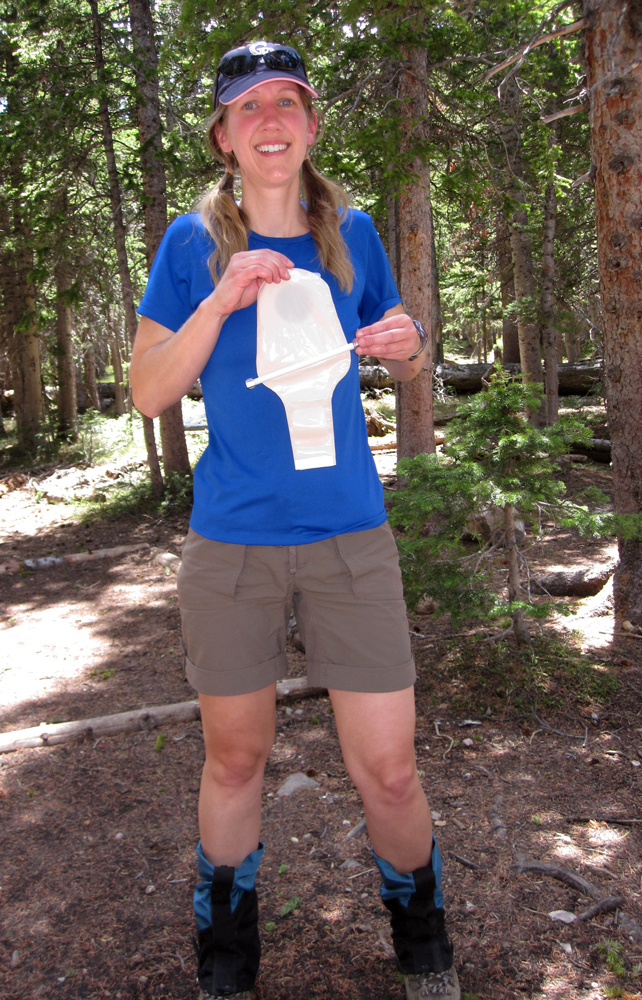
The OPODD clamps on the pouch. Emptying the contents only takes one smooth downward swipe.

After trying it out, I was convinced that the OPODD was great to use at home. Now it was time to take it into the wilderness with me. Ever mindful of my pack weight, I am very picky about what I choose to bring on backpacking trips. Something has to be highly useful to make the cut. It didn’t take long to realize how happy I was to have the OPODD along on my first backpack adventure of the season. In the middle of cooking dinner on our first night, the sky darkened and big heavy raindrops spilled from the sky. We swiftly donned our rain gear and dashed under the trees with our dinner. Despite being covered by tree branches and Gore Tex, my clothing soaked up the dampness and my teeth began to chatter from the chill. Leave it to my ostomy to decide that this was the best time to produce ample amounts of output. I had to make a trek to the camp privy in a full-on rain storm.

When I got to the backcountry restroom facilities (a pit toilet sitting out in the middle of the woods with no walls or roof), I quickly grabbed my OPODD, clamped it on my pouch, slid it down and had the contents emptied within seconds. Normally it would have been hard to manually work output to the tail-end of my pouch with such cold hands, but maneuvering the device was easy even with the chill-induced clumsiness.

Heading to the privy with my OPODD on a very chilly evening.

That night, the handiness of the OPODD proved itself again. When I do strenuous exercise such as backpacking during the day, my output often slows down or stops almost entirely. That means everything comes out later — often in the middle of the night. Getting up at 2 a.m and walking five minutes away from camp alone is unnerving.  Sitting down to empty my appliance by headlamp while surrounded by miles and miles of pitch black wilderness  spooks me out. It is one of those times when I swear twigs are being stepped on all around me, and I imagine mountain lions behind every boulder. Pulse racing and goosebumps fully engaged, I want to purge the contents of my pouch as fast as possible and get back to the tent. This particular night, I ended up having to endure this experience a couple of times. It was wonderful to be able to clamp the OPODD on my pouch, slide the contents out quickly and return to the comfort of my sleeping bag and the company of a snoring Doug.

My positive experiences that first day made the device completely worth its weight — and that is really the only issue with bringing the OPODD on outdoor trips. For those who try to backpack on the ultra-light side, the OPODD weighs in at 3.6 ounces. Not heavy by any means, but when one is trying to get their pack weight as low as possible, every ounce counts. Personally I feel that the extra weight is a small price to pay for the ease the device adds to emptying my pouch in the wilderness.

The only challenge I noticed with the OPODD was that it couldn’t slide over the Velcro at the end of my Convatec Pouches. This didn’t end up being an issue though. I would just push the output as far as the Velcro with the OPODD and then drain out the rest manually. This actually worked great because it prevents any output from getting on the device.

You can’t see my OPODD, but it is tucked in my pack as I head out on a backpacking  trip in the Mt. Massive Wilderness two weeks after the one in Rocky Mountain National Park. I plan to bring the OPODD on every wilderness excursion in the future.

As I continued to test out the OPODD, I  realized that it was going to become an indispensable piece of outdoor gear. Two weeks after the Rocky Mountain National Park trip, Doug and I were out in the backcountry again on a hike up Mt. Massive which included two nights of camping in the wilderness. This time the challenge was mosquitoes which swarmed around me every time I tried to empty.  One plus of having an ostomy is that you don’t have to expose your bum when emptying like you would when having a normal bm. Still, the skeeters were happy to attack the uncovered skin on my hands instead. The speed at which the OPODD allowed me to empty prevented me from getting many itchy bites.

From cold hands, to scary dark nights and blood-thirsty insects, the OPODD came to the rescue and allowed me to empty quickly and easily. I never plan to hit the trail without it again.
Trading disappointment for delight at the Bolder Boulder 10K

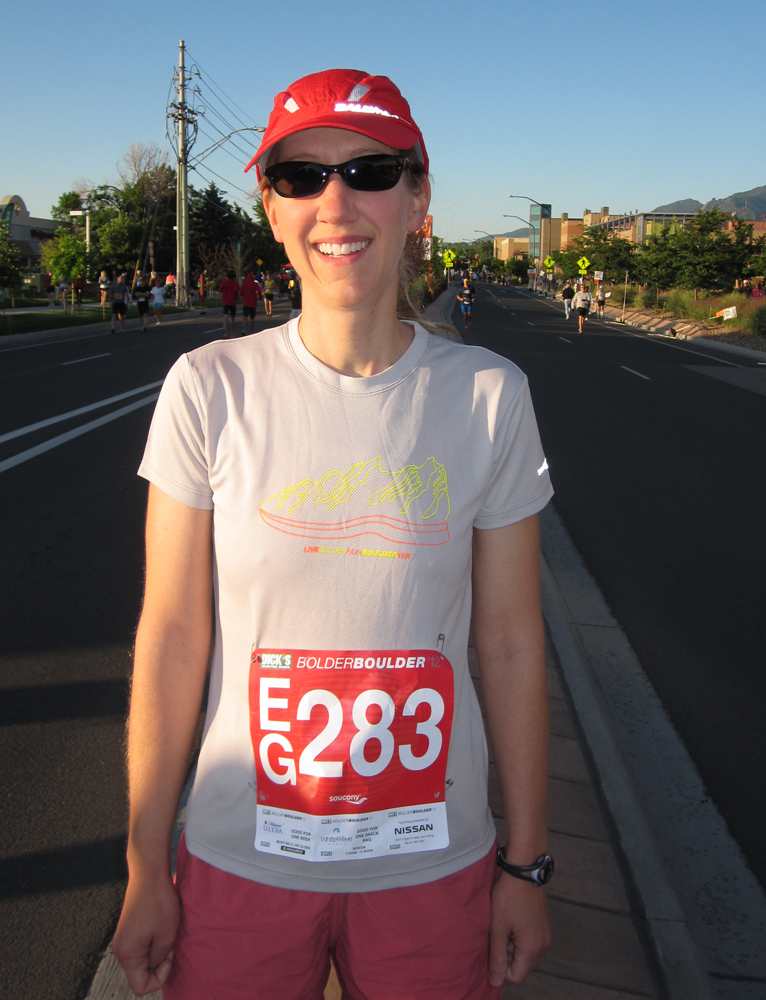
Disappointment is one of the emotions I have the hardest time dealing with. As I was standing at the start line of the Bolder Boulder 10K on Monday waiting for the gun to go off, I wasn’t sure how to prepare my mind for the letdown I was sure to have at the finish line. I knew before I even began to put one foot in front of the next that I had no chance of matching or beating my results from the last time I did this race in 2009. I hadn’t run for at least a month and had just found out from my physical therapist a few days before that I had some major pelvis misalignment issues that were likely causing some of my pain and injury. Though he didn’t say I shouldn’t do the race, he did say I should take it easy and stop to do some exercises and stretches along the route. I had no idea what a taking it easy pace would even be. Did that mean I should jog? Walk? I had never done a race where I wasn’t running as fast as I possibly could.

Making my way to the Bolder Boulder starting area at 6:30 a.m.

I was still pondering these questions when the shot fired. I took off at a pace between a jog and a run, but still the questions lingered. What time would I be satisfied with? An hour? Two? Though I don’t have a competitive streak when comparing my performance with others, I am fiercely competitive with myself. Ever since recovering from ostomy surgery, I had wanted to prove that I could do as well in this race as I had before getting so sick.  I knew that was impossible with my current painful hip, but there had to be some sort of goal, right?

As I ran down the street and watched the people in my wave pass me one by one, I realized that this race wasn’t going to be about reaching any pace goals. It was about simply being there. After all, just weeks ago Doug had picked up my race package for me. At the time, I couldn’t even make myself open it. I didn’t want to see the running bib that I was sure I wouldn’t be wearing due to what was thought to be a stress fracture in my pelvis. Yet luck had veered my way.  The x-ray had been a misread and I had been given the go-ahead to run while undergoing further tests for other pain causes. Here I was immersed in the event that I had wanted to do so much, and all I could focus on were things I had no control over. I couldn’t make my injury go away, and I couldn’t magically make up for a month of lost training time. I could, however, adjust my outlook.  As I ran under the banner marking mile two, I flicked an attitude switch in my head from the side that read  I am so bummed that I am not going to get the time I hoped for to the one that said I am so amazed to be running through the streets of Boulder surrounded by beautiful views, music on the street corners and onlookers handing out treats to the runners like bacon, cotton candy, and marshmallows.

I much preferred the second attitude and decided to keep the switch there for the remainder of the race. (I did, however, avoid catching any marshmallows. I had already had my fill of those the day before after consuming six of them to slow output before my appliance change.) At every mile marker, I stopped to do the exercises the physical therapist had recommended I do during the race. I knew that these stops were sabotaging my time, but I no longer cared. When my hips started to hurt slightly at mile four, I slowed down the pace. I had no worries. No expectations. In the past, I would never have veered off course to become a target for child with a Super Soaker. Never before had I taken advantage of the offers for high fives from sideline spectators. I don’t remember looking at the stunning vistas of the Flatiron rock formations along the race route in previous race years. At the slower pace, I took all this in.

Every other time I ran the Bolder Boulder, I finished in just under an hour. This time, when I looked at my watch at 59 minutes, I still had a little over a half mile to go. Just for old times’ sake and knowing that I was close to the end of the race, I picked up the pace and ran as fast as I could for that last half mile. I felt strong and vibrant as I entered the stadium and sprinted the final half lap to the finish line. Other than amidst the marshmallow-catching antics earlier in the route, this was the first time I thought of my ostomy during the entire race. I thought of  all the things I had gone through since last entering that stadium in 2009, and how lucky I was to be back to health and running there again.

As I crossed the finish line, the letdown and disappointment that I was sure would greet me there had been replaced by delight. And when I finally looked down at my watch to see my time, 1:06:33, I was even more blown away. That was only about eight minutes longer than my 2009 time. This was certainly enough to please my self-competitive side — well, for the most part. In the stands after the race, there was a moment when I lamented to Doug that had I not been injured, I would have really nailed it. He reminded me that I was injured and that I did nail it. Oops, that little attitude switch had gotten bumped into the wrong place again. I put it back to the “here and now” slot, slathered myself with some sunscreen and sat back to watch others racers jubilantly cross the finish line — including a banana, gorilla, coyote, bear ,and unicorn. Hmm… maybe my goal for next year should be to run the Bolder Boulder in costume.

Resting in the stadium with Doug after the race.

Drawing my way out of the doldrums

My first mainly sedentary week has been hard mentally. I wish so much that I could go for a hike or run, but just walking around the grocery store makes my hip throb with pain, so that is not going to be a reality any time soon. I went swimming at the gym and did an upper-body weight workout. Both of those activities went okay, but it feels like all the amazing  progress I made working out with my personal trainer is going to slip away.

When sadness and anxiety start to take over and I can’t deal with the stress using exercise, I often turn to my nature journal to lift my spirits. Somewhere in those moments when I am looking closely at the pattern of veins in a leaf, and my pen is moving over paper recording what I see, my mind finds peace. Expect to see many drawings in the weeks ahead!


Turning 40

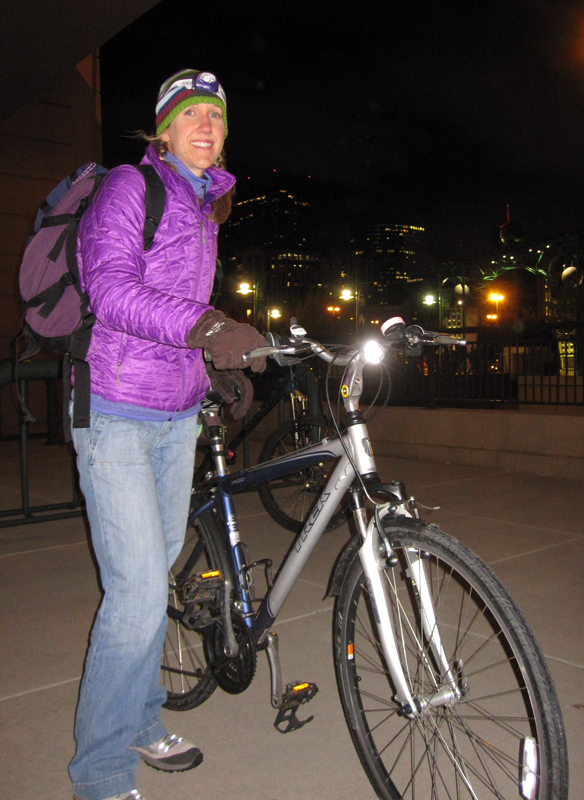
I couldn’t stop smiling as I sat in the stands at Coors Field. I was attending a Colorado Rockies game for my 40th birthday, and the evening had been amazing so far. Planning to ride our bikes to the stadium (to avoid traffic and the parking fee), Doug and I had parked our car about a mile away.  Just as we were about to unload our bikes from the roof rack, a massive storm blew in and we watched lighting streak across the Denver skyline as hail pummeled our car. Once the storm ended, we jumped on our bikes and cruised downtown, breathing in the wonderful spring smell of rain-soaked ground and blossoming trees.

We arrived at the stadium an hour early, so we stopped to enjoy drinks at the Irish pub next door. I was halfway done with my Strongbow Cider when the waitress surprised me with a free birthday shot. I have no idea what was in the fruity purple concoction, but she assured me it didn’t have gluten in it, so down the hatch it went. This was a little more than I would normally drink on a mostly empty stomach with my ostomy, but hey, it was my birthday. Time to throw caution to the wind. My stomach wasn’t empty for long. As soon as we walked over to the stadium, I indulged in one of my favorite treats. I hardly ever eat hamburgers due to having celiac disease (and the fact that they are not that healthy), but Coors Field has a special gluten-free concession stand. Soon I was in my seat, huge burger in hand and eagerly anticipating the game.

Nature even provided some pre-game entertainment for my birthday. Perched on the balcony railing above me, a male house finch was singing his heart out. Over and over he belted out his melodious tune, and I kept thinking that there had to be a female baseball-fan-of-a-finch listening somewhere in the stands. I hope he finds her. There are certainly many great places to tuck a nest in the stadium and then the pair can watch every home game as they raise the next generation of Rockies-loving finches.

If this amazing start to my birthday evening wasn’t great enough, things got even better. The Rockies were clobbering the opposing team in one of the best games I had the pleasure of watching. In between watching unbelievable plays, my mind cycled through memories of being at the stadium so many times before.

It was on a previous visit to Coors Field that my final UC flare first made itself known. I am sure many IBDers know the feeling of thinking they have finally found the magic bullet of probiotics, diet and medication to keep their illness in control, only to have their body fail them yet again. It was during a night similar to this one that I was having fun watching the Rockies when one such disappointing moment came. I got up to use the restroom during the 7th inning stretch and noticed a tiny speck of blood from my intestines on the toilet paper. My heart sank. I left the bathroom and tried to focus on the rest of the game, but all I could think about was the fact that my four-month remission was over and my UC was back. At the time, I had no idea that those initial specks of blood would turn into the massive flare that would cost me my colon. When I look back at my photos from that evening, I see a woman who is blissfully unaware of the major life change that is about to happen. If you would have told me that night that I would have an ostomy a few months later, I would have said you were out of your mind.

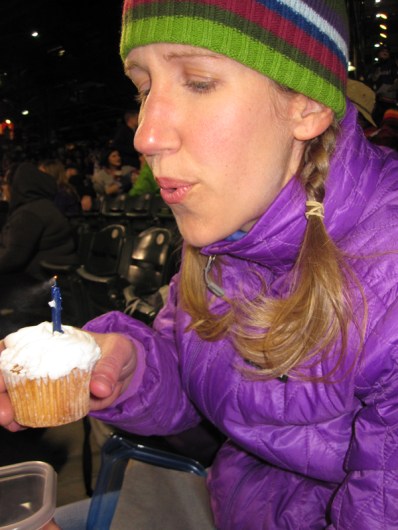
Sitting in the stadium on my 40th birthday, I realized that I still had no idea what was around the corner. But if there is one thing I have learned in my 39th year, it is that this uncertainty is okay. Tomorrow would be on its way soon enough, but right now I was enjoying watching the players slide into bases and hearing Doug yell GO TODD at the top of his lungs every time Todd Helton was up to bat. Right now I was having fun singing Take Me out to the Ball Game and seeing the people around me laughing and goofing around with their friends and family. Right now I was smiling as I blew out the candle in my birthday cupcake and made my wish for the year. Right now I was happy that my ostomy had allowed me all these moments.

For me, turning 40 wasn’t something to be sad about. It wasn’t about all the things that I hadn’t done or about goals not yet achieved. Turning 40 was about celebrating all the things I had done. It was about lightning and skyscrapers, house finches on balconies, bike rides through puddles, baseball players getting out of pickles and every other great memory I have from that day and all of those before.

Let the races begin!

Last Sunday I went with Doug and his dad to run the Journey Quest 5k in Fort Collins, a fundraiser for the Shared Journeys Brain Injury Foundation (SJBIF). The organization provides programs that help people with acquired brain injuries regain independent, satisfying and productive lives. This was my first 5k race since my ostomy surgery 16 months ago. The overall time I achieved in this run would determine my wave for the 10k Bolder Boulder, which I plan to run on Memorial Day.

Getting ready for the run.

I started running again last summer, but have mainly been working on endurance by going on longer runs. Since I have not been focusing on speed, I wasn’t sure what to expect my finishing time to be for this race. I have never been a very fast runner. My speed has been in the nine-minute mile range in just about every 5k or 10k I have done. Therefore, when I set my goal for this run, I simply hoped to at least match my time from the last 5K I did prior to surgery, which I completed in 29:43.

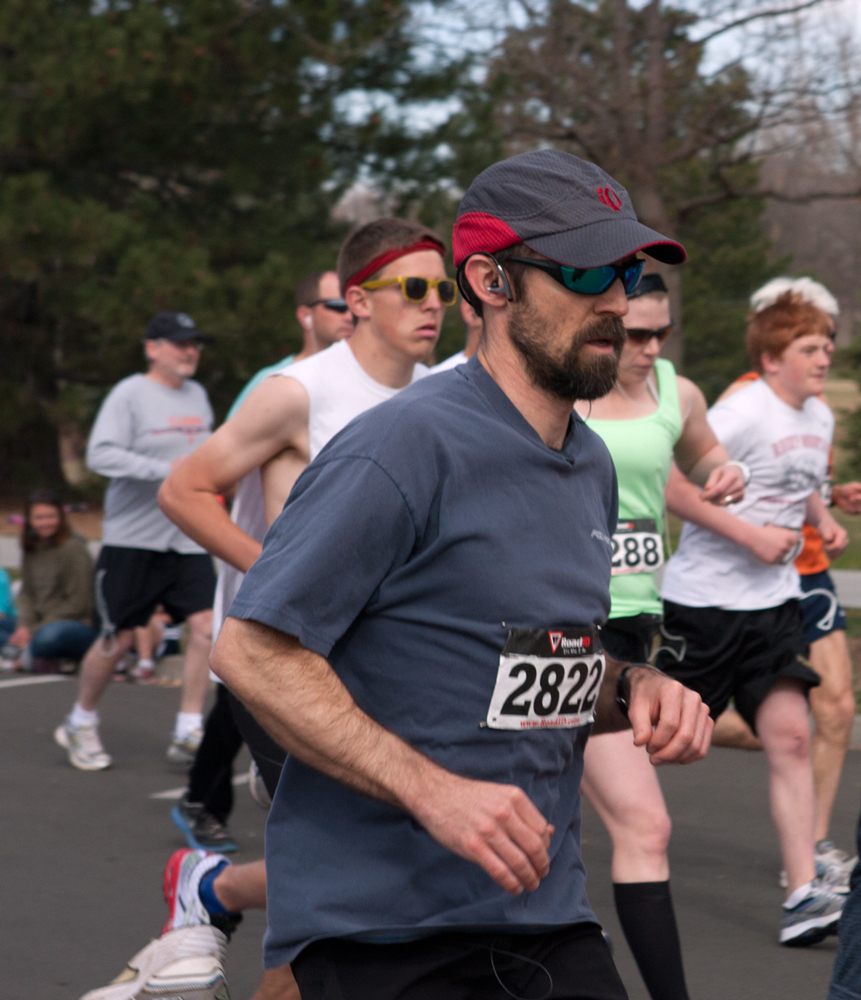
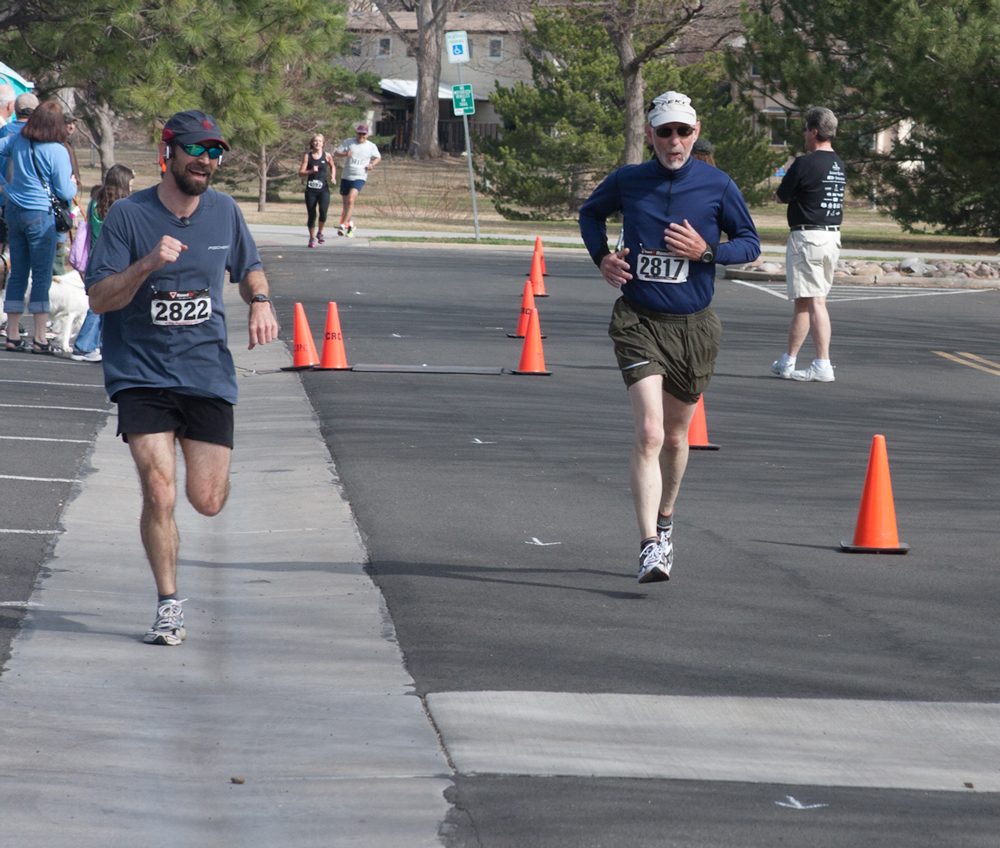
I felt fairly strong and crossed the one-mile mark in nine minutes and then the two-mile mark at 18 minutes. Despite the decent start, I really struggled in the final mile. There were a few times I had to tell myself that I needed to ease up because my lungs and heart felt like they could barely keep up with what I was trying to make my legs do– I simply could not breathe. I relaxed the pace a bit, crossed the finish line and realized that I actually shaved a handful of seconds off my last 5k with a time of 29:19. I was happy with the result, but could not believe how hard the race felt. I have never been so utterly exhausted during or after a 5k. Doug and his dad met me at the finish line after running great races too (Doug came in second in his age group, 40 to 49), and I couldn’t even talk from lack of breath. Doug’s mom caught us each on camera as we ran the race.

Doug heads out from the starting line.
Doug cheers on his dad as he prepares to cross the finish line.
I am exhausted but still smiling as I finish the race.

This race made me realize that if I want to get faster times, I must change my training strategy. I really like going out for long, slow runs, especially on the trails, but I need to mix things up and start including some speedier runs in the mix if I am going to match my pre-surgery time for the Bolder Boulder 10k. I have always finished that race in just under an hour, but based on how I felt on this run, that would be impossible right now. Time to put some more miles on the running shoes.

I am also glad to report that my ostomy caused no issues during the race. The event started at 10 a.m., so I ate my normal breakfast of a protein shake, a banana and a bowl of oatmeal at 6 a.m. I emptied my pouch before heading to the start line and was good to go for the entire time. There was a party following the race and I refueled on some chili and a few cups of popcorn. Yes, I said popcorn! I find I have no issues with this favorite treat of mine if I chew it well and drink plenty of water (24 ounces in this case.)

Speaking of water, I have never been a fan of the hydration stations at races where one stops to slam a small cup of water. Even before surgery, I always got a gassy bellyache from gulping the water down… that is if I didn’t choke on it first because I was breathing so hard. Most of the time I would just drink a little and toss the half-full cup onto the ground or skip some of the water stations altogether. With my ostomy, I am even more conscious of avoiding things that cause me gas pains. Not to mention that I need to drink a lot more water during activity to prevent dehydration. I usually carry a CamelBak hydration backpack on my runs, and decided this would be a good strategy for the race as well. I filled it with just the amount of water that I would need for the race so that the pack was light. This worked well because I could sip small amounts of water through the hose as I ran to stay well hydrated and didn’t get a bunch of air in my stomach.

One less-than-ideal thing I had to deal with during the race was trying a different wafer than my favorite one. Typically, I reserve sampling new supplies for times when I know I don’t have something big going on in my schedule. However, I have recently had some skin issues under the tape of my wafer: little red bumps that are insanely itchy. My stoma nurse is working with me to try to troubleshoot the cause, but in the meantime, I decided to try a sample of a tape-less wafer to give my skin a break. The 5k was on day four of wearing this new wafer. I was worried the sweat might make it fall off during the race, yet I didn’t want to risk irritating my skin by removing it early. By the morning of the race, my wafer was already starting to peel up on the edges. However, with a few little pieces of 3M Medipore tape in strategic places, the wafer held on just fine. Whew!

All in all, the race went well, and I am excited to push my running to the next level. I look forward to adding a few more races to my schedule in the coming months. And I still have my sights on the CCFA Team Challenge Half Marathon in December. I am hoping the shorter races will help prepare me for that big distance. Most of all, it feels great to discover another favorite activity that is once again possible thanks to my ostomy surgery.

Opening up about my ostomy

Last weekend I took a course to recertify my Wilderness First Responder credential with the Wilderness Medicine Institute. The first order of business in the course was to do short introductions with the other class participants. My heart pounded as my turn to introduce myself to 25 absolute strangers fast approached. I had planned to say something about my ostomy to the group, but I was having second thoughts. Maybe I should just stick to a standard intro and move on to the next person? After all, we only had to say four basic things: our name, where we were from, what we would be doing outside at that moment had we not been in class, and what our previous pertinent medical experience was. None of these things really had to do with my ostomy, right? Why did I feel this huge need to let everyone know?

It would not be my standard practice to announce my ostomy if I was taking a class on computer programs or art techniques. However, wilderness medicine courses involve a lot of mock wilderness medicine scenarios where we role-play rescuer and patient. As course participants practice patient assessments on each other, abdomens are palpated and shirts get peeked under to see if there are any clues to injuries. It is not unusual to have fake bruises or wounds put on our bellies and other body parts with stage make-up to make things more realistic. I knew it would be impossible to hide my ostomy. I wanted to have everyone know about it right away so there were no awkward surprises. And I didn’t want to explain it individually to each team I worked with — I only wanted to have to mention it once.

Recovering from a fake head injury after a wilderness medicine scenario.

As my turn to introduce myself crept closer and closer, and my palms became sweatier and sweatier, I had a decision to make. It would have been so easy to give into my fears and not say a thing about my ostomy — but that is not what I did. Instead, I took a deep breath and spoke:

Hi, I am Heidi. I am from Golden, Colorado. If I wasn’t in class today, I would choose to be rock climbing with Doug, who is my husband. (I motioned toward Doug who was sitting beside me as a classmate.) I have been a Wilderness First Responder since 1998. I have also had a lot of medical experience in dealing with one of my own health issues. Eighteen months ago I became severely ill with a disease called ulcerative colitis and had my entire colon removed. I now have an ostomy where my small intestine sticks out of my belly and I wear a pouch over it. If you see this over the next couple of days, it is not part of a scenario (I smiled and chuckled).

I looked around the room to see if anyone was looking at me in a strange way, but they weren’t. The instructor nodded and smiled at me like he did with each person, and the introductions continued without the loud sound of a record-scratch. As the heat in my flushed face dissipated, a huge sense of relief washed over me. Now I could relax and enjoy the course, knowing that everyone would know what the pouch on my belly was for, should they see it.

Sure, I probably could have worn a wrap. But it is likely that people would have been just as curious about that. Anyway, as much as I like ostomy undergarments, nothing is quite as comfy for me as my regular low-rise undies with my pouch flopped over the top. I knew I was going to be sitting in class for two days and wanted to be comfortable.

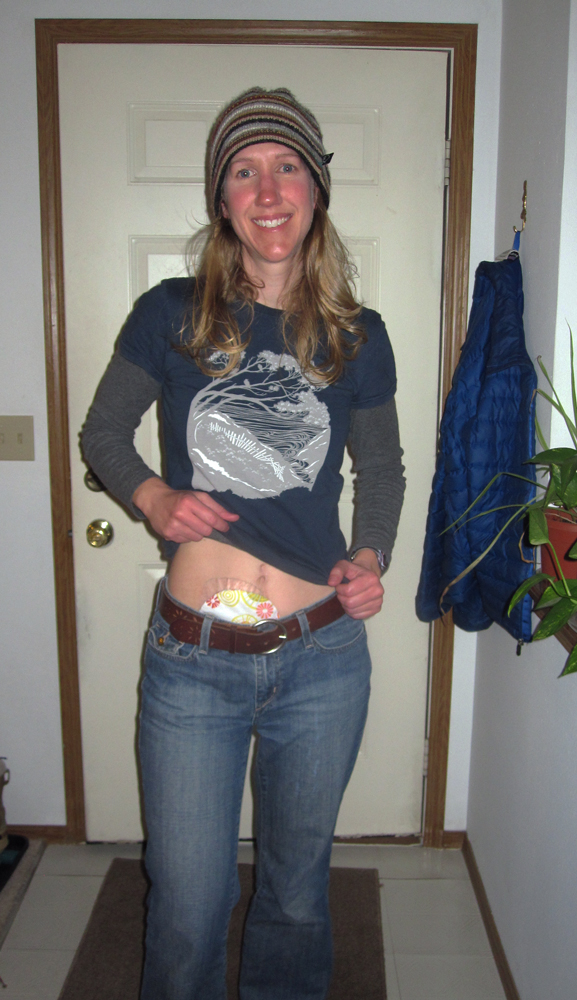
My pouch is easily visible when my shirt is lifted, but it ended up being no big deal during the course.

As the class unfolded over the next two days, I was happy to discover that people didn’t treat me any differently because of my ostomy. When we ran through head-to-toe exams and practiced “log rolling” to check each other’s spines in the wilderness medicine scenarios, there were times that my shirt rode up and everyone could see my pouch. Yet not one person acted awkwardly towards me and no one tip-toed around me when it came time to touch my belly or move me around. I had a great class, refreshed all my skills, passed my exams, and was successfully recertified.

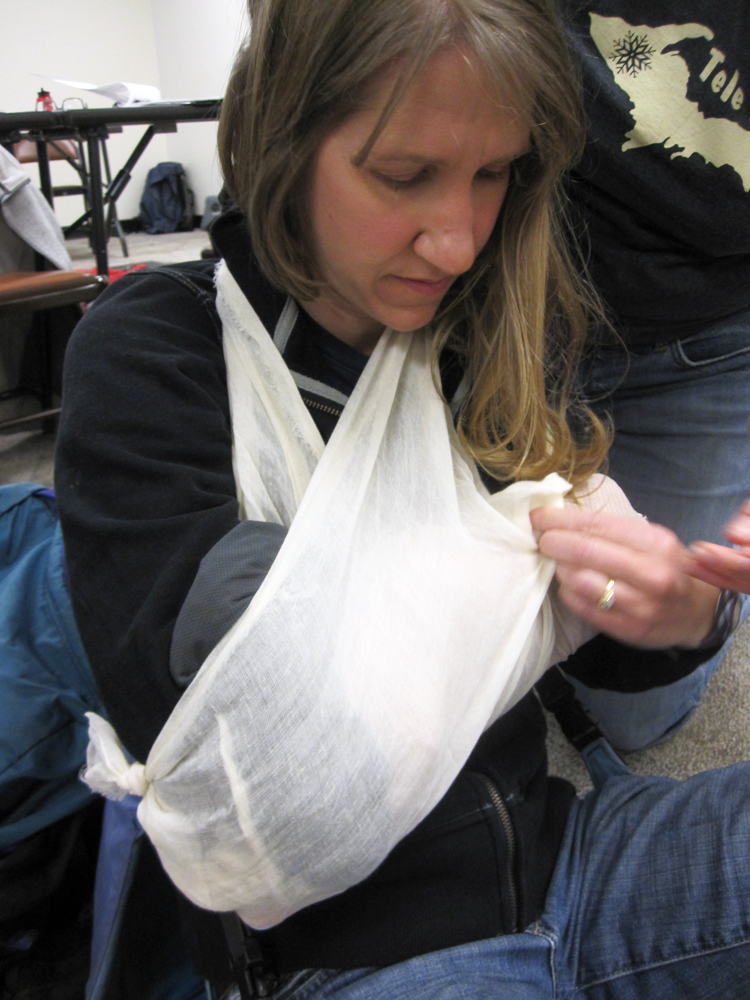
My mock broken radius is all splinted up.

Looking back, I am so glad I decided to share the information about my ostomy with the group in those initial moments of class. Being open about it not only helped me feel more relaxed about people seeing my pouch, but it allowed the other course participants to be more comfortable with it as well. More and more, I am discovering that this is true in so many aspects of my life with an ostomy.

Climbing progress

On Sunday I climbed a few feet above the fourth bolt on the wall at the rock climbing gym, held my breath, and jumped off. I felt a few butterflies in my stomach as I free-fell 10 feet before my rope and harness caught me and brought me to a stop. Doug lowered me to the ground where a staff member gave me a smile and a casual “nice job” nod. I had just passed the test to be able to lead climb at our local rock gym. This was my second such test. I had also taken one in Fort Collins last month at the gym we sometimes climb at with Doug’s father.

In lead climbing, a climber clips their rope into protection placed in the rock (or on the artificial gym-wall) as they go. This “pro” is either: 1) temporary equipment that a climber places in cracks outdoors, or 2) permanent, preexisting bolts drilled into the rock or artificial wall. If a climber falls above the last piece they clipped, they will travel some distance before the rope catches. For instance, if a person falls three feet above their pro, they will fall that distance plus three more feet until the rope catches. Factor in a bit of rope stretch and the total distance could be 10 feet. The climbing gym wants to make sure climbers know how to safely clip their rope into the bolts on the wall and fall properly before they will allow you to lead climb.

Top roping is a different style of protecting the climber in which the person will only fall a short distance because the rope is already anchored at the top of the cliff or wall. When I began climbing again a year after ostomy surgery, I started with top rope climbing. Though I am now leading in the gym, it will be a while before I feel confident to lead routes outdoors again where there are more hazards.

Nothing has been a bigger symbol of my climbing progress as being able to get back on the “sharp end” of the rope. I was fearful of what a big fall might feel like after surgery. Would falling several feet in my harness hurt my stoma? Would the resulting tug make my pouch pop off? As has often been the case when returning to my active pursuits, none of my fears came true, and my stoma and pouching system held up just fine through the tests at the gym.

Lead climbing has not been my only measure of progress lately. While climbing weekly, I am quickly moving up the grades and getting on some overhanging routes (steeper than 90 degrees). When I returned to the rock gym five months ago, I didn’t even try to do any marked climbs — I just grabbed any hold on the wall. Soon after, I was only using the “on route” holds, but sticking to routes in the 5.7 range. Last month I ventured into the 5.8 and 5.9 territory, and last weekend I did my first 5.10-. I am feeling powerful and strong with not the slightest pain in my core.

When I got back into climbing, I told myself that I would be happy doing 5.7 routes for the rest of my life if that was all my body could handle. All that mattered was that I could climb again. However, I now see that these restrictions won’t be necessary. By conditioning my body, progressing slowly to build the required strength, and always wearing my six-inch-wide hernia belt, I am quickly returning to my pre-surgery climbing abilities. I look forward to warmer days when I can start climbing outdoors on a regular basis and head out on some much longer routes. And, of course, I’ll share some of those through videos!

Cartwheeling, tumbling and cratering myself to confidence

Yesterday I cartwheeled, tumbled, and cratered countless times on the slopes while snowboarding. Normally, one might not be pleased with such a performance, but these mishaps were a major milestone for me. Up to this point after surgery, I have been very tentative while snowboarding. To fall so many times meant one thing: I was pushing it on the slopes and feeling absolutely wonderful.

Last year during my initial two times out boarding post-surgery, I fell a lot too. However, that was a different situation because those falls were caused by my muscles being weak. Yesterday, the tumbles happened because I was going faster, turning more aggressively, venturing onto some black diamond runs and even doing some tiny jumps (okay… I only caught a foot of air, but it was something). And most importantly, I had finally let go of some fears that had been holding me back.

During my earlier snowboarding trips this season, I was always afraid of falling. What if I twisted a weird way? Would my body be able to handle it? Though the fears were likely justified in the beginning, I was having growing suspicions that I was babying my body too much while snowboarding the last few times. So, this time I put the trepidations aside and went for it.

As I zipped down the slopes, I not only had some little tumbles, I also managed to squeeze in a few of my most dreaded fall types. One of these was an edge-catch going at a slow speed on a catwalk. My healed butt incision survived the resulting sling-shot slam on to my bum and back just fine. I also did a great snowboard nosedive into fresh powder. My body twisted as it came to a sudden stop, but weathered this graceful move as well as it did during the countless times before surgery. In the late afternoon, the sky clouded up and the light became flat, and I couldn’t see the ungroomed terrain beneath my feet well enough to gauge my speed. I soon found myself in a vertigo-induced cartwheeling fall. Yep, I came away from that one unscathed too.

Getting up from one of my many falls.

By the end of the day, my legs were so fatigued that I could barely link my turns. Doug and I had caught the first (well, about the 20th chair–we were in line) and last chairlifts, and except for a short lunch break, had snowboarded at a hard pace all day long. The conditions were phenomenal and it was just like the old days when we would do countless laps up and down the mountain, not wanting to waste a minute of time on the snow.

I sometimes think back to the time when I was sick with Ulcerative Colitis, and how it felt like my body had betrayed me by attacking itself and causing me to become ill enough to lose my colon. It has been extremely difficult to build up trust in my body after that. Even though I have recovered and regained my health, I still find myself with the unsettling feeling that something else could go wrong. Without trust in my body, it is very difficult to overcome fears that could prevent me from reaching my goals, not only in sports, but in life as a whole. I desperately need to believe in it again! As I put myself through the wringer on the slopes yesterday, I finally felt strong signs that my post-surgery body is working hard to regain my confidence.

A shining highlight in the midst of the flu

My abdominal muscles are the sorest they have been since surgery. No, it isn’t because I started doing crunches, ascended the overhanging roof at the climbing gym or tried some difficult new yoga pose. It is due to having one of the most horrendous respiratory viruses I have had in years. I was hoping my flu shot would have prevented this, but alas, I caught something anyway. Each night for almost a week, I have been up all night coughing violently, and it has made my core very sore– especially around my stoma. Ever paranoid about getting a parastomal hernia, I cringe every time I feel that tickle in my throat. There seems to be no way to stop the cough though, and I know this just has to run its course. In the meantime I have been taking loads of vitamin C, doing sinus rinses, drinking various teas to ease my throat, taking cough medicine and cough drops and trying to get a good night’s sleep which has been almost impossible. Mother nature did provide some relief today in the form of a huge snowstorm. A snow day was called at my work, so I was able to have some extra time to rest at home.

Due to the worries of coughing pressure and my stoma, I have even been wearing my hernia prevention belt 24/7 for the past week. That, along with bracing my stoma area with my hand when I cough, gives my abs a bit of support while I cough. I eagerly removed my appliance on my change day this morning so I could check to see if I had done any damage with all the hacking. I was relieved to find that everything looked fine around my stoma, though the area around it is still sore to the touch. I am hoping it is just strained muscles and will clear up once I get better. It would be unfortunate to be so careful climbing and backpacking, only to get a hernia from something as simple as coughing.

Though it hasn’t been the best week due to illness, there was one absolutely amazing highlight. On Tuesday afternoon, I left work early because I felt so awful. I was about ready to plop down in my bed when I decided to check my Facebook. There I saw a message from my friend congratulating me on winning the WEGO Health Health Activist Best Kept Secret Award for Ostomy Outdoors. I had been feeling so crummy I had forgotten that it was the day to announce the award recipients. I was absolutely shocked to find out I was selected, and the excitement is still sinking in a few days later! Thank you to my husband, Doug, for posting the update when I was feeling a bit too sick and exhausted to write on my blog.


Thank you to everyone at WEGO Health and those who were involved in the nomination and judging process. I am so grateful and humbled to have been selected for the award among so many other dedicated and deserving health activists. Thanks also to everyone who reads and contributes to Ostomy Outdoors. Your thoughts, comments and stories not only help keep me motivated, but provide inspiration and encouragement to others who follow the blog.  Together we can all make a difference and help spread awareness for ostomies.

Watching my award video while resting up.


Craving normalcy (feat. new video)

In the initial months after ileostomy surgery, all I craved was normalcy. Life as I knew it had completely disappeared. Gone were the days of getting up and going to the office to work on a variety of enjoyable challenges like writing nature-education curriculum and leading hikes. In my free time, there were no more hiking, snowboarding or running adventures anywhere on the horizon. Instead, life revolved around the wiggly red stoma on my belly. My days played out around endless worries and looked something like this:

7 a.m.  How am I going to get my appliance on while my stoma is spewing liquid output everywhere?

9:30 a.m. Okay… got the appliance on. Wait, is that skin showing between my barrier ring and stoma? Geez, maybe I should do it over. My output will certainly eat away my skin if it touches that exposed 1/8 inch. But will it destroy my skin more if I pull the wafer off so soon? I better just do it to be on the safe side.

10:30 a.m. I can’t believe it took me over two hours to get an appliance on and this second one still doesn’t look that great. I need to call Doug and vent about it or I will cry for hours.

10:45 a.m. I need to drink some water. I am already way behind on my liquids today and I haven’t eaten breakfast yet either.  I am really not hungry, but Dr. Brown said I need more protein. Is a protein shake and eggs enough?

11:30 a.m. I have only been up for a few hours and I am already tired. Better go take a nap. Am I always going to have to sleep this much?

1:30 p.m. Is that just a regular itch or is it from output touching my skin? Man, this incision hurts. I am not hungry, but I need to eat with my pain pills. I better have some lunch. When are these pain pills going to kick in? Drat, maybe I should have just sucked it up and not taken the pills. What if I become addicted to them?

2 p.m. Why am I watching this stupid TV show? Shouldn’t I be doing something productive? I am just too tired. Dang, I forgot to order those Hollister samples again. I am too tired to do that too. I can’t believe I am about to take another nap. I am supposed to be going for a walk right now, not sleeping.

3:30 p.m. The neighbors must be wondering what happened to me. I am walking so slow and hunched over, but it hurts too much to stand up straight. Is this two-block walk through the park really all I can muster? I can’t believe how much this hurts. This used to be my warm-up walk before I ran five miles, and now I can’t even cover this short distance. And I’m walking as slowly as a turtle.

4 p.m. I miss Doug. I am so lonely stuck here by myself. When is he coming home from work?

5 p.m. Doug is home! Doug is home! Doug is home!

6 p.m. Is this too late to be eating dinner? I am supposed to eat before now, but that isn’t very handy. Is four weeks post-op too soon to eat steamed broccoli if I chew it really, really well? I am so hungry for veggies. What if I get a blockage? Or horrible gas?

7 p.m. Wasn’t that just the 12th time I emptied my pouch for the day? When is this output going to slow down! It is like water. Have I had enough liquids to drink to offset that?

9 p.m. Okay, time to take a shower. Can I get this appliance wet? I better tape plastic wrap all over my belly just to make sure it stays dry and doesn’t peel off.

10 p.m. Time for bed. I should lie on my right side all night just in case I leak. Don’t want to get stool into my open wound.

11 p.m. My back hurts. I sure wish I could lie on my left side but I am too afraid.

12 a.m. Better get up to empty my appliance just in case.

2 a.m. Better get up to empty my appliance just in case.

4 a.m. Better get up to empty my appliance just in case.

7 a.m Thank goodness it is morning but I don’t want to get up. I am going to lie here and cry for a while. Will my life ever be normal again?

And so it went for the initial couple months after surgery. I was overwhelmed and depressed that my entire life now seemed to revolve around my stoma. I tried and tried to picture what things would be like when everything settled down, and I actually learned how to manage my ostomy, but it seemed impossible. I couldn’t see beyond the hard times I was facing in those moments. It was particularly difficult to imagine how I could possibly ever do outdoor sports like snowboarding again.

I wish I would have had a crystal ball back then. Had I, I would have seen that I shouldn’t have worried so much. My ostomy output would settle down as my body adapted. I would figure out my systems and become more efficient with them. My incision would heal. Someday in the not so distant future, my ostomy would feel like a regular part of my life as I returned to work and went on outdoor adventures again. In the crystal ball, I would have seen the point I am at now when everything is so much easier. The normalcy I craved after surgery has been restored to my life.

Last Sunday was a beautiful powder day in the mountains, and Doug and I headed up to go snowboarding. I decided to film the day’s events and create a video showing a typical day on the slopes with my ostomy. I realize everyone’s experiences are going to be a little different regarding their emptying schedule, when they eat, etc. What I hope to show is that once a person adapts to life with an ostomy and gets their own particular systems down, life can feel wonderfully natural again.